


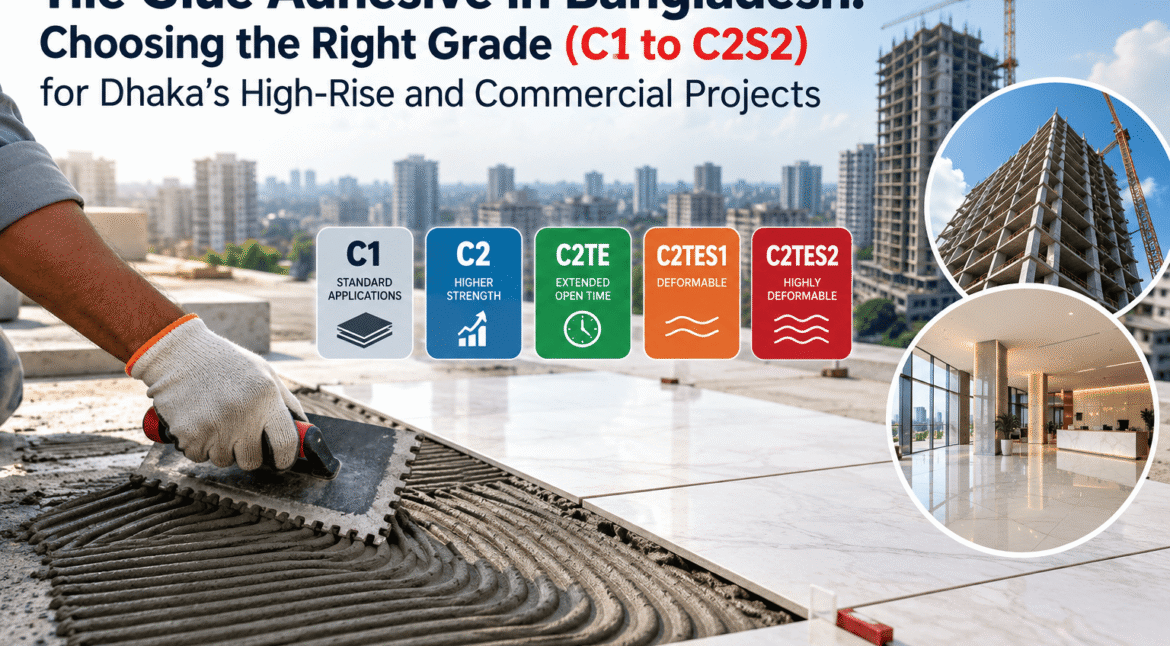
Tile Glue Adhesive in Bangladesh: Choosing the Right Grade (C1 to C2S2) for Dhaka’s High-Rise and Commercial Projects
Ask five tile fixers in Dhaka what they mean by “tile glue” and you may hear five answers: a bag of grey powder, a white paste, an epoxy kit, or plain cement with a splash of chemical. On a high-rise, that confusion shows up later as hollow floor tiles, cracked slabs and bathroom walls that shed tiles after a monsoon or two.
The fix is to buy tile glue adhesive by its grade, not its name. This guide explains the grades from C1 to C2 S2, which one each part of a Dhaka project needs, and which Redwop Teratile product matches it.
What Tile Glue Adhesive Means in Bangladesh
In Bangladesh’s market, tile glue usually means a factory-made, cement-based tile adhesive mixed with water. Polymer-modified powders, ready-mix pastes, epoxy kits, and PU adhesives are all sold under the same name, which is why the grade on the bag matters (tile adhesive vs tile glue).
Compared with a thick sand-cement bed, a thin-bed adhesive adds far less weight to the slab and leaves fewer voids under the tile. Redwop’s application guide uses a 3–6 mm notched trowel for standard tiles.
Why the Right Grade Matters in Dhaka
- Heat and humidity shorten working time. Redwop gives an open time of 10–15 minutes, depending on site conditions.
- Monsoon wet–dry cycles in bathrooms, balconies, and external walls test how well an adhesive keeps its strength after soaking.
- Dense tiles such as vitrified and porcelain absorb 0.5% water or less (ISO 13006 group BIa), so plain cement struggles to grip them.
- High-rise movement from wind, heat, and shrinkage cracks rigid beds (tile adhesive for high-rise buildings).
- Large formats such as 600 × 1200 mm magnify every void and every millimetre of lippage.
Using the wrong grade usually ends in:
- Hollow-sounding floor tiles that crack under trolleys and furniture
- Wall tiles that slide during fixing or drop later
- Debonding in bathrooms and on balconies after the monsoon
- Costly re-tiling in occupied apartments, offices and malls
Understanding the Grades: C1 to C2 S2
Most tile adhesives sold internationally are graded under EN 12004 or its ISO equivalent, ISO 13007-1. Redwop states that its adhesives meet EN 12004 and ISO standards, and that Teratile Prolix complies with India’s IS 15477 (source).
Code | Meaning | What the test requires |
C | Cementitious | Powder mixed with water |
D | Dispersion | Ready-mixed paste |
R | Reaction resin | Two-part epoxy or similar |
1 | Normal | Tensile adhesion of at least 0.5 N/mm² after dry, wet, heat and freeze–thaw conditioning |
2 | Improved | At least 1.0 N/mm² after the same four conditionings |
T | Reduced slip | Slips no more than 0.5 mm on a wall |
E | Extended open time | Still at least 0.5 N/mm² when tiles are placed after 30 minutes |
F | Fast setting | Early strength within hours, with a shorter open time |
S1 | Deformable | Bends 2.5 mm to under 5 mm before breaking |
S2 | Highly deformable | Bends 5 mm or more |
So C2TE S1 means an improved cement-based adhesive with reduced slip, extended open time, and deformability.
Common Questions Asked:-
What is the strongest tile adhesive?
Among cement-based products, C2 is the stronger class, and an epoxy adhesive such as Redwop FLEXOPLUS goes further on strength and chemical resistance. But the strongest tile adhesive on paper still fails if the bed is hollow or the adhesive cannot flex with the building.
Redwop Teratile Grades for Every Part of a Dhaka Project
Redwop’s Teratile range covers every grade from Type I to Type IV (full list).
Teratile product | Grade | Best use |
Type I, C1TE | Ceramic floor and wall tiles in dry interiors | |
Type II, C2TE | Ceramic tiles and sandstone | |
Type II, C2TE | Ceramic, sandstone, limestone, granite and marble | |
Type III, C2TES1 | Vitrified tiles, glass mosaic and all stones; wet areas | |
Type IV, C2TES2 | Large formats, facades, elevations and sun-exposed terraces |
Beyond Teratile, Redwop also makes:
- Polymer Tile Adhesive: high polymer content for tiles up to 600 × 600 mm, wet areas and outdoor use, with anti-slip for walls
- Epoxy Tile Adhesive: two-component, 100% solids epoxy with high chemical and stain resistance, rated up to 120°C
- PU Based Tile Adhesive: single-component, moisture-curing polyurethane for non-porous substrates such as metal and wood
- Gel Adhesive: strong initial grab for large porcelain tiles (why gel adhesive)
- Normal Tile Adhesive: small ceramic tiles indoors, mixed with 4.5–5.5 litres of water per 20 kg bag
Choosing Tile Glue Adhesive by Tile Type
Ceramic Tile Adhesive
Standard ceramic wall and floor tiles in dry interiors can use a Type I grade such as Teratile Classic. Move up a grade for bathrooms, kitchens, balconies and anything larger than standard wall formats.
Polymer Modified Tile Adhesive for Vitrified and Porcelain Tiles
Dense vitrified and porcelain tiles need a polymer modified tile adhesive. Redwop places vitrified tiles in its Type III grades, Teratile Diamond and Teratile Platinum (C2TES1), which add deformability for movement and wet areas.
White Tile Adhesive for Marble and Glass Mosaic
Translucent glass mosaic and light marble show the colour of the bed through the tile. Use a white tile adhesive there to avoid grey shadows and staining (why it matters).
Granite, Marble and Natural Stone
Granite, marble, sandstone and limestone suit Type II grades such as Teratile MP, Gold and Sinex. For heavy stone on facades or large slabs, use Teratile Prolix (C2TES2) (heavy stone guide).
Large-Format Tiles and Slabs
Tiles of 600 × 1200 mm and above need a C2TES2 adhesive such as Teratile Prolix, or a gel adhesive with strong grab. Back-butter every tile so the bed is full.
Tile Glue Adhesive for Floors, Walls and Wet Areas
Glue Tiles for Floor Areas
To glue tiles for floor areas in malls, hospitals and offices, aim for a solid bed with no hollow spots. Lift a tile now and then to check: ANSI A108 sets 80% contact for dry interior floors and 95% for wet and exterior areas (heavy-load floors).
Wall Tiles and Facades
Wall tiles need a reduced-slip (T) adhesive so they stay put while the bed sets. On external walls and elevations, Redwop recommends Teratile Prolix (Type IV, C2TES2) for its flexibility and weather resistance. For heavy stone cladding at height, ask the facade engineer whether mechanical restraints are also needed.
Waterproof Tile Adhesive for Bathrooms and Kitchens
A waterproof tile adhesive resists water, but it does not make a bathroom watertight on its own. Lay a membrane such as Polycote 2K elastic waterproofing first, then tile with Teratile Diamond or Platinum (Bangladesh waterproofing guide).
Tile-on-Tile Renovation
Tiling over old tiles works when the existing tiles are sound. Redwop’s guidance is to clean and lightly roughen the old surface, use a bonding agent, then tile with a C2TES1 grade (why tile-on-tile fails).
Metal to Tile Adhesive and Wood Substrates
For steel staircases, metal panels or plywood, a metal to tile adhesive must cope with a non-porous, moving surface. Use Redwop’s PU Based Tile Adhesive or Epoxy Pro rather than a cement-based glue (metal staircases).
How to Apply Tile Glue Adhesive Correctly
- Make sure the surface is clean, sound, cured and flat. A thin-bed adhesive is not a levelling layer.
- Mix about 3–4 parts powder to 1 part clean water until lump-free, and use it within 60 minutes.
- Use the notch size on the TDS: 3–6 mm for standard tiles, larger plus back-buttering for big formats.
- In Dhaka’s heat, spread only what you can tile in a few minutes, and adjust tiles within 15 minutes.
- Leave movement joints at perimeters and changes of plane. TCNA EJ171 suggests field joints every 6–7.5 m indoors and every 2.5–3.6 m where tiles get sun or moisture.
- Allow light foot traffic and grouting after 24 hours; full bond develops over 48–72 hours (source).
Tile Glue Adhesive Price and Coverage in Bangladesh
Tile glue adhesive price depends on the grade, bag size, quantity, packaging, freight terms and the port or land route used. As a general guide:
- Type I adhesives cost the least and suit only basic interior ceramic work
- Type II and Type III grades cost more but prevent the most common failures with vitrified tiles and stone
- Type IV and epoxy adhesives cost the most and belong on facades, large slabs and chemical-exposed floors
Redwop’s average coverage is 4–6 kg/m², depending on tile size, surface and notch, so a 20 kg bag covers roughly 3.3–5 m². Use the coverage calculator for your layout, then ask for a landed-cost quote to Chattogram or your nearest land port.
Why Redwop Offers the Best Tile Glue Adhesive for Bangladesh
Redwop makes a complete ladder of tile adhesives from Type I to Type IV, plus epoxy, PU and gel systems, so every area of a project can be specified from one supplier. Its tile adhesives carry a BIS licence for IS 15477 (CM/L-7600053713), and the company holds GEV-EMICODE EC1 PLUS, ISO 9001, ISO 14001 and ISO 45001 certification, with an ISO/IEC 17025 laboratory.
For Bangladeshi developers and distributors, that means consistent batches, documentation for approvals, and technical guidance on choosing the grade for each area.
How to Choose: A Quick Reference
Application | Recommended Redwop adhesive |
Ceramic tiles in dry interiors | Teratile Classic (C1TE) |
Sandstone, limestone, granite and marble | Teratile MP, Gold or Sinex (C2TE) |
Vitrified tiles, glass mosaic, bathrooms and kitchens | Teratile Diamond or Platinum (C2TES1) |
Large formats, facades and sun-exposed terraces | Teratile Prolix or Prolix Extra (C2TES2) |
Large porcelain needing strong grab | Redwop Gel Adhesive |
Chemical-exposed floors and food plants | Redwop Epoxy Pro |
Metal, wood and other non-porous substrates | Redwop PU Based Tile Adhesive |
Final Thoughts
In a Dhaka high-rise, the cheapest bag of tile glue adhesive is rarely the cheapest job. Match the grade to the tile, the substrate and the exposure, fill the bed fully, and leave room for movement.
Redwop’s Teratile range gives you a grade for every area, from Classic for interior ceramics to Prolix for facades, with technical support to specify it right.
FAQS:-
-
1. Is tile glue the same as tile adhesive?
In Bangladesh, mostly yes: tile glue usually means a cement-based tile adhesive. Check the grade code on the bag, not the name.
-
2. Which tile glue adhesive should I use for vitrified tiles?
A C2TES1 grade. Redwop recommends Teratile Diamond or Teratile Platinum.
-
3. What is the strongest tile adhesive for heavy granite?
Type II grades suit most granite. For heavy cladding or large slabs use Teratile Prolix (C2TES2), and epoxy where chemicals are present.
-
4. What does a polymer modified tile adhesive do?
Polymers add flexibility, stronger bonding and better water resistance, which vitrified and larger tiles need.
-
5. Is there a waterproof tile adhesive for bathrooms?
Water-resistant C2TES1 grades work well in bathrooms, but always lay a waterproofing membrane under the tiles.
-
6. When do I need a white tile adhesive?
For glass mosaic, light marble and translucent stone, to avoid shadows and stains showing through.
-
7. How much tile glue adhesive do I need per square metre?
Redwop’s average is 4–6 kg/m², depending on tile size, surface and trowel notch.
-
8. How soon can I grout after tiling?
After 24 hours. Full bond strength develops over 48–72 hours.
-
9. Can I fix tiles on metal or wood?
Yes, with Redwop PU Based Tile Adhesive or Epoxy Pro, after preparing the surface.
-
10. Does Redwop supply tile adhesive to Bangladesh?
Redwop exports from India and can quote landed costs to Chattogram, with TDS and MSDS for project approvals.