


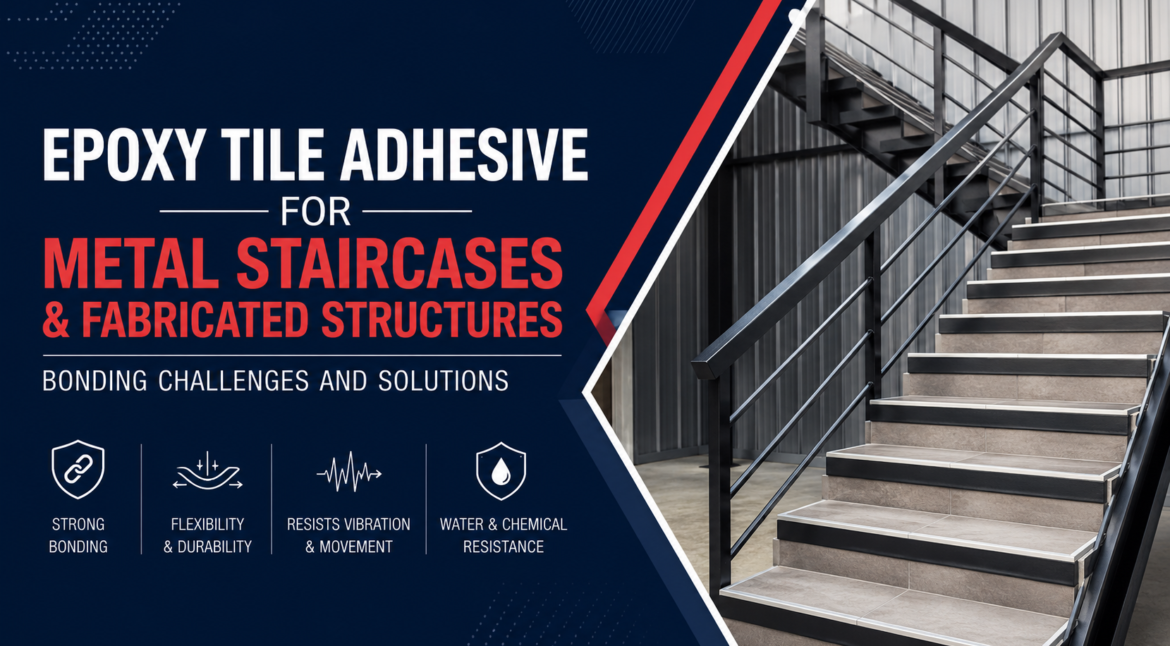
Epoxy Tile Adhesive for Metal Staircases and Fabricated Structures: Bonding Challenges and Solutions
Modern commercial and industrial projects increasingly use fabricated steel staircases because of their faster installation, lighter structural load, and architectural flexibility. However, tiling over metal surfaces is far more challenging than conventional RCC staircases.
Unlike concrete, metal surfaces continuously expand, contract, and vibrate under movement and temperature variation. These conditions place significant stress on the tile bonding layer. As a result, many staircase tiling failures begin with hollow sound, tile slippage, cracked edges, or complete tile detachment.
This is where selecting the correct Epoxy Tile Adhesive becomes essential for long-term durability and bonding reliability.
Common Question Asked:
Q.1 Why do tiles fail on metal staircases and fabricated structures?
Tiles fail mainly because metal surfaces are non-absorbent and prone to movement, vibration, and thermal expansion, which weakens conventional adhesive bonding over time.
Why Metal Staircases Create Bonding Challenges
Metal behaves differently from concrete substrates in several ways:
- higher thermal expansion
- continuous vibration during use
- smooth non-porous surface
- structural flexing under load
Traditional cement-based adhesives often cannot tolerate these conditions, leading to premature tile failure.
Common Tile Failures on Fabricated Staircases
Tile Edge Detachment
Stair nosing and tile corners receive repeated impact loads. Weak bonding at these locations causes gradual edge lifting and cracking.
Hollow Sound Beneath Tiles
Incomplete adhesive contact creates air voids beneath tiles, reducing load resistance and increasing breakage risk.
Tile Slippage on Vertical Risers
Riser tiles require a strong initial grab. Poor adhesive performance can cause tiles to shift during installation.
Adhesive Bond Failure
Movement and thermal stress weaken rigid adhesive systems, especially on untreated metal surfaces.
Why Epoxy Tile Adhesive Performs Better on Metal Structures
Metal substrates require adhesives with:
- high bond strength
- flexibility under movement
- strong adhesion on non-absorbent surfaces
- vibration resistance
This is where epoxy tile adhesive systems perform better than conventional adhesives.
For fabricated steel staircases exposed to movement and dynamic loading, FLEXOPLUS helps improve bonding performance on smooth metal substrates while reducing debonding risks caused by vibration and thermal movement.
Its stronger adhesion makes it suitable for:
- industrial staircases
- fabricated platforms
- commercial access stairs
- heavy-traffic structures
Importance of Surface Preparation Before Tile Installation
Even high-performance adhesive systems fail without proper substrate preparation.
Metal surfaces often contain:
- fabrication oil
- rust traces
- dust and contaminants
- smooth glossy finish
Before applying any tile fixing adhesive, the substrate should be:
- mechanically roughened
- cleaned thoroughly
- degreased properly
- made free from loose particles
Proper preparation significantly improves adhesive grip and bonding durability.
Role of Polymer Tile Adhesive in Staircase Applications
In fabricated staircase areas where flexibility and movement resistance are important, polymer tile adhesive systems improve bond retention under stress conditions.
For moderate traffic staircases and fabricated indoor structures, Teratile Prolix helps improve adhesion consistency while accommodating slight substrate movement.
In staircase zones exposed to heavier traffic and repeated loading, Teratile Gold provides stronger bonding performance and better resistance against stress concentration near tile edges.
Why Floor Tile Adhesive Performance Matters on Steps
Staircases function as concentrated load-bearing surfaces.
Unlike regular floors, step tiles experience:
- repetitive foot impact
- edge pressure
- movement vibration
- concentrated load transfer
Selecting a durable floor tile adhesive becomes critical to prevent edge cracking and tile loosening.
For high-load staircase applications where stronger bonding stability is needed, Teratile Diamond helps improve load-bearing performance and long-term adhesion durability.
Waterproof Tile Adhesive for External Staircases
Outdoor fabricated staircases remain exposed to:
- rainwater
- humidity
- temperature fluctuation
- moisture penetration
A suitable waterproof tile adhesive system helps reduce moisture-related debonding and bonding deterioration.
For external staircase installations exposed to weather and thermal movement, Teratile Platinum provides improved adhesion reliability under wet and fluctuating site conditions.
How Thermal Expansion Causes Tile Failure
Metal expands and contracts faster than ceramic or vitrified tiles.
When adhesive systems are too rigid:
- stress transfers directly to tiles
- cracks develop at corners
- debonding begins gradually
Flexible adhesive systems absorb movement stress more effectively and maintain bond stability over time.
Common Site Mistakes That Lead to Tile Failure
Direct Tiling Over Untreated Metal
Smooth surfaces reduce adhesive grip and weaken bonding.
Insufficient Adhesive Coverage
Voids beneath tiles create weak points and hollow sound.
Using Standard Adhesive on Fabricated Structures
Basic adhesives often cannot tolerate vibration and thermal stress.
Poor Tile Support at Edges
Improper adhesive spread weakens staircase nosing and corners.
Early Loading Before Adhesive Cure
Premature traffic reduces bonding strength development.
Best Practices for Tiling Metal Staircases
Prepare the Surface Correctly
Ensure the substrate is roughened, clean, and structurally stable.
Use High-Performance Flexible Adhesive
Select an adhesive designed for metal and non-absorbent substrates.
Ensure Full Adhesive Contact
Avoid hollow pockets beneath tiles.
Maintain Proper Joint Spacing
Movement joints help absorb expansion stress.
Allow Proper Curing Time
Avoid traffic until full adhesive strength develops.
Why Adhesive Selection Determines Staircase Durability
Most staircase tile failures originate from poor bonding performance rather than tile quality itself.
Using the correct epoxy tile adhesive helps:
- improve adhesion on metal
- resist vibration stress
- reduce tile cracking
- prevent edge detachment
- improve long-term staircase durability
Proper adhesive selection significantly reduces maintenance and repair issues in fabricated structures.
Conclusion
Metal staircases and fabricated structures create unique tiling challenges because of thermal movement, vibration, and non-absorbent surfaces. Conventional adhesives often fail under these demanding conditions.
Using high-performance epoxy tile adhesive systems such as FLEXOPLUS improves bonding reliability and movement resistance on fabricated metal substrates. Advanced polymer tile adhesive solutions like Teratile Prolix, Teratile Gold, Teratile Diamond, and Teratile Platinum further improve staircase tile performance under traffic and environmental stress.
Combined with proper surface preparation and full adhesive coverage, the right adhesive system helps achieve durable, safe, and long-lasting staircase tile installations. For more information, Contact Us.
FAQs
-
1. Why do staircase tiles detach on metal structures?
Tiles detach due to vibration, thermal expansion, and weak bonding on smooth metal surfaces.
-
2. Is epoxy tile adhesive suitable for fabricated staircases?
Yes, epoxy adhesives provide stronger bonding and better flexibility on non-absorbent substrates.
-
3. Why is hollow sound common beneath staircase tiles?
Hollow sound occurs because of incomplete adhesive contact beneath the tiles.
-
4. Can polymer tile adhesive handle staircase movement?
Yes, polymer-modified adhesives improve flexibility and bond retention under movement stress.
-
5. Why is waterproof tile adhesive important for outdoor staircases?
It helps maintain bonding durability under moisture exposure and changing weather conditions.