


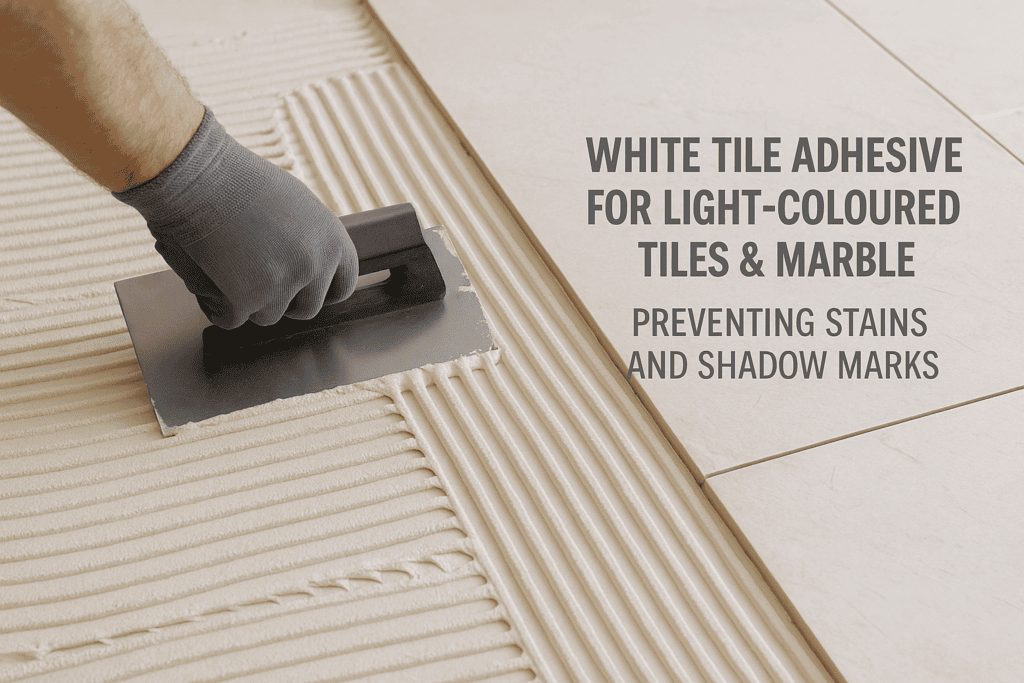
White Tile Adhesive for Light Coloured Tiles and Marble: Stain Prevention
A light marble tile can be securely fixed and still look wrong when the installation is finished. Dark patches, uneven shading or a change in the visible colour may be enough to spoil a surface chosen for its clean appearance. A white tile adhesive is one material worth considering for this work, but its colour alone cannot establish that a particular marble or tile will remain free of staining.
Redwop's existing article discusses shadow marks, adhesive colour and moisture-related appearance concerns. This guide takes a more practical approach: identify what the finished tile is expected to look like, verify the stone and adhesive combination, control the conditions documented in the selected product instructions, and examine the result before repeating it across a larger area. It does not revisit heavy-stone structural fixing, which Redwop covers in its separate heavy-stone adhesive guide.
On This Page
- Start with the appearance requirement
- What white adhesive can and cannot establish
- Reading light-tile and marble appearance concerns
- Checking the tile and its back before specifying adhesive
- Redwop products: verified uses and colour information
- Choosing tile adhesive for marble
- Where granite and wall tiles fit the decision
- Comparing a trial area with the intended finish
- Substrate and application checks that affect the result
- When an appearance difference is found
- Approval record for a consistent finished surface
- Frequently asked questions
- Final Thoughts
Start with the appearance requirement
A product decision is easier when the expected finish has been described first. Record the tile or stone name, its shade, its intended location and the appearance the client has approved. If several batches or stone pieces are involved, identify which samples represent the intended finish. These are project approval details rather than performance claims about an adhesive.
Redwop's existing discussion of light stone names dark patches, shadowing and uneven tone as possible concerns. Those words are useful descriptions of what someone sees; they are not, by themselves, a diagnosis of why it happened. A visible difference may lead to a review of adhesive colour or application, but it should not be assigned automatically to one cause without examining the actual installation.
| Appearance question | What to establish | Why it matters to selection |
|---|---|---|
| What is being fixed? | Tile or stone type and approved sample | Product suitability must match the finish material |
| How light is the surface? | Intended colour and any visible variation | Creates a fair appearance reference |
| Where will it be installed? | Interior wall, floor or documented wet-area location | Product uses and exposure must match |
| Is the backing unusual? | Any visible backing, residue or treatment | May require an additional compatibility check |
| Has the finish been accepted? | Sample approval and responsible reviewer | Avoids a subjective decision after full installation |
A written appearance requirement does not replace a technical specification. It helps the installer and specifier ask the right technical questions before the finish is covered by adhesive.
What white adhesive can and cannot establish
The most direct difference between a white and a grey adhesive is the material's stated colour. Redwop lists TERATILE DIAMOND as white on its product page, and its existing article explains why the colour of a bonding bed matters when choosing light-coloured tiles or marble. The same article discusses moisture-related shadowing and possible variation in tone.
However, white is not a guarantee of stain prevention. Colour is only one part of compatibility. Redwop's tile adhesive range distinguishes products by intended tile type, installation surface and application conditions. An adhesive should therefore be selected for the actual tile, stone and substrate, not because its name or packaging looks suitable for a premium finish.
The product page is also the place to check whether the white version is actually specified. Some Redwop products have grey/white colour information, while others publish stone compatibility without explicitly identifying a white colour on the page reviewed. Stone suitability and adhesive colour are two different facts; do not combine them into an unsupported claim.
For an independent explanation of tile adhesive terminology, the ISO 13007-1 standard overview is a supplementary reference. It is not used here to claim that any particular Redwop product prevents staining or meets a specification beyond Redwop's published information.
Reading light-tile and marble appearance concerns
An appearance concern should first be described without naming its cause. Redwop's existing white-adhesive article mentions dark patches, uneven colour, shadow marks and visible staining. It also discusses differences in the adhesive bed as an installation concern. The table below turns those topics into observations that can be checked, not automatic diagnoses.
| What is visible | Useful record | What to review, without assuming a cause |
|---|---|---|
| Darker area in a light finish | Position, size and photograph | Stone sample, product selection and application record |
| Uneven tone across adjacent pieces | Which pieces differ and their batch identifiers | Approved natural variation and installation details |
| Shadow-like pattern | Whether it follows a repeatable visible pattern | Adhesive application and contact information |
| Colour change noted after installation | When it was first observed | Earlier photographs, exposure and product documentation |
| Local mark near an edge or joint | Exact position and affected pieces | Relevant finishing materials and site conditions |
Neither a colour change nor a visible pattern is sufficient evidence that the adhesive caused the issue. The purpose of the record is to narrow the questions for a contractor or technical reviewer, rather than to prescribe removal or cleaning immediately.
Checking the tile and its back before specifying adhesive
Redwop describes preparing the base and cleaning the back of tiles among its product-specific installation instructions. Its Knowledge Centre also discusses the removal of foreign material from tile backs. For a light finish, checking the actual tile and its backing is useful before assuming that all units in a delivery have the same surface condition.
Identify the tile or marble precisely, confirm the intended bonding face and record any existing backing or residue. A visible backing treatment should prompt a compatibility check with the chosen adhesive. Do not assume that instructions written for an untreated ceramic tile apply equally to a backed natural stone or engineered finish.
The difference matters because an otherwise suitable product may be documented for the stone type without the page giving approval for a particular factory backing. If the backing is not covered by Redwop's instructions, obtain technical confirmation rather than creating an on-site cleaning or priming procedure.
Surface shade versus bonding-face suitability
The visible face establishes the appearance requirement; the back and substrate establish what the adhesive has to contact. Both must be considered in one specification. A white adhesive may be selected with the visible face in mind, but its documented compatibility with the bonding surfaces is equally important.
Do not treat every stone as identical
Redwop's stone-adhesive content discusses marble, granite and other natural stones as separate finishes. A product page that lists marble does not automatically establish stain-free suitability for every marble variety, especially where an individual stone sample or backing differs from the standard material being described.
Redwop products: verified uses and colour information
Redwop's published range includes several adhesives for tiles and natural stone. The table focuses on what the product pages support and what must still be established for an appearance-sensitive job. It is not a ranking from best to worst.
| Product | Relevant published information | Appearance-related selection check |
|---|---|---|
| TERATILE DIAMOND | Polymer-modified cementitious adhesive; colour listed as white; marble and other stones included in internal uses | Confirm the actual stone, substrate and current datasheet |
| TERATILE GOLD | Polymer-modified adhesive for internal ceramic, porcelain and listed stones including marble and granite; page lists grey/white appearance | Confirm the supplied colour variant rather than assuming white |
| TERATILE SINEX | Listed for floor and wall tiles, marble and natural stone; page lists grey/white colour | Check product variant and the intended application |
| TERATILE PLATINUM | Polymer-modified adhesive with listed uses including marble and granite in internal applications | Confirm colour separately; the page reviewed does not establish a white version |
The strongest direct white-colour confirmation in these pages is for TERATILE DIAMOND. Redwop's general article also mentions DIAMOND, GOLD and PLATINUM in connection with light finishes, but the actual product page and datasheet should govern what is supplied and how it is used.
Redwop describes some products as water-resistant after setting and lists shower or immersed uses. That does not mean the product makes every substrate waterproof or guarantees that a pale marble will be unaffected by moisture. The relevant system and finish requirements still need separate approval.
Choosing tile adhesive for marble
A tile adhesive for marble must first be documented for marble, then checked against the particular finish and the intended installation. TERATILE DIAMOND lists marble among its internal stone applications and explicitly gives white as its colour. That makes it a relevant product to examine when both stone compatibility and a light-coloured adhesive bed are requirements.
Redwop's article on stone adhesive and staining also connects light stone appearance with adhesive choice. It discusses avoiding visible colour problems and selecting an adhesive appropriate to the stone. These statements support the need for careful selection, not a universal promise that every marble will remain unchanged.
Before approving the product, identify whether the marble is an untreated natural stone, has a special backing or has a manufacturer-specific fixing requirement. The Redwop product listing can establish general intended uses; the stone's own particulars still determine what requires confirmation. Where the evidence is incomplete, ask Redwop's technical team to review the proposed combination.
The most useful comparison is between the approved sample and the installed trial under the actual project conditions. A clean-looking result at initial placement alone should not be represented as proof of permanent colour stability.
Where granite and wall tiles fit the decision
The phrase adhesive for granite stone is relevant because Redwop lists granite alongside marble in several product uses. Yet the appearance question is not identical. A light granite installation still needs verification of the selected stone and bonding surface, but the fact that a product is listed for granite does not establish its suitability for every marble shade or backing.
This article is not a structural stone-fixing specification. For large, elevated or mechanically restrained stone, adhesive compatibility must not be confused with approval of the complete fixing design. Redwop's separate heavy-stone content addresses the wider installation context.
For wall tile adhesive, Redwop identifies products suitable for wall as well as floor applications. On a light-coloured wall, check both that the adhesive's stated application includes the wall substrate and that the supplied product meets the appearance requirement. Do not transfer a floor-only instruction or a stone-specific claim to an unrelated wall finish.
| Installation context | Product information to confirm |
|---|---|
| Pale marble floor | Marble use, colour, substrate and finish compatibility |
| Light-coloured interior wall tile | Wall use, tile type and actual adhesive colour |
| Light granite finish | Granite use, stone backing and intended environment |
| Wet-area light tile | Published exposure suitability and separate waterproofing system |
| Engineered or specially backed finish | Product-specific technical approval for the actual finish |
Comparing a trial area with the intended finish
Redwop's existing white-adhesive article emphasises even application and correct product selection, but the pages reviewed do not provide a universal mock-up size, appearance tolerance or formal acceptance procedure for every marble. A limited trial area can therefore be treated as a project approval exercise, not as an official Redwop test method.
Select representative pieces and record their identification, the product actually used, its colour variant, the substrate and the person reviewing the result. Install only according to the chosen product's current instructions. Compare the completed trial with the approved material sample under the agreed viewing conditions, and record whether a visible difference needs further investigation.
| Trial record | What to note |
|---|---|
| Material identity | Tile or marble type and sample/batch reference |
| Adhesive identity | Product, colour variant and datasheet revision |
| Substrate | Surface type and approved preparation |
| Application | Installer and product-instruction reference |
| Appearance | Photographs and comparison with the approved sample |
| Decision | Accepted, held for clarification or not accepted; reviewer |
The trial should not be described as laboratory proof of stain resistance. Its value is practical: it creates a shared reference before the whole room or wall is installed. If a difference is visible, the team can review the stone and bonding combination before multiplying the same outcome.
Substrate and application checks that affect the result
Redwop's TERATILE GOLD product information calls for cleaning the substrate to remove dust, loose matter, laitance and efflorescence. The same page gives instructions for tile-back cleaning, mixing and application, and warns against adding more water or powder once the product has started setting. These are product-specific instructions, not universal figures for the entire range.
For a light-coloured installation, the preparation record should confirm that the substrate was assessed and that the selected product's instructions were followed. If a surface treatment or existing finish is present, compatibility needs to be checked before proceeding. Do not assume that applying a white product compensates for weak material or residue at the bonding interface.
Redwop's existing article recommends consistent adhesive coverage and warns about spot fixing and uneven beds in appearance-sensitive installations. The point is to use the manufacturer's approved application method, not to invent a trowel size, bed thickness or coverage rate for every material. Refer to the selected product's datasheet for those details.
Mixing is another place to avoid generalisation. The products in Redwop's range have individual instructions, and one page's water quantity, working time or bed thickness must not be copied to another. In particular, an installer should not adjust a setting mixture simply to change its appearance or make it spread differently.
When an appearance difference is found
A visible difference should trigger examination, not an immediate diagnosis. Record when it appeared, which tiles are affected, the product used and the installation stage. Check whether the material was already variable in the approved sample and whether the concerned pieces have a distinct backing or substrate condition.
If the problem is localised, do not assume that all installed tiles are defective. If it appears across several areas, do not automatically infer one shared cause. Redwop's existing article lists possible adhesive-related reasons for shadowing, but those are possibilities to assess against the actual site, not conclusions that follow from appearance alone.
Avoid promising that an appearance mark can be cleaned, resealed or corrected by changing the grout. Redwop's information reviewed here does not establish a universal repair for stained marble or light tile. Where the cause or safe remedial method is unclear, involve the stone supplier, installer and Redwop's technical team before approving treatment or replacement.
Approval record for a consistent finished surface
The simplest way to reduce disagreement is to keep the approval decision connected to the exact material and product combination. It should be possible to identify what was specified, what was delivered, what was tried and what the reviewer accepted.
| Approval point | Evidence to retain |
|---|---|
| Finish selection | Approved tile or marble sample |
| Product selection | Redwop product page and current datasheet |
| Adhesive colour | Confirmation of the supplied colour or variant |
| Substrate compatibility | Documented application and technical clarification where needed |
| Trial appearance | Dated photographs and observations |
| Final decision | Named reviewer and any conditions for proceeding |
This is a suggested project record, not a Redwop certification scheme. Its purpose is to make the approved finish reproducible and to reduce decisions based on assumptions about the word white.
Frequently asked questions
1. Why consider white tile adhesive for light-coloured tiles?
Redwop's existing article identifies possible shadowing and uneven tone under light surfaces. A white bonding bed may be relevant to the appearance requirement, but the product must also be suitable for the tile and substrate.
2. Does white adhesive guarantee that marble will not stain?
No. Redwop discusses stain-prevention benefits, but product colour alone does not establish a guarantee for every marble variety, backing or installation condition.
3. Which Redwop product explicitly lists a white colour?
TERATILE DIAMOND's product page lists its colour as white. Confirm the current datasheet and the actual supplied product before specification.
4. Can TERATILE GOLD be used for marble?
Redwop lists marble among its internal applications. Its page also describes grey/white appearance, so confirm the exact supplied variant for a light-finish project.
5. Is every tile adhesive for marble suitable for pale marble?
Not automatically. General marble suitability and the appearance requirement are separate checks. Confirm the exact stone and any special backing before approval.
6. What should be checked on the back of a light tile?
Identify visible residue, unusual backing or other conditions requiring compatibility review. Follow the selected Redwop product's documented preparation instructions rather than assuming every tile back is the same.
7. Is an adhesive for granite stone automatically appropriate for marble?
No. Some Redwop products list both materials, but the actual stone, substrate, exposure and appearance requirement must still match the product's documented uses.
8. Can a white adhesive be used on walls?
Only when the selected product is documented for the particular wall tile and substrate. Adhesive colour does not establish wall-application suitability.
9. What if the trial area shows a darker patch?
Record the observation and compare it with the approved sample, adhesive information and installation record. Do not label the adhesive as the cause without further assessment.
10. Where can the latest product instructions be checked?
Use Redwop's product pages and the product-specific datasheets. For an unusual marble, backing or appearance requirement, seek technical confirmation before proceeding.
Final Thoughts
The purpose of specifying white adhesive is not simply to choose a lighter-coloured bag of material. It is to protect an approved visual finish while making sure the adhesive is documented for the tile or stone, the backing, the substrate and the intended application. Redwop's published pages provide a solid starting point: TERATILE DIAMOND explicitly lists a white colour and marble among its internal uses, while other stone-compatible products require their colour variant to be checked separately.
For a light-coloured finish, establish the appearance requirement first, confirm the product and its instructions, and use a representative project review before repeating the installation widely. A visible stain or shadow should be investigated rather than assigned an automatic cause. Redwop's contact page is available for product-specific technical questions.
Tags: White Tile Adhesive, Tile Adhesive for Marble, Light-Coloured Tiles, Marble Appearance, Tile Installation