


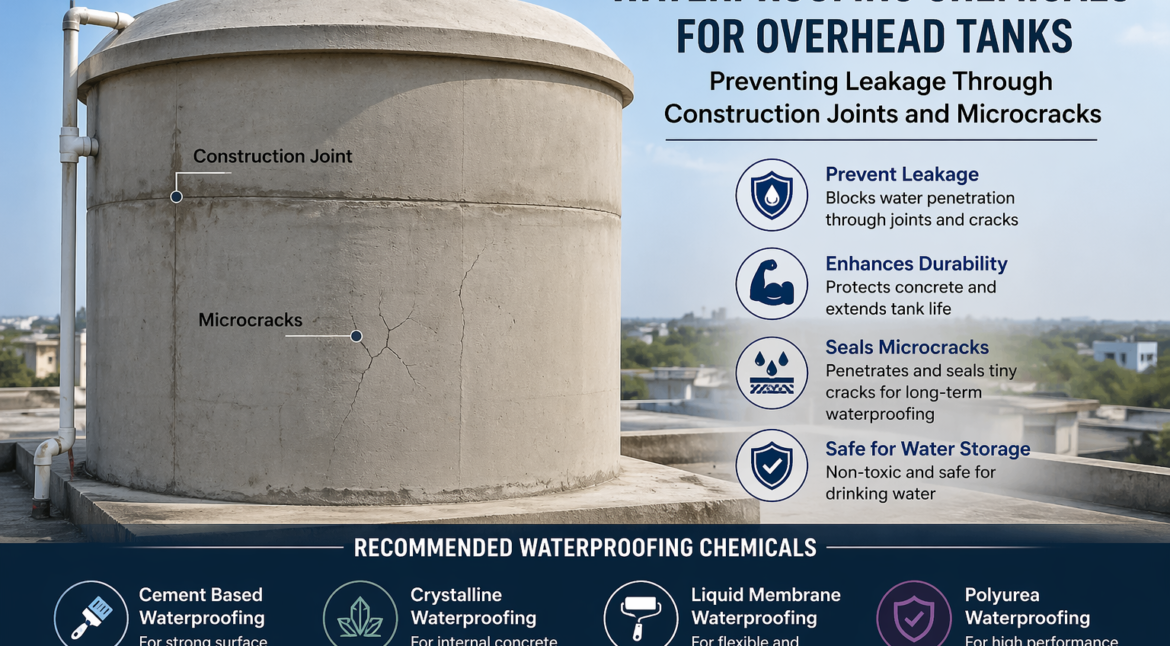
Waterproofing Chemicals for Overhead Tanks: Preventing Leakage Through Construction Joints and Microcracks
Overhead water tanks are critical components in residential, commercial, and industrial buildings. Since they store water continuously, they are always under internal hydrostatic pressure. Even small defects such as microcracks or weak construction joints can eventually lead to leakage.
In many cases, leakage does not appear immediately after construction. It develops gradually due to shrinkage, thermal movement, or poor waterproofing practices. This is why selecting the right waterproofing chemicals is essential for long-term performance and durability of overhead tanks.
Proper waterproofing not only prevents leakage but also protects the structural integrity of the tank.
Common Question Asked:
Q.1 Can waterproofing chemicals completely stop leakage in overhead tanks?
Yes, when applied correctly, waterproofing chemicals can effectively seal microcracks, protect construction joints, and prevent water leakage in overhead tanks.
Why Overhead Tanks Are Prone to Leakage
Overhead tanks face constant exposure to water pressure and environmental conditions. Over time, this leads to several common issues.
1. Construction Joints
Construction joints are unavoidable in tank construction. However, these joints often become weak points where water can seep through if not treated properly.
2. Microcracks in Concrete
Concrete naturally develops microcracks due to:
- shrinkage
- temperature variation
- structural movement
Even hairline cracks can allow water to pass through under pressure.
3. Porosity of Concrete
Concrete is not fully impermeable. Without proper treatment, water can penetrate through capillary pores and reach the outer surface.
4. Poor Surface Treatment
Inadequate surface preparation or improper waterproofing application can result in weak protection layers that fail over time.
Role of Waterproofing Chemicals in Overhead Tanks
Modern waterproofing systems are designed to address these problems through different mechanisms such as surface sealing, internal crystallization, and flexible membrane protection.
Cement-Based Waterproofing for Internal Tank Surfaces
One of the most commonly used solutions for overhead tanks is cement based waterproofing. These coatings bond strongly with concrete and create a dense, water-resistant layer.
They are suitable for:
- internal tank surfaces
- water-retaining structures
- damp concrete substrates
Products like POLYCOTE WH are used to form a protective coating over concrete surfaces. For enhanced performance, POLYCOTE WH CRETE offers improved strength and durability.
In high-performance applications, POLYCOTE WH100 provides stronger resistance to water pressure and long-term exposure.
These systems are widely used because they integrate well with concrete and provide reliable internal waterproofing.
Crystalline Waterproofing for Internal Protection
For long-term durability, crystalline waterproofing systems are highly effective. Unlike surface coatings, these materials work within the concrete structure.
They react with moisture and cement particles to form crystals that block capillary pores and microcracks.
Products like POLYCOTE CWP provide internal sealing by filling water pathways inside the concrete matrix.
This type of waterproofing is particularly useful for:
- preventing seepage through microcracks
- improving durability of water-retaining structures
- providing long-term internal protection
Liquid Membrane Waterproofing for External Protection
For external surfaces of overhead tanks, liquid membrane waterproofing systems are commonly used.
These coatings form a seamless and flexible layer over the surface, preventing water ingress from outside and protecting against environmental exposure.
Products such as SUPERKOT are used to create protective coatings on exposed surfaces. For better flexibility and durability, SUPERKOT N can handle minor cracks and surface movement effectively.
Liquid membranes are especially useful where tanks are exposed to weather conditions.
Polyurea Waterproofing for High-Performance Applications
In demanding applications where fast curing and high flexibility are required, polyurea waterproofing systems are used.
Polyurea coatings provide:
- seamless waterproof protection
- high elasticity
- excellent crack-bridging ability
- fast curing time
Products like Redopol 264 are suitable for advanced waterproofing requirements where durability and performance are critical.
Treating Construction Joints in Overhead Tanks
Construction joints are one of the most vulnerable areas in any water-retaining structure.
Proper treatment involves:
- cleaning and preparing the joint surface
- sealing cracks and gaps
- applying a suitable waterproofing system
Combining cement-based coatings with crystalline systems can provide better joint protection and long-term sealing.
Preventing Leakage Through Microcracks
Microcracks are often invisible but can cause serious leakage issues.
Effective solutions include:
- crystalline waterproofing to block internal pathways
- flexible membrane coatings to bridge surface cracks
- proper curing to reduce shrinkage cracks
Using the right combination of waterproofing systems ensures that both internal and external protection is achieved.
Best Practices for Waterproofing Overhead Tanks
To ensure effective waterproofing, the following steps should be followed:
Surface Preparation
Remove loose particles, dust, and contaminants before application.
Crack and Joint Repair
Repair visible cracks and treat construction joints before applying waterproofing.
Use Compatible Systems
Select waterproofing systems based on exposure conditions and structural requirements.
Apply in Recommended Layers
Follow manufacturer guidelines for thickness and number of coats.
Proper Curing
Ensure adequate curing for cement-based systems to achieve full performance.
Why Waterproofing Chemicals Are Essential
Without proper waterproofing:
- Leakage can damage surrounding structures
- Reinforcement corrosion may occur
- Maintenance costs increase
- Water quality may be affected
Using reliable waterproofing chemicals ensures the durability, safety, and long-term performance of overhead tanks.
Conclusion
Overhead tanks are constantly exposed to water pressure, making them highly susceptible to leakage through construction joints and microcracks. Selecting the right waterproofing chemicals is essential to protect these structures from long-term damage.
Cement-based coatings provide strong surface protection, crystalline systems offer internal sealing, liquid membranes protect external surfaces, and polyurea coatings deliver high-performance waterproofing.
When combined with proper surface preparation and correct application practices, these systems ensure durable, leak-free overhead tanks. For more information, Contact Us.
FAQs
-
1. What causes leakage in overhead water tanks?
Leakage is usually caused by microcracks, construction joints, and porous concrete.
-
2. Which waterproofing method is best for overhead tanks?
A combination of cement-based and crystalline waterproofing systems is commonly used for effective protection.
-
3. Can crystalline waterproofing stop microcracks?
Yes, crystalline waterproofing blocks capillary pores and seals microcracks internally.
-
4. Is liquid membrane waterproofing suitable for tanks?
It is mainly used for external surfaces to protect against environmental exposure.
-
5. What is the role of polyurea waterproofing?
Polyurea provides fast-curing, flexible, and durable waterproof protection in high-performance applications.