


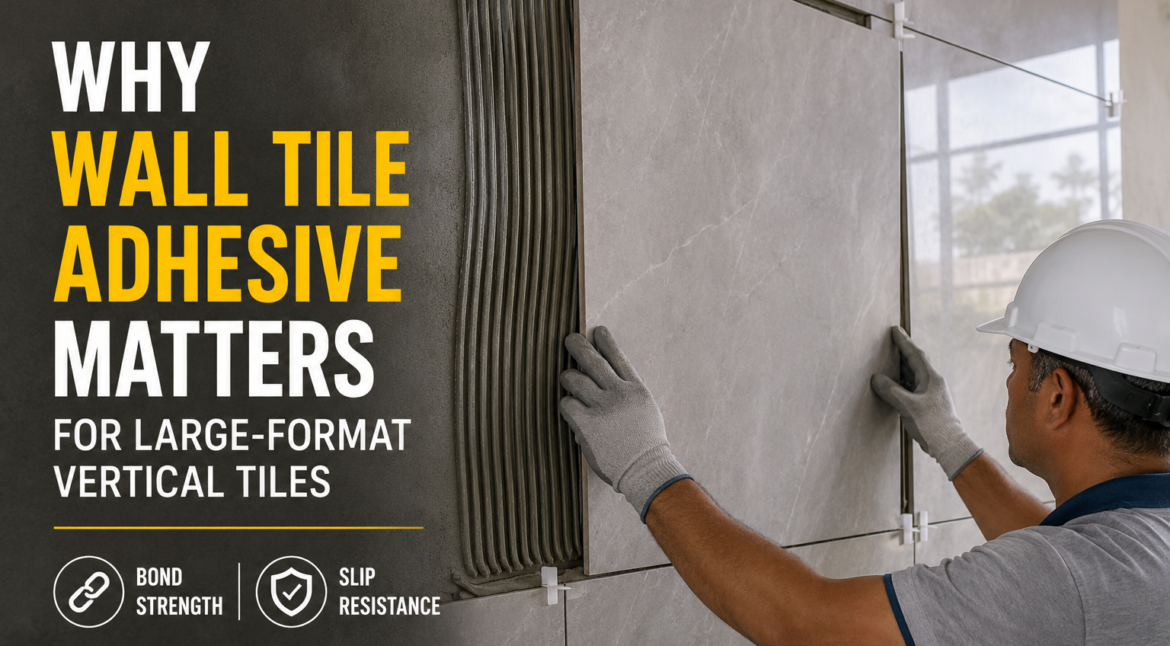
Why Wall Tile Adhesive Matters for Large-Format Vertical Tiles: Bond Strength and Slip Resistance
Large-format tiles have become increasingly popular in residential, commercial, and hospitality projects because of their modern appearance, minimal grout lines, and premium finish. However, installing large-format tiles on vertical surfaces presents unique challenges that are very different from standard wall tiling applications.
Due to their larger size and heavier weight, these tiles place greater stress on the adhesive layer. If the wrong adhesive system is used, issues such as tile slippage, hollow sound, edge lifting, and complete tile detachment can occur over time.
This is why selecting the correct Wall Tile Adhesive is essential for achieving reliable bond strength and long-term tile stability on vertical surfaces.
Common Question Asked:
Q.1 Why do large-format wall tiles slip or detach after installation?
Large-format wall tiles often fail because of inadequate adhesive strength, insufficient slip resistance, poor surface preparation, improper adhesive coverage, or using an adhesive not designed for vertical tile installations.
Why Large-Format Vertical Tiles Are More Demanding
Unlike standard ceramic wall tiles, large-format tiles:
- have greater weight per tile
- exert higher downward force on the adhesive bed
- require a stronger initial grab
- demand better adhesive coverage
- are more sensitive to substrate irregularities
Even minor installation mistakes can significantly affect long-term performance.
Common Problems Seen in Large-Format Wall Tile Installations
Tile Slippage During Installation
One of the most common site challenges is tile movement immediately after placement.
When the adhesive lacks sufficient non-sag properties:
- tiles slide downward
- joint alignment becomes uneven
- installation quality suffers
Hollow Sound Behind Tiles
Large-format tiles require high adhesive contact coverage.
Voids behind tiles can lead to:
- hollow sound
- weak bonding zones
- increased breakage risk
Edge Lifting and Debonding
Insufficient bond strength may cause tile edges to separate from the substrate over time.
This is especially common in:
- high-rise buildings
- commercial washrooms
- façade walls
- moisture-prone environments
Cracked Tiles Due to Uneven Support
Large-format tiles are less forgiving than smaller tiles.
Poor adhesive distribution creates stress points that may eventually cause tile cracking.
Why Bond Strength Is Critical for Vertical Tile Installations
Vertical surfaces continuously place a gravitational load on the adhesive layer.
A high-performance wall tile adhesive must provide:
- strong initial grab
- high bond strength
- slip resistance
- long-term durability
Without these characteristics, tiles gradually lose stability and become vulnerable to failure.
Role of Polymer Tile Adhesive in Large-Format Wall Applications
Modern polymer tile adhesive systems are specifically designed to improve adhesion, flexibility, and bond retention.
For large-format wall tiles where enhanced bonding performance is required, Teratile Prolix helps improve adhesive strength and workability, making installation more reliable.
In vertical installations subjected to higher stress and loading, Teratile Gold supports stronger bonding performance and improved tile stability.
Why Slip Resistance Matters on Vertical Surfaces
Slip resistance is often overlooked during tile selection.
However, on walls, the adhesive must resist the downward force created by tile weight.
Poor slip resistance leads to:
- uneven tile alignment
- wider joints
- installation delays
- bonding inconsistencies
For large-format wall applications requiring improved non-sag performance, Teratile Platinum helps maintain tile position during installation while supporting long-term bond durability.
Importance of Surface Preparation Before Applying Wall Tile Adhesive
Even the best adhesive system cannot compensate for poor substrate conditions.
Common substrate issues include:
- dust contamination
- weak plaster
- uneven surfaces
- loose particles
- moisture problems
Before tiling:
- Surfaces should be clean
- loose material removed
- substrate level checked
- cracks repaired where necessary
Proper preparation significantly improves bonding performance.
Normal Tile Adhesive for Standard Wall Applications
For standard ceramic wall tile installations in low-stress indoor environments, Type I systems can provide adequate bonding performance.
For routine residential wall applications, Teratile Classic offers reliable adhesion for conventional ceramic tile installations where large-format tile loads are not a primary concern.
However, as tile size increases, higher-performance adhesive systems become increasingly important.
Waterproof Tile Adhesive for Wet Wall Areas
Bathrooms, showers, kitchens, and utility rooms expose wall tiles to continuous moisture.
Using a suitable waterproof tile adhesive helps:
- improve bond durability
- reduce moisture-related failures
- enhance tile stability in wet environments
For wet-area wall installations, Teratile Prolix Extra provides improved bonding performance where moisture resistance is important.
Where additional waterproofing support and enhanced adhesion are required, Polymix and ADMIIX ETRA BOND helps improve substrate compatibility and overall bonding performance.
Epoxy Tile Adhesive for Challenging Vertical Applications
Certain vertical installations demand even higher bonding performance.
Examples include:
- industrial walls
- commercial kitchens
- heavy stone cladding
- difficult non-absorbent surfaces
In such situations, epoxy tile adhesive systems offer:
- superior adhesion
- chemical resistance
- improved durability
- strong bonding on difficult substrates
For demanding wall applications where maximum bond reliability is required, FLEXOPLUS helps provide stronger adhesion and long-term installation stability.
Why Large Tiles Need Full Adhesive Coverage
Large-format tiles require significantly higher adhesive contact than smaller tiles.
Insufficient coverage can cause:
- hollow spots
- stress concentration
- bond failure
- tile cracking
Proper trowel selection and installation technique are critical for achieving complete adhesive transfer.
Common Site Mistakes That Cause Wall Tile Failure
Using Standard Adhesive for Large Tiles
Not all adhesives are designed to support large-format vertical tiles.
Inadequate Adhesive Coverage
Voids reduce load-bearing capacity.
Poor Surface Preparation
Weak substrates compromise bond performance.
Ignoring Tile Weight
Heavier tiles require higher-performance adhesive systems.
Improper Curing
Premature loading weakens bond development.
Best Practices for Large-Format Vertical Tile Installation
Prepare the Surface Properly
Ensure the substrate is sound, clean, and level.
Use High-Performance Wall Tile Adhesive
Select adhesive suitable for large-format vertical applications.
Achieve Full Adhesive Coverage
Minimize voids behind tiles.
Use Correct Trowel Techniques
Improve adhesive transfer and support.
Allow Adequate Curing Time
Ensure full bond development before loading.
Why Adhesive Selection Determines Long-Term Tile Performance
Large-format tiles place greater demands on the adhesive layer than conventional wall tiles.
Choosing the correct wall tile adhesive helps:
- improve bond strength
- prevent tile slippage
- reduce hollow sound
- improve durability
- minimize maintenance issues
Proper adhesive selection is one of the most important factors affecting the long-term success of vertical tile installations.
Conclusion
Large-format vertical tiles create unique installation challenges because of their weight, size, and bonding requirements. Without adequate adhesive performance, problems such as tile slippage, hollow sound, edge lifting, and debonding can occur.
Using high-performance wall tile adhesive systems significantly improves installation quality and long-term durability. Advanced polymer tile adhesive solutions such as Teratile Prolix, Teratile Gold, Teratile Platinum, and Teratile Prolix Extra, and Teratile Diamond help provide stronger bonding and better slip resistance for demanding wall applications. For highly challenging environments, epoxy tile adhesive systems like FLEXOPLUS offer superior bonding performance and durability.
With proper surface preparation, full adhesive coverage, and correct adhesive selection, large-format vertical tile installations can deliver long-lasting and reliable performance. For more information, Contact Us.
FAQs
-
1. Why do large-format wall tiles slip during installation?
Large-format tiles are heavier and require adhesives with strong non-sag and bonding properties.
-
2. Is polymer tile adhesive suitable for vertical applications?
Yes, polymer-modified adhesives improve bond strength, flexibility, and slip resistance.
-
3. Why is full adhesive coverage important for large-format tiles?
Incomplete coverage creates hollow spots that can weaken bonding and cause cracking.
-
4. When should epoxy tile adhesive be used on walls?
Epoxy adhesives are recommended for demanding applications involving difficult substrates, moisture, or heavy tile loads.
-
5. Can normal tile adhesive be used for large-format wall tiles?
Normal tile adhesive may be suitable for standard wall tiles, but large-format tiles often require higher-performance adhesive systems for reliable bonding.