


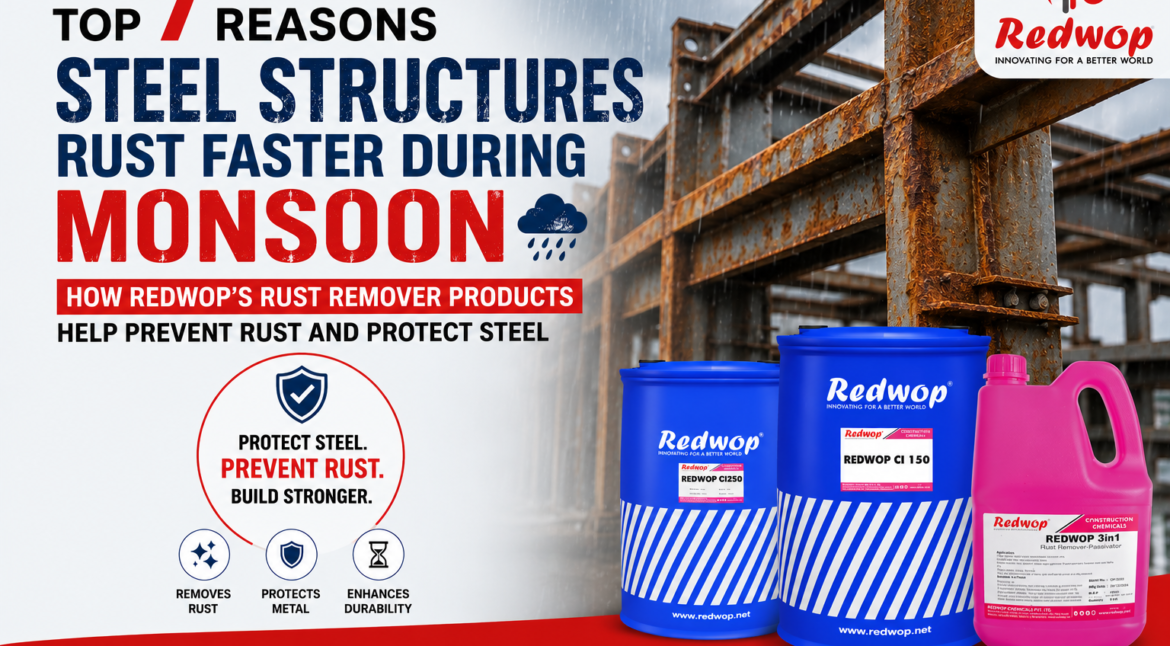
Top 7 Reasons Steel Structures Rust Faster During Monsoon – How REDWOP's Rust Remover Products Help Prevent Rust and Protect Steel
Introduction:-
Every monsoon season, structural engineers, contractors, and building owners across India deal with the same frustrating reality: steel that looked perfectly fine in April starts showing orange patches, flaking surfaces, and deep pitting by July. What feels like an overnight problem is actually the result of a precise set of conditions that Indian monsoons create better than almost any other season and understanding those conditions is the first step to preventing the damage they cause.
This article breaks down the seven specific reasons why steel corrodes faster during India’s monsoon months, and then walks through how REDWOP’s rust remover products the REDWOP 3IN1, REDWOP CI 150, and REDWOP CI 250 address each stage of the corrosion problem, from active rust removal to long-term passivation and protection.
Common Question Asked:
Why does steel rust faster during the monsoon compared to other seasons in India?
Monsoon creates the perfect combination for accelerated corrosion, continuous surface moisture from rainfall, sustained high humidity between rain spells, chloride-laden winds in coastal zones, and temperature-driven condensation cycles. Each of these conditions individually accelerates rusting; together they produce the rapid steel deterioration seen across Indian construction sites every monsoon season.
Why Monsoon Accelerates Steel Corrosion: The Science in Plain Terms
Rust is an electrochemical process. Iron in steel reacts with oxygen in the presence of moisture to form iron oxide which we see as rust. The faster moisture reaches the steel surface, and the longer it stays there, the faster corrosion progresses. India’s monsoon creates a sustained, high-intensity version of every condition that drives this process which is why structural steel can develop significant rust in a matter of weeks during peak monsoon months, even when it showed little deterioration through the dry season.
Reason 1: Continuous Surface Moisture From Rainfall
During the monsoon, steel surfaces don’t just get wet they stay wet. Rainwater pools on horizontal surfaces like chajjas, beams, and roof purlins, and runs down vertical surfaces like columns, trusses, and railing posts. Even between rain spells, ambient humidity keeps the surface film of moisture intact. This continuous electrolyte layer on the steel surface keeps the electrochemical corrosion reaction running without interruption, dramatically accelerating the rate of rust treatment compared to dry months when the surface dries out between exposures.
Reason 2: High Humidity Levels Sustain the Corrosion Reaction
Steel begins to corrode meaningfully once relative humidity crosses approximately 60%. During India’s peak monsoon months, coastal cities like Mumbai, Chennai, and Kochi regularly sustain 85–95% relative humidity, while inland cities like Rajkot, Pune, and Hyderabad aren’t far behind at 70–85%. Even when it isn’t actively raining, the air holds enough moisture to maintain a thin invisible film of water on any exposed steel surface. This is why steel stored in a warehouse with open sides can rust during monsoon season even without direct rainfall; the humidity alone is sufficient to keep the rust treatment for metal problems active around the clock.
Reason 3: Chloride-Laden Air in Coastal and Industrial Zones
Steel structures within a few kilometres of the coastline face a compounded problem during monsoon season. Sea-salt aerosols microscopic droplets carrying sodium chloride — travel inland on monsoon winds and deposit on steel surfaces. Chlorides are particularly damaging because they penetrate the natural oxide layer on steel, displace oxygen in the corrosion cell, and accelerate the electrochemical reaction significantly. In industrial zones, sulphur dioxide and nitrogen oxide emissions from nearby facilities combine with monsoon humidity to form dilute acid rain, which attacks steel with even greater aggression. For structures in these environments, a basic rust remover isn’t enough what’s needed is a chemical rust remover with corrosion inhibitor chemistry that neutralises the aggressive ions as part of the treatment process.
Reason 4: Temperature Fluctuations Cause Condensation on Steel
Monsoon season in India brings frequent temperature swings warm, humid afternoons followed by cooler evenings after rain. Steel, being a good thermal conductor, cools faster than the surrounding air during these drops, causing water vapour in the warm air to condense directly on the steel surface. This condensation cycle repeats multiple times daily through the monsoon period, and each cycle deposits a fresh electrolyte film on the steel. Exposed structures on terraces, open fabrication yards, and rooftop equipment are particularly vulnerable to this form of accelerated attack one reason why industrial rust remover applications on rooftop and exposed steel need to happen before the monsoon begins, not after visible rust appears.
Reason 5: Breakdown of Existing Protective Coatings
Paint and primer systems applied to steel are designed for normal weather exposure they are not always tested or specified for the sustained alkalinity and UV fluctuations of a sustained Indian monsoon. During monsoon season, existing coatings absorb moisture through micro-pores, begin to blister, and eventually delaminate at the edges or around scratches and mechanical damage points. Once the coating lifts, bare steel is directly exposed to the moisture beneath it and this under-film corrosion spreads laterally, making the problem far larger than the original damage point. An early rust treatment including a rust stain remover application on surface-level discolouration on any areas showing coating failure before monsoon is the most effective time to intervene, before the season creates conditions that accelerate what would otherwise be a slow process.
Reason 6: Standing Water Around Foundations and Ground-Level Steel
Monsoon flooding and waterlogging around building foundations, compound walls, and ground-level structural steel creates prolonged immersion conditions that surface coatings were never designed to handle. Reinforcement bars in concrete near the soil surface, anchor bolts, column bases, and underground pipelines are all at risk when the water table rises during sustained rainfall. Soil chemistry particularly alkaline soils with high sulphate or chloride content, common across Rajasthan, Gujarat, and coastal Maharashtra makes the corrosion environment around buried and partially buried steel even more aggressive. This is precisely why rust remover for metal treatments on embedded or partially buried steel reinforcement need to be followed up with a passivating coat, not left as standalone treatments.
Reason 7: Neglected Maintenance Before Monsoon Onset
The most controllable factor in monsoon rust damage is also the most commonly overlooked one: the absence of systematic pre-monsoon inspection and treatment. Hairline scratches, small rust spots, and areas of thinning paint that seem cosmetic in the dry season become entry points for accelerated corrosion the moment sustained monsoon moisture arrives. A small rust patch that could be treated with a targeted application of rust treatment in May can develop into structural pitting and section loss by September if left untreated. The monsoon doesn’t cause rust from nothing it accelerates what already exists and what hasn’t been properly protected.
REDWOP’s Rust Remover and Rust Converter Product Range
REDWOP offers a three-product system that covers the full spectrum of monsoon steel protection needs from active rust removal and conversion to passivation and surface preparation for protective coatings. Each product targets a specific stage of the corrosion treatment process.
REDWOP 3IN1 — Rust Remover-Passivator
REDWOP 3IN1 is a single-component liquid rust treatment solution that simultaneously removes rust, phosphetizes the surface, and provides a passivating coat three functions delivered in one application. It is the workhorse of the REDWOP range for rust treatment for metal on structural steel in construction, infrastructure, and industrial settings.
What it does in practice: When applied to a rusted steel surface, REDWOP 3IN1 converts the reddish rust to a black passivated layer, temporarily halting further rusting while the surface is prepared for a protective topcoat. Its liquid form means it can be applied with a brush, cotton waste swab, or spray gun allowing it to reach congested reinforcement areas, complex structural profiles, and confined sections that mechanical cleaning tools cannot access.
Where it is used:
- New and old reinforcement steel in construction and repair
- Embedded steel in repairable concrete structures
- Tanks, water pipelines, effluent pipelines, trusses, purlins, and rafters
- Ball bearings, valves, and industrial tools applications where a fast rust killer for metal action is essential
- Reinforcements with insufficient concrete cover or in thin sections
Key technical specifications:
Property | Specification |
Appearance | Clear liquid |
Specific gravity @27°C | 1.07 to 1.10 |
Flash point | Not applicable |
Shelf life | 06 months at room temperature |
Coverage | 1 kg covers 3–5 m² in 2 coats |
Application: Surface must be dry, free from oil, dirt, and grease. For heavily rusted surfaces, wire-brush or sand-blast mechanically first. Apply REDWOP 3IN1 by brush or spray; leave until the reddish colour changes to black. After a minimum of 24 hours, remove loose rust, clean with water jet, and dry. Follow immediately with a corrosion protection coating REDWOP recommends REDOPOXY 330ERC,,, Barguard, Zincrich, Steelguard as compatible follow-up systems.
Important note: REDWOP 3IN1 is a temporary passivator it is not a permanent standalone treatment. It must be followed by a protective coating to deliver lasting rust treatment performance.
Packaging: Available in 1, 5, 10, and 20 kg packs.
REDWOP CI 150 — Rust Converter
REDWOP CI 150 is a one-part, alkaline-based rust converter with corrosion inhibitors and dispersing agents supplied as a dark brown liquid. It is specifically designed as a chemical rust remover for steel bars prior to encasing in concrete or micro-concrete, and for steel surfaces prior to coating with epoxy systems two of the most common pre-treatment needs on Indian construction sites.
As a rust converter and primer preparation agent, CI 150 works by penetrating oil and grease on the corroded surface, neutralising the rust chemistry, and restoring the surface toward its nearest original colour making it a true rust converter primer and rust converter paint preparation step before protective or structural coatings are applied.
Key technical specifications:
Property | Specification |
Appearance | Dark brown liquid |
Specific gravity @25°C | 1.2 to 1.22 |
pH | 9.5 to 10 |
Coverage | 2.0–2.5 m² per litre |
Shelf life | 12 months at room temperature |
Application: Surface free from oil, dirt, and grease. Remove loose particles on steel bars; for heavily rusted surfaces, wire-brush mechanically first. Apply CI 150 by brush, cotton waste swab, or spray. Leave in contact until the reddish corroded colour changes to nearest original colour. After 5 days, remove loose rust particles by wire brush, clean with water, and dry fully before applying protective coating.
Packaging: Available in 5, 20, and 210 litre drums.
REDWOP CI 250 — Rust Converter (Heavy-Duty)
REDWOP CI 250 is the higher-concentration version in REDWOP’s rust converter range a one-part alkaline-based best rust converter solution with a slightly higher specific gravity (1.21–1.24) and the same proven corrosion-inhibitor and dispersing-agent chemistry as CI 150. It is the preferred choice for more heavily corroded surfaces, larger-area applications, and industrial settings where a higher-strength water based rust converter treatment is required.
Like CI 150, it functions as a rust reformer and rust transformer that converts active rust into a stabilised surface, making it suitable for use before epoxy coatings, protective paints, and waterproofing systems. As the best rust remover for metal in high-corrosion environments, Regarded as the best rust converter option for high-volume applications, CI 250 is available in drum quantities specifically for industrial and large-scale construction applications.
Key technical specifications:
Property | Specification |
Appearance | Dark brown liquid |
Specific gravity @25°C | 1.21 to 1.24 |
pH | 9 to 10 |
Coverage | 2.0–2.5 m² per litre |
Shelf life | 12 months at room temperature |
Application: Identical to CI 150 mechanical pre-cleaning for heavily rusted surfaces, brush/swab/spray application, wait for colour change to nearest original, wire-brush and water-clean after 5 days, apply protective coating after drying.
Packaging: Available in 5, 10, 20, and 210 litre drums.
Choosing the Right REDWOP Product for Your Application
Application | Recommended Product | Why |
Reinforcement bars before concrete encasing | CI 150 or CI 250 | Direct rust converter action, safe before concrete contact |
Steel before epoxy coating | CI 150 or CI 250 | Surface preparation for rust converter and primer systems |
Complex structural profiles, trusses, purlins | REDWOP 3IN1 | Liquid form reaches congested areas; 3-in-1 function reduces steps |
Embedded or repairable steel in structures | REDWOP 3IN1 | Passivation + rust remover for metal in single application |
Industrial tanks, pipelines, effluent systems | REDWOP 3IN1 or CI 250 | High coverage, rapid action for industrial rust remover needs |
Pre-monsoon maintenance of exposed steel | REDWOP 3IN1 | Water based metal rust remover + passivator reduces follow-up steps |
Ball bearings, valves, precision tools | REDWOP 3IN1 | Liquid penetrates fine surfaces without mechanical abrasion |
The Correct Pre-Monsoon Steel Protection Sequence
Getting the most out of REDWOP’s corrosion treatment range means following the correct treatment sequence the chemistry works best when each step is completed properly before the next begins:
- Inspect all exposed steel for active rust, coating failure, and surface contamination
- Mechanically clean heavily rusted surfaces by wire brushing or sand blasting before chemical treatment
- Apply REDWOP 3IN1, CI 150, or CI 250 depending on the application type (see table above)
- Wait for the colour change to confirm the rust conversion reaction has completed
- Remove loose rust residue by wire brush after the specified dwell time, clean with water, and dry
- Apply a compatible corrosion-protection topcoat — REDOPOXY 330 ERC,, Barguard, Zincrich, steel guard as recommended by REDWOP
- Re-inspect all treated areas after the first heavy monsoon spell and re-treat any areas where moisture has found its way back in
This seven-step process is what separates a surface treatment that lasts through monsoon season from one that fails by August.
Why REDWOP for Rust Treatment in India
REDWOP Chemicals Pvt. Ltd., headquartered in Rajkot, Gujarat, has developed its rust treatment range specifically for the conditions that Indian construction and industrial projects face high humidity, aggressive coastal and industrial atmospheres, and the sustained moisture of a three-to-four month monsoon season. The steel treatment products in the REDWOP range are supported by the company’s multi-standard certification framework: ISO 9001:2015 for quality management, ISO 14001:2015 for environmental responsibility, ISO 45001 for occupational health and safety, and GEV Ec1 Plus for low-VOC emissions — standards that matter not just on paper but in the field reliability of each product.
For contractors, structural engineers, and maintenance teams across India comparing rust treatment and converter options before the monsoon season, REDWOP’s range provides the critical combination of fast action, ease of application, and compatibility with follow-up coating systems — making it a practical, field-proven choice for steel protection in Indian construction conditions. Visit redwop.net for the full product catalogue and technical data sheets.
-
1.What is the difference between a rust remover and a rust converter?
A rust remover chemically dissolves or lifts rust from the steel surface. A rust converter reacts chemically with the rust (iron oxide) and transforms it into a more stable compound, effectively neutralising it in place. REDWOP's CI 150 and CI 250 function as rust converters, while REDWOP 3IN1 is a rust remover-passivator that removes rust and provides a temporary protective passivating coat.
-
2.Is REDWOP 3IN1 a permanent rust treatment?
No REDWOP 3IN1 is a temporary passivator and rust remover. It removes rust and slows further rusting by creating a passivating coat, but it must be followed by a proper corrosion-protection coating
-
3Can REDWOP CI 150 or CI 250 be used directly on steel bars before casting in concrete?
Yes this is one of the primary listed uses for both CI 150 and CI 250. They are specifically designed as rust removers for steel bars prior to encasing in concrete or micro-concrete.
-
4.What is the difference between REDWOP CI 150 and CI 250?
Both are alkaline-based rust converters with corrosion inhibitors and dispersing agents. CI 250 has a slightly higher specific gravity (1.21–1.24 vs. 1.2–1.22) and a broader pH range, making it the heavier-duty option for more severely corroded surfaces or larger-scale industrial applications. Both have the same application procedure and coverage rate.
-
5. How long should REDWOP 3IN1 be left on the surface before cleaning?
After application, leave REDWOP 3IN1 in contact with the surface until the reddish rust colour changes to black (indicating the passivation reaction is complete). After a minimum of 24 hours, remove loose rust by wire brush, clean with a water jet, and allow to dry before applying a protective coating.
-
6. How long should REDWOP CI 150 or CI 250 be left on the surface?
After application, leave in contact until the reddish corroded colour changes to nearest original colour. After 5 days, remove loose rust particles with a wire brush, clean the surface with water, and allow it to dry completely before applying a protective coating.
-
7. Can REDWOP 3IN1 be diluted with water?
Yes REDWOP 3IN1 can be applied either pure or diluted with water, depending on the requirement and extent of rusting.
-
8. What is the coverage rate for REDWOP 3IN1?
1 kg covers 3–5 m² in 2 coats, depending on the diameter of the reinforcement rods and the extent of rusting. Application rate is 0.120–0.150 kg/m² per coat.
-
9. Can REDWOP's rust converter products be used on aluminium or zinc surfaces?
No both CI 150 and CI 250 (alkaline-based) and REDWOP 3IN1 (acid-based) attack zinc, aluminium, and putty. They should only be used on steel and iron surfaces. If in doubt, test on a small inconspicuous area first.
-
10.What protective coatings should follow REDWOP 3IN1 treatment?
REDWOP recommends REDOPOXY, CLOUDATES, TEPALS, and REDOTHANE Primer as compatible corrosion-protection coating systems to apply after REDWOP 3IN1 treatment for long-term steel protection.