


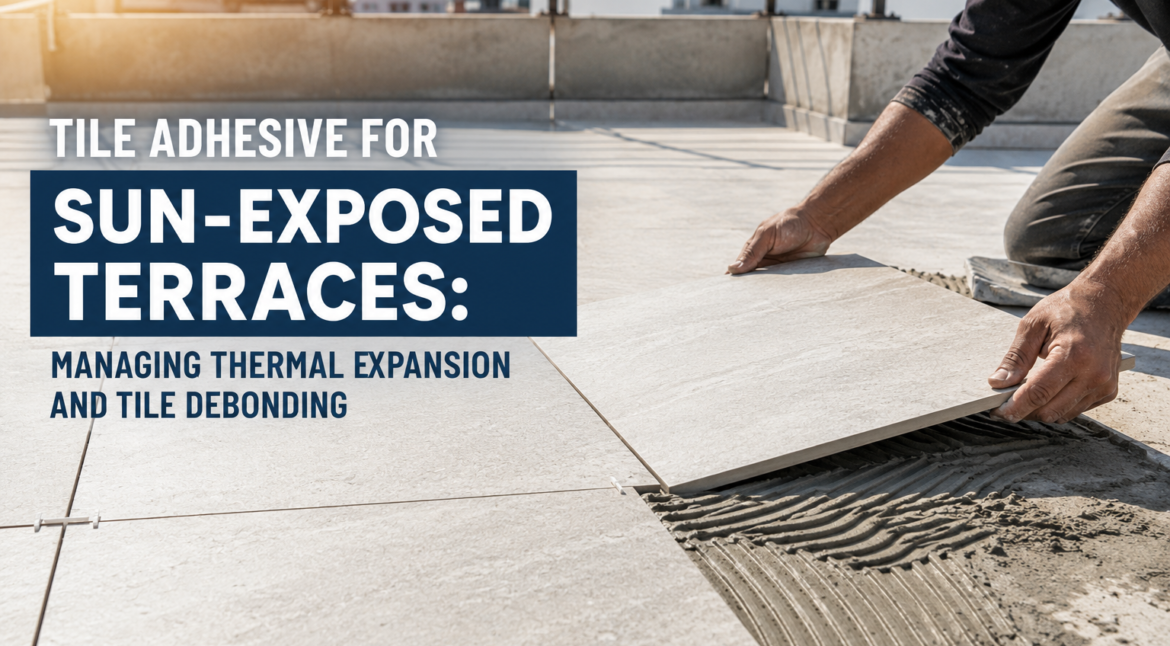
Tile Adhesive for Sun-Exposed Terraces: Managing Thermal Expansion and Tile Debonding
Terrace tiling is exposed to some of the harshest environmental conditions in construction. Unlike indoor floors, terrace surfaces face constant sunlight, temperature fluctuations, rainwater exposure, and thermal movement throughout the day. These conditions create continuous stress between the tile, adhesive layer, and substrate.
One of the most common failures in such areas is tile debonding. Tiles may sound hollow, lift at corners, crack, or completely detach over time. In many cases, the root cause is improper selection or application of tile adhesive for exterior conditions.
Understanding how thermal expansion affects tiled terraces is essential for selecting the correct adhesive system and preventing long-term failures.
Common Question Asked:
Q.1 Why do terrace tiles debond under sunlight exposure?
Terrace tiles debond mainly due to thermal expansion, substrate movement, improper adhesive selection, and insufficient bonding coverage.
Why Sun-Exposed Terraces Are High-Risk Areas
Outdoor terraces experience extreme surface temperature variation.
During the daytime:
- Tiles expand due to heat
- substrate temperature rises significantly
At night:
- surfaces cool rapidly
- contraction occurs
This repeated expansion and contraction creates stress within the tiling system.
Common Tile Failures on Terraces
1. Hollow Sound Beneath Tiles
Voids under tiles caused by incomplete adhesive coverage result in hollow sound and weak bonding.
2. Tile Debonding
Thermal movement gradually breaks the adhesive bond, leading to tile lifting or detachment.
3. Cracked Tiles and Joints
Stress accumulation due to movement can crack tiles or grout joints.
4. Water Ingress Below Tiles
Once tiles loosen, water penetrates beneath the surface and worsens failure.
How Thermal Expansion Affects Tile Adhesive Performance
Tiles and concrete substrates expand at different rates under temperature changes.
If the adhesive layer cannot absorb this movement:
- stress transfers directly to the tile
- bond strength weakens
- debonding occurs
This is why exterior tiling requires more flexible adhesive systems compared to indoor applications.
Why Standard Adhesives Fail on Outdoor Terraces
Basic cement adhesives often fail because they:
- lack flexibility
- cannot accommodate thermal movement
- develop shrinkage stress
Under continuous heat exposure, rigid adhesive layers lose bonding performance.
Role of Polymer Tile Adhesive in Terrace Applications
Using polymer tile adhesive improves flexibility, bonding strength, and durability in outdoor conditions.
Polymer-modified systems are designed to:
- absorb thermal stress
- improve adhesion
- reduce shrinkage
- enhance flexibility
Products such as Teratile Prolix and Teratile Platinum provide improved bonding for terrace and exterior tile applications.
For high-performance outdoor conditions, solutions like Teratile Prolix Extra and Teratile Gold help manage movement stress more effectively.
Importance of Flexible Adhesive Systems
Terraces require adhesive systems that can tolerate movement without losing bond strength.
Products like:
are suitable where:
- The temperature variation is high
- tile sizes are larger
- Outdoor exposure is continuous
These adhesives improve durability by maintaining flexibility under thermal stress.
PU Based Adhesive for Critical Movement Areas
In high-movement or demanding outdoor conditions, PU based adhesive systems provide even greater flexibility.
A Redwop’s Flexo PU is useful where:
- thermal movement is severe
- vibration or substrate movement occurs
- high flexibility is required
PU-based systems absorb stress more effectively than rigid cement-based adhesives.
Why Full Adhesive Coverage Is Critical
Outdoor tiling requires near-complete adhesive contact beneath tiles.
Poor coverage creates:
- air pockets
- stress concentration points
- weak bonding zones
This increases the risk of:
- hollow sound
- cracking
- debonding
Using proper troweling technique and back buttering becomes essential in terrace tiling.
Outdoor Tile Adhesive vs Indoor Adhesive
An outdoor tile adhesive must perform under:
- UV exposure
- moisture variation
- thermal expansion
- rainwater exposure
Indoor adhesives are generally not designed for these conditions.
Exterior-grade polymer-modified systems provide:
- better flexibility
- stronger adhesion
- improved weather resistance
Role of Floor Tile Adhesive on Terraces
Terraces are load-bearing walking surfaces, making floor tile adhesive performance extremely important.
A suitable floor adhesive should:
- support tile loads evenly
- Resist thermal stress
- maintain bonding under movement
Redwop’s Products:
help improve adhesion and installation stability in floor applications.
How Bonding Additives Improve Adhesion
Additional bonding support may be required in difficult substrates or renovation works.
Redwop’s Admix Extra Bond improves:
- bonding strength
- adhesive performance
- substrate compatibility
This helps enhance durability in terrace installations.
Common Site Mistakes That Cause Terrace Tile Failure
Applying Adhesive on Hot Surfaces
High substrate temperature reduces open time and weakens bonding.
Inadequate Surface Preparation
Dust, laitance, or uneven substrate reduces adhesion.
Insufficient Expansion Joints
Without movement joints, stress accumulates and tiles crack or debond.
Using Interior Adhesive Outdoors
Indoor-grade products fail under UV and thermal exposure.
Best Practices for Terrace Tile Installation
Prepare the Surface Properly
Ensure the substrate is level, clean, and structurally sound.
Use Flexible Polymer Adhesive
Select an exterior-grade adhesive suitable for thermal movement.
Apply Full Adhesive Coverage
Avoid voids beneath tiles.
Use Expansion Joints
Allow movement accommodation across large areas.
Avoid Midday Installation
High temperatures reduce adhesive performance during application.
Why Adhesive Selection Matters in Exterior Tiling
Terrace tiling failures are often blamed on tiles, but adhesive performance is usually the real issue.
Selecting the right tile adhesive ensures:
- stronger bonding
- better flexibility
- resistance to thermal stress
- longer tile life
This reduces maintenance and improves long-term performance.
Conclusion
Sun-exposed terraces experience continuous thermal movement that places significant stress on tiled surfaces. Without the right adhesive system, tiles can debond, crack, or fail prematurely.
Using high-performance polymer tile adhesive and flexible systems, such as PU-based adhesives, improves bonding durability under exterior conditions. Products like Teratile Prolix, Teratile Gold, Teratile Diamond, and Flexo PU help manage thermal stress and enhance long-term performance.
Proper installation practices combined with the correct adhesive system are essential for durable and failure-free terrace tiling. For more information, Contact Us.
FAQs
-
1. Why do terrace tiles sound hollow?
Hollow sound occurs due to incomplete adhesive coverage or voids beneath tiles.
-
2. What causes tile debonding on terraces?
Thermal expansion, poor bonding, and incorrect adhesive selection are common causes.
-
3. Is polymer tile adhesive suitable for outdoor use?
Yes, polymer-modified adhesives provide better flexibility and weather resistance.
-
4. When should PU based adhesive be used?
PU adhesives are used where high flexibility and movement resistance are required.
-
5. Why are expansion joints important in terrace tiling?
They help absorb movement stress and reduce cracking or debonding risk.