


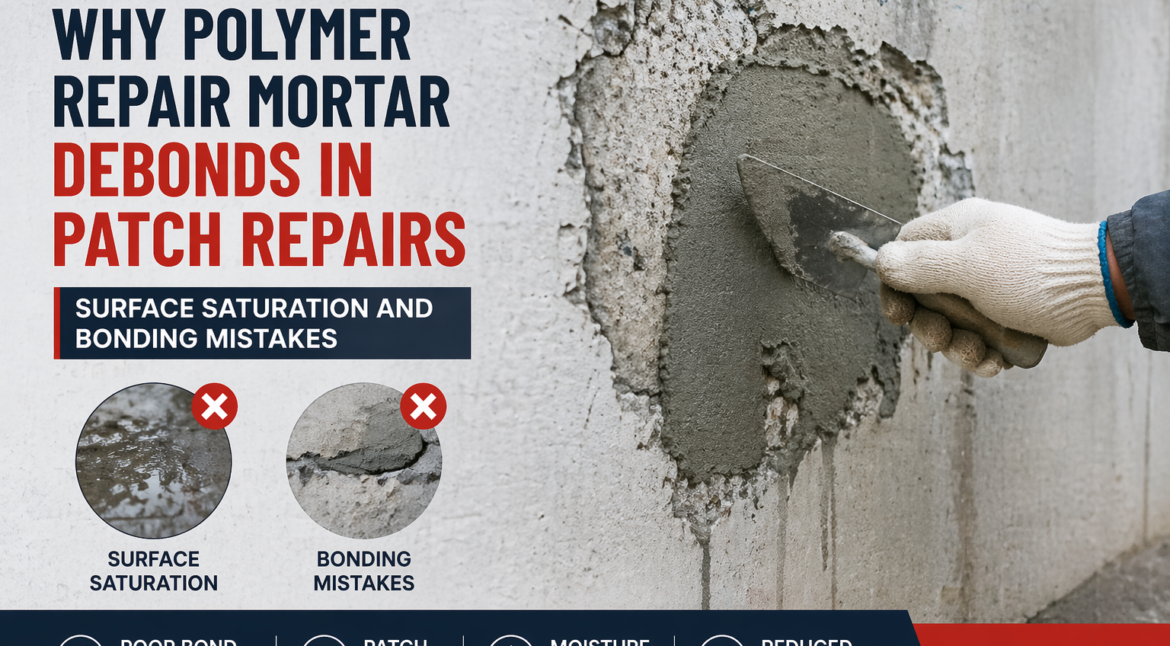
Why Polymer Repair Mortar Debonds in Patch Repairs: Surface Saturation and Bonding Mistakes
Patch repair failures are one of the most common problems seen in concrete repair works. A repaired area may look sound initially, but within a short period, it starts to crack, hollow, or detach from the substrate. In many cases, the issue is not the repair material itself but how it was applied.
This is especially true when using polymer repair mortar. While these materials are designed to provide strong adhesion and durability, their performance depends heavily on surface preparation, moisture conditions, and bonding practices.
If the base surface is not properly treated or if bonding is not achieved correctly, even a high-quality repair mortar can fail.
Common Question Asked:
Q.1 Why does polymer repair mortar debond after patch repairs?
Debonding usually happens due to improper surface preparation, incorrect moisture condition, or failure to use the right bonding system before applying the repair mortar.
What Does Debonding Mean in Patch Repairs?
Debonding refers to the separation of the repair layer from the existing concrete surface. This can appear as:
- hollow sound when tapped
- visible separation at edges
- cracking along patch boundaries
- complete detachment of the repair layer
This failure not only affects appearance but also compromises structural durability.
Major Causes of Debonding in Polymer Repair Mortar
1. Improper Surface Preparation
One of the most critical mistakes in patch repairs is inadequate surface preparation.
If the substrate is not cleaned properly, contaminants such as:
- dust
- laitance
- oil or grease
- loose particles
can prevent proper bonding between the old surface and the repair mortar.
A rough, clean, and mechanically prepared surface is essential to achieve strong adhesion.
2. Incorrect Surface Saturation (SSD Condition)
Surface moisture condition plays a major role in bonding performance.
For cement-based repair systems, the substrate should generally be in SSD (Saturated Surface Dry) condition. This means:
- The surface is moist internally
- But no free water is present on the surface
If the surface is too dry, it absorbs water from the repair mortar, weakening the bond.
If the surface is too wet, it creates a film that prevents proper adhesion.
Incorrect saturation is one of the most common reasons for debonding.
3. Lack of Proper Bonding Agent
In many repair cases, a bonding agent is required to improve adhesion between old and new concrete.
For example, products such as Butabond AR, Butabond SBR, Butabond SBR 45, and Butabond SBR SL, EPBOND EP are used to enhance bond strength and reduce interfacial shrinkage.
These bonding agents act as a bridge layer that ensures proper adhesion between the substrate and the repair mortar.
Skipping this step often leads to weak bonding and early failure.
4. Poor Application Timing
Even when a bonding agent is used, incorrect timing can cause failure.
Common mistakes include:
- Allowing the bonding slurry to dry before the mortar application
- Applying the repair mortar too late
- working outside the open time of the bonding system
For effective bonding, repair mortar should be applied while the bonding layer is still active or tacky.
5. Inadequate Compaction and Placement
Repair mortar must be properly compacted into the prepared surface.
If voids or air pockets remain:
- The bonding area reduces
- weak zones form
- stress concentration increases
This can lead to localized debonding over time.
6. Incorrect Use of Epoxy Mortar
In certain structural repairs, epoxy mortar is used instead of cement-based systems.
Products like EPFloor NF40 MTR and Epmotar ER provide strong adhesion and high mechanical strength.
However, epoxy systems require:
- completely dry surfaces
- precise mixing
- strict application control
If used incorrectly, epoxy mortar can also fail due to poor bonding or surface incompatibility.
7. Improper Curing Practices
Curing is often overlooked in repair works.
Without proper curing:
- Rapid moisture loss occurs
- shrinkage increases
- Bond strength reduces
Polymer-modified mortars still require controlled curing to develop full strength and adhesion.
Role of Bonding Agents in Preventing Debonding
Using the right bonding system is critical in patch repair.
A bonding agent or plaster bonding agent helps:
- improve adhesion between old and new surfaces
- reduce shrinkage stress
- Enhance the durability of the repair
In some structural repairs, an epoxy bonding agent may also be used where high bond strength is required.
Choosing the correct bonding system depends on:
- type of repair
- surface condition
- environmental exposure
- structural requirements
Best Practices to Avoid Debonding
To ensure long-lasting repair performance, the following steps should be followed:
Proper Surface Preparation
Remove all loose material and create a rough surface profile.
Maintain Correct Moisture Condition
Ensure SSD condition for cement-based systems.
Use a suitable bonding agent
Apply the bonding layer where required and follow the correct timing.
Apply Mortar Correctly
Compact properly to avoid voids and ensure full contact.
Follow Proper Curing
Protect the repair area from rapid drying.
Select Correct Repair Material
Choose between polymer repair mortar and epoxy mortar based on the application.
Why Polymer Repair Mortar Still Fails on Site
Even though polymer repair mortars are designed for high performance, failure still occurs due to execution errors rather than material defects.
Most failures are caused by:
- poor workmanship
- lack of surface preparation
- incorrect application sequence
- ignoring bonding requirements
This highlights the importance of proper site practices along with material selection.
Conclusion
Debonding in patch repairs is a common but preventable problem. The performance of polymer repair mortar depends not just on the material, but on how well the surface is prepared, how bonding is achieved, and how the repair is executed.
By ensuring proper surface preparation, correct moisture conditions, and appropriate use of bonding agents, contractors can significantly improve the durability and performance of repair works.
When done correctly, polymer repair mortar provides strong, reliable, and long-lasting repair solutions for structural and non-structural applications. For more information, Contact Us.
FAQs
-
1. What causes polymer repair mortar to debond?
Debonding is mainly caused by poor surface preparation, incorrect moisture condition, or lack of bonding agent.
-
2. What is SSD condition in repair works?
SSD (Saturated Surface Dry) means the surface is moist internally but has no free water on it.
-
3. Is bonding agent necessary for patch repairs?
Yes, bonding agents improve adhesion and reduce the risk of debonding.
-
4. Can epoxy mortar replace polymer repair mortar?
Yes, in certain cases, epoxy mortar is used for high-strength structural repairs.
-
5. Why is curing important in repair mortar?
Proper curing helps develop strength, reduces shrinkage, and improves bond performance.