


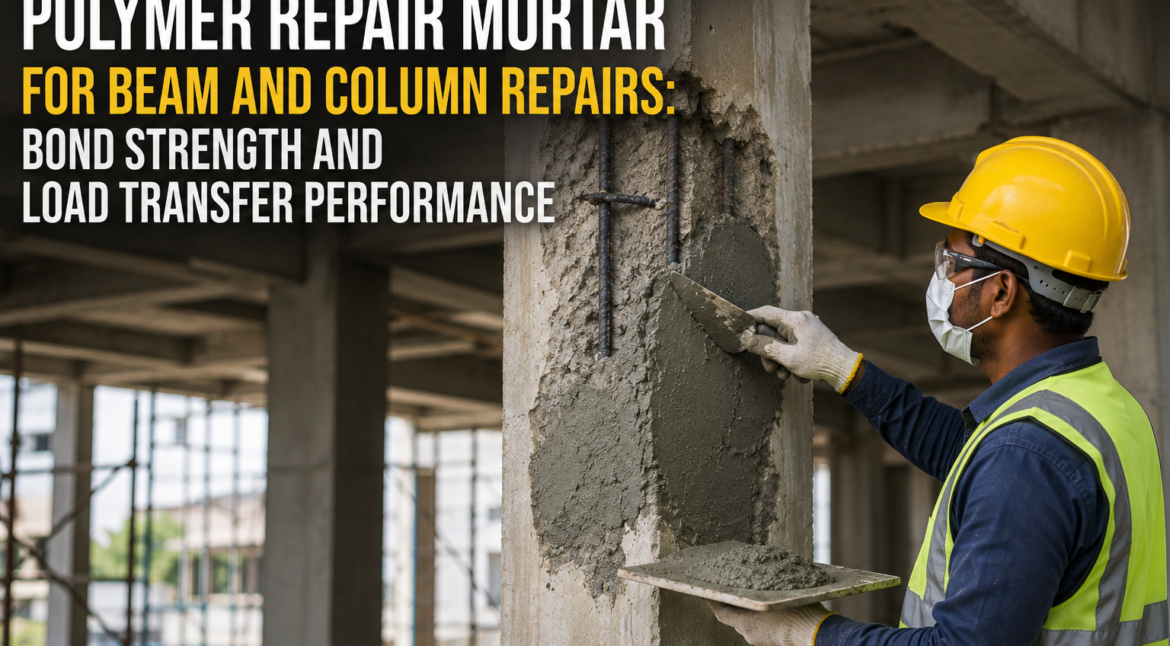
Polymer Repair Mortar for Beam and Column Repairs: Bond Strength and Load Transfer Performance
Beams and columns are among the most critical structural elements in any RCC structure. Over time, these members can suffer from cracking, honeycombing, reinforcement corrosion, impact damage, or concrete deterioration caused by environmental exposure and structural stress.
Repairing these structural components requires more than simply filling damaged areas. The repair material must restore bonding continuity, transfer structural loads effectively, and remain durable under long-term service conditions. This is where selecting the correct Polymer Repair Mortar becomes essential.
A properly designed repair system helps restore structural integrity while improving bonding between old and new concrete surfaces.
Common Question Asked:
Q.1 Why do beam and column repairs fail after some time?
Repairs often fail due to weak bonding, improper surface preparation, corrosion of reinforcement, shrinkage stress, and poor load transfer between old and new concrete.
Why Beam and Column Repairs Are Structurally Sensitive
Unlike plaster or surface patch repairs, beam and column repairs directly affect:
- structural load transfer
- reinforcement protection
- durability of RCC members
- long-term stability of the structure
Poor repairs can lead to:
- recurring cracks
- delamination
- concrete spalling
- reinforcement exposure
This makes material selection and repair methodology extremely important.
Common Causes of RCC Damage in Structural Members
Reinforcement Corrosion
Moisture and carbonation gradually corrode embedded steel reinforcement, causing concrete expansion and spalling.
Honeycombing and Voids
Improper compaction during concreting creates weak zones and voids.
Cracking Due to Structural Stress
Load concentration and movement create cracks in beams and columns over time.
Poor Previous Repairs
Improper patching materials often fail to bond properly with existing concrete.
Why Bond Strength Matters in RCC Repairing
The success of any RCC repairing system depends heavily on bond strength between:
- old concrete substrate
- repair mortar layer
- reinforcement surface
Weak bonding causes:
- repair debonding
- crack reappearance
- poor load transfer performance
A high-performance repair mortar must maintain strong adhesion even under structural stress and movement.
Role of Polymer Repair Mortar in Structural Repairs
Unlike ordinary cement mortar, polymer repair mortar systems improve:
- adhesion strength
- flexural performance
- crack resistance
- shrinkage control
These properties help the repair layer behave more compatibly with existing RCC members.
For beam and column repairs where stronger adhesion and structural durability are required, repair systems from the Repairs category help improve bonding continuity and long-term repair performance.
Importance of Surface Preparation Before Repair
Even high-performance repair mortars fail if the substrate is not prepared properly.
Damaged concrete surfaces often contain:
- loose particles
- laitance
- dust contamination
- weakened concrete layers
Before repair application:
- loose concrete must be removed
- reinforcement cleaned properly
- substrate roughened mechanically
- surface saturated appropriately
Proper preparation significantly improves bonding performance.
Role of Concrete Bonding Agent in Load Transfer
A suitable concrete bonding agent improves adhesion between old and new concrete surfaces.
In beam-column junctions and structural patch repairs, bonding agents help:
- improve interlayer adhesion
- reduce debonding risk
- Enhance load transfer efficiency
For repair substrates exposed to movement and structural stress, BUTABOND AR improves bonding strength and repair durability between repair mortar and existing concrete.
Where enhanced flexibility and cement compatibility are required, BUTABOND SBR and BUTABOND SBR 45 help improve adhesion and reduce shrinkage-related cracking in repair applications.
Epoxy Bonding Agent for Critical Structural Repairs
In high-stress structural zones, using an epoxy bonding agent provides:
- stronger adhesion
- improved chemical resistance
- better load transfer performance
Epoxy bonding systems are especially useful in:
- beam-column junctions
- heavily damaged RCC members
- industrial structural repairs
These systems create stronger mechanical bonding compared to ordinary cement slurry bonding methods.
Why Anticorrosive Coating Is Essential Before Repair
Repairing damaged concrete without protecting reinforcement often leads to recurring failure.
Before applying repair mortar, exposed reinforcement should be protected using suitable anticorrosive coating systems.
Anticorrosive coatings help:
- reduce steel corrosion
- improve reinforcement durability
- prevent future concrete spalling
In RCC repair applications where reinforcement exposure is severe, protective coating systems help extend the lifespan of repaired structural members.
How Load Transfer Affects Repair Performance
Repair mortar must not function as a simple surface patch.
It must:
- transfer structural loads effectively
- bond integrally with existing concrete
- tolerate stress concentration
- resist shrinkage and cracking
Poor load transfer causes:
- crack reappearance
- delamination
- repair failure under stress
This is why polymer-modified repair systems are preferred in structural repairs.
Common Site Mistakes That Cause Repair Failure
Inadequate Surface Preparation
Loose concrete and dust reduce bonding strength.
Ignoring Reinforcement Corrosion
Unprotected steel continues corroding beneath repairs.
Applying Thick Repair Layers in One Coat
Excess thickness increases shrinkage stress.
Using Ordinary Cement Mortar for Structural Repairs
Standard mortar lacks bonding and durability performance.
Improper Curing
Rapid moisture loss weakens repair strength.
Best Practices for Beam and Column Repairs
Remove Damaged Concrete Properly
Expose the sound substrate before repair.
Clean Reinforcement Thoroughly
Remove rust and corrosion products completely.
Use a suitable bonding agent
Improve adhesion between old and new concrete.
Apply Repair Mortar in Controlled Thickness
Reduce shrinkage stress and improve curing.
Protect Reinforcement Before Repair
Use anticorrosive coating systems where steel is exposed.
Why Repair Material Selection Matters
Structural repairs require materials that perform under:
- load transfer stress
- vibration
- environmental exposure
- thermal movement
Using the correct polymer repair mortar system improves:
- bonding durability
- crack resistance
- structural compatibility
- long-term repair stability
Proper material selection significantly reduces recurring repair problems.
Conclusion
Beam and column repairs are structurally critical because they directly affect load transfer and RCC durability. Weak bonding, reinforcement corrosion, and improper repair materials often lead to premature repair failure.
Using high-performance polymer repair mortar systems improves adhesion, crack resistance, and compatibility with existing concrete. Combining repair mortar with suitable concrete bonding agent, epoxy bonding agent, and anticorrosive coating systems further enhances repair durability and structural performance.
With proper surface preparation, reinforcement protection, and correct repair methodology, durable and long-lasting RCC repairs can be achieved. For more information, Contact Us.
FAQs
-
1. Why do beam repairs crack again after repair?
Recurring cracks usually occur due to weak bonding, shrinkage stress, or unresolved structural movement.
-
2. What is the role of concrete bonding agent in repairs?
Bonding agents improve adhesion between old concrete and repair mortar.
-
3. Why is anticorrosive coating important in RCC repair?
It protects exposed reinforcement from future corrosion and extends repair life.
-
4. Can ordinary cement mortar be used for structural repairs?
Ordinary mortar is not recommended because it lacks bonding strength and durability.
-
5. Why is polymer repair mortar preferred for beams and columns?
It provides better adhesion, crack resistance, and load transfer performance compared to standard mortar.