


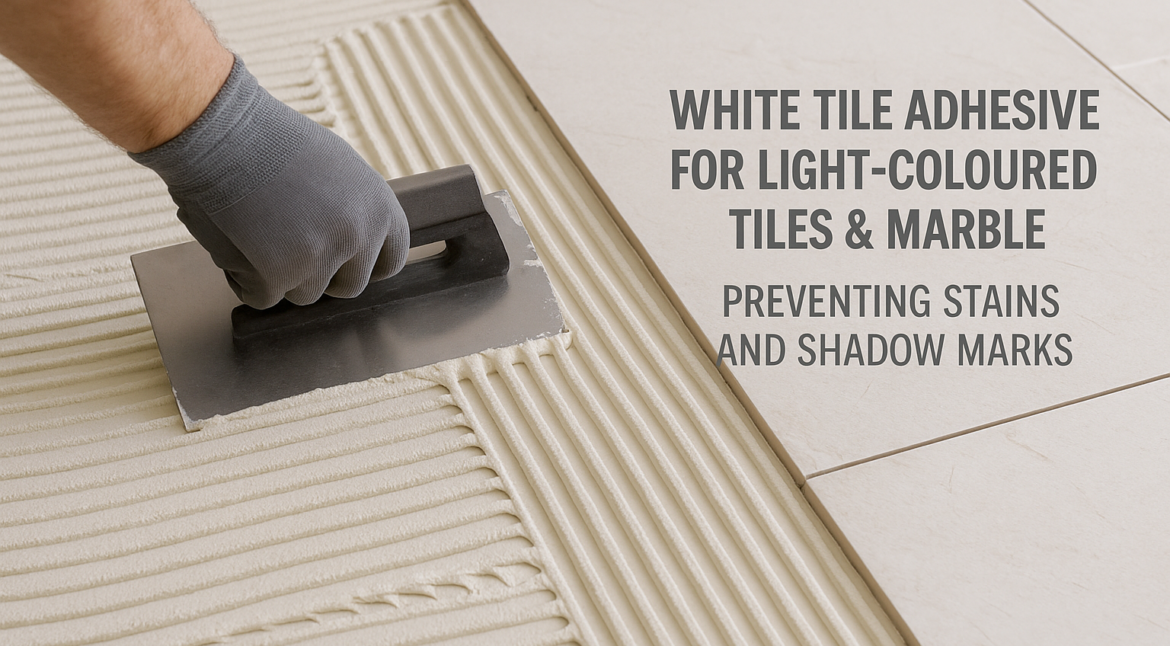
White Tile Adhesive for Light-Coloured Tiles & Marble: Preventing Stains and Shadow Marks
Light-coloured tiles and marble are chosen for their clean appearance, brightness, and premium finish. However, these materials are far less forgiving than darker tiles. Even small mistakes in adhesive selection can lead to visible stains, shadow marks, patchiness, or colour variation that permanently affects the final look.
In most cases, these issues are not caused by the tile itself but by the adhesive used underneath. Choosing the right white tile adhesive is critical when working with light tiles, marble, and other moisture-sensitive materials.
Common Question Asked:
Q.1 Can regular grey tile adhesive cause stains or shadow marks on marble and light-coloured tiles?
Yes, regular grey tile adhesive can cause shadowing, dark patches, and staining on light-coloured tiles and marble due to moisture retention and pigment bleeding.
Why Light-Coloured Tiles and Marble Need Special Adhesive
Unlike darker tiles, light shades and natural stones allow light to pass through their surface. This translucency makes whatever lies beneath them visible over time.
Problems commonly seen when the wrong adhesive is used include:
- Dark patches forming under tiles
- Uneven colour tone after installation
- “Shadow marks” that worsen after exposure to moisture
- Permanent staining on marble surfaces
These issues are especially common in bathrooms, wash areas, kitchens, and wet zones where moisture movement is constant.
What Causes Shadow Marks and Staining Under Tile
1. Pigment Bleeding from Grey Adhesives
Traditional grey adhesives contain cement pigments that can migrate upward into light tiles or marble. Over time, this results in dull or uneven colour patches.
2. Moisture Retention Under Tiles
Poor-quality adhesive beds trap moisture beneath the tile. In wet areas, this moisture slowly travels upward and becomes visible through light-coloured tiles.
3. Incompatible Adhesive Chemistry
Marble and certain light stones react with standard cementitious adhesives. This chemical reaction causes yellowing, dark halos, or permanent surface discoloration.
4. Uneven Adhesive Coverage
Spot bonding or uneven trowel application creates thicker and thinner adhesive zones. On translucent tiles, this leads to visible shadow patterns.
Why White Tile Adhesive Makes a Difference
A properly formulated white tile adhesive solves these problems by addressing both colour stability and moisture control.
White adhesives:
- Do not contain dark pigments
- Reduce visual shadowing under tiles
- Offer better compatibility with marble and stone
- Provide a uniform bonding bed
- Improve aesthetic consistency
This is especially important for premium finishes where even small imperfections become noticeable.
Use of White Adhesive in Bathrooms and Wet Areas
Bathrooms are one of the most common places where staining problems appear. Constant water exposure increases moisture movement through tiles.
A suitable bathroom tile adhesive for light-coloured installations should:
- Be moisture-resistant
- Prevent water absorption into the bonding layer
- Maintain colour stability
- Support long-term durability
In bathroom installations using marble or light vitrified tiles, installers often rely on white, polymer-modified adhesives to reduce long-term visual defects.
White Adhesive for Marble Tile Installation
Marble is a natural material with varying porosity. Some varieties absorb moisture faster than others, making adhesive selection extremely important.
When installing marble:
- Grey adhesive can cause visible darkening
- Moisture migration leads to staining
- Alkali content can react with stone minerals
This is why a marble tile adhesive with a white base and controlled moisture properties is essential. White adhesives reduce chemical reaction risks and preserve the original appearance of the stone.
Products like TERATILE DIAMOND are often used in marble installations because they offer higher bond strength along with colour safety for light and natural stone surfaces.
Polymer-Modified White Adhesives and Their Role
Basic white adhesive alone is not enough for demanding conditions. Polymer modification improves performance by adding flexibility, bonding strength, and moisture resistance.
A polymer tile adhesive:
- Reduces water absorption
- Improves adhesion to dense tiles
- Handles thermal movement better
- Prevents micro-cracks beneath tiles
In wet zones or areas using large tiles, polymer-modified white adhesives provide better long-term performance than standard cement-based products.
In premium residential and commercial interiors, installers often select solutions like TERATILE PLATINUM to ensure strong bonding without visual defects beneath light tiles.
Importance of Adhesive Consistency and Coverage
Even the best adhesive will fail visually if applied incorrectly.
Key practices that prevent shadow marks:
- Use the correct notch trowel size
- Maintain consistent adhesive thickness
- Avoid spot fixing
- Ensure full tile coverage
- Back-butter larger tiles
These practices ensure uniform curing and prevent moisture pockets beneath tiles.
Mistakes That Lead to Permanent Visual Defects
Common site mistakes include:
- Using grey adhesive for light tiles
- Applying adhesive unevenly
- Installing tiles on damp substrates
- Ignoring the curing time
- Using non-polymer adhesives in wet areas
Once staining appears, it usually cannot be corrected without tile removal.
Choosing the Right White Adhesive Based on Application
- Bathrooms and wet areas
White, moisture-resistant adhesive with polymer modification is preferred. - Marble and natural stone
A stone-safe white adhesive that prevents discoloration is essential. - Large or light-coloured tiles
High bond strength with consistent coverage reduces shadow formation.
In practical applications, installers often use TERATILE GOLD where a balance of strength, colour, safety, and moisture resistance is required for light tile installations.
Conclusion
Light-coloured tiles and marble demand more attention than standard flooring materials. The wrong adhesive choice can permanently affect the appearance of the finished surface, even if the installation itself appears structurally sound.
Using a proper white tile adhesive, combined with correct application techniques, prevents shadow marks, staining, and long-term visual degradation. Whether the project involves bathrooms, marble flooring, or premium interiors, selecting the right adhesive is not about preference — it is about protecting the final finish. For more information, Contact Us.
FAQs
-
1. Why is white tile adhesive recommended for light tiles?
White adhesive prevents pigment bleeding and reduces visible shadowing under light-coloured tiles.
-
2. Can grey adhesive permanently stain marble?
Yes. Grey adhesives can cause dark patches or chemical staining on marble surfaces.
-
3. Is white adhesive necessary for bathroom tiles?
It is strongly recommended for light tiles in wet areas to reduce moisture-related shadow marks.
-
4. Does polymer-modified adhesive help prevent staining?
Yes. Polymer modification improves moisture control and reduces discoloration risk.
-
5. Can shadow marks be fixed after installation?
In most cases, no. Once shadowing appears, tiles usually need replacement.