


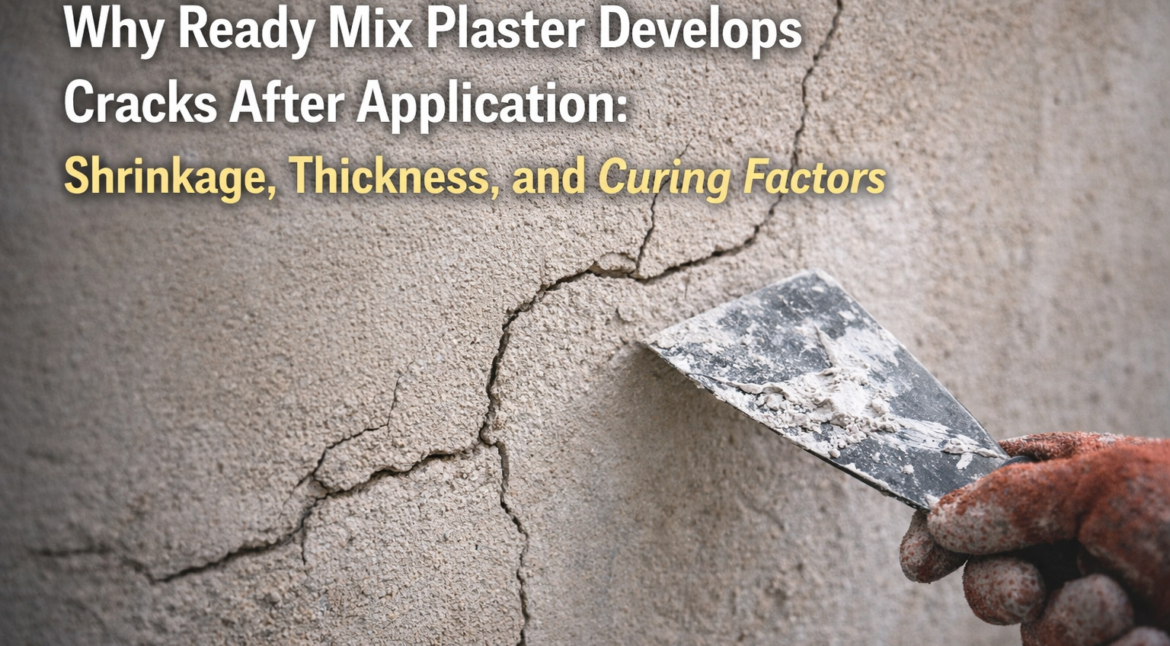
Why Ready Mix Plaster Develops Cracks After Application: Shrinkage, Thickness, and Curing Factors
Cracks in plastered walls are one of the most common post-finishing issues in construction. A surface may look smooth immediately after application, but within days or weeks, fine cracks begin to appear. In some cases, they grow wider and become visible through paint, affecting both aesthetics and long-term durability.
Because modern construction often uses factory-prepared materials, many contractors assume that ready mix plaster should automatically prevent cracking. However, even high-quality plaster systems can develop cracks if site practices, thickness control, curing, and substrate conditions are not handled correctly.
Understanding why ready mix plaster for walls cracks after application is essential for achieving consistent finishes in both residential and industrial projects.
Common Question Asked:
Q.1 Can ready mix plaster crack even if applied correctly?
Yes, ready mix plaster can crack if water content, application thickness, curing discipline, or plaster type selection is not properly controlled.
What Ready Mix Plaster Is Designed to Do
Ready mix plaster is a pre-blended plaster system manufactured under controlled conditions. It is designed to provide:
- Consistent workability
- Uniform finish quality
- Faster site application
- Reduced dependency on manual mix variations
- Better bonding compared to traditional site-mixed mortar
Because it is produced by professional ready mix plaster manufacturers, it offers more predictable performance than conventional sand-cement plastering.
However, plaster cracking is often driven by application factors rather than material inconsistency.
Main Reasons Ready Mix Plaster Develops Cracks
Cracks in plaster are rarely caused by one single factor. They usually result from a combination of shrinkage stresses, poor curing, and thickness-related issues.
Shrinkage from Excess Water Addition
One of the most common reasons plaster cracks is the addition of excess water during mixing.
Why It Happens
On-site, workers often add extra water to:
- Improve spreadability
- Extend working time
- Make plaster feel “smoother.”
What It Causes
Excess water increases drying shrinkage, leading to:
- Hairline cracking
- Surface powdering
- Reduced strength
- Lower durability under paint systems
Even the best ready mix plaster will shrink if the water ratio is disturbed.
Best practice: Always follow manufacturer’s water dosage recommendations.
Over-Thickness Application Layers
Plaster thickness plays a major role in crack formation.
Recommended Practice
Plaster should be applied in controlled thickness layers rather than excessive buildup in one coat.
What Happens with Thick Application
When plaster is applied too thick:
- The surface dries faster than the core
- Differential shrinkage develops
- Internal stress builds up
- Cracks form as plaster tries to contract
This is especially common around:
- Beam-column junctions
- Wall chases for electrical conduits
- Uneven masonry surfaces
Controlled layering prevents stress concentration.
Poor Curing or Rapid Drying
Curing is often ignored in plastering, but it is critical.
Why Curing Matters
Ready mix plaster needs moisture retention for proper hydration. Without curing:
- Surface dries too quickly
- Shrinkage cracks appear early
- Bond strength reduces
- Paint finishes later show visible crack lines
Common Curing Mistakes
- No curing in hot weather
- Delayed curing after application
- Inadequate curing duration
Proper curing is one of the most effective crack prevention steps.
Weak or Improperly Prepared Substrates
Plaster bonds to the substrate, not just itself.
If the masonry surface is:
- Dusty
- Smooth
- Contaminated with oil
- Too dry and highly absorbent
Then, plaster adhesion weakens, increasing the risk of cracks.
Best Practice
- Clean the substrate thoroughly
- Wet the wall surface before plastering
- Ensure proper keying on smooth concrete surfaces
Substrate preparation is often the missing link in crack-free plaster work.
Curable vs Non-Curable Ready Mix Plaster Performance
Ready-mix plaster systems are generally classified by curing requirements.
Curable Ready Mix Plaster
Curable Ready Mix Plaster requires curing after application and is preferred for:
- Exterior walls
- High-temperature zones
- Thicker plaster applications
- Long-term durability-focused projects
These systems deliver strong performance when curing discipline is maintained.
Non-Curable Ready Mix Plaster
Non-Curable Ready Mix Plaster is designed for applications where curing is minimal or difficult, such as:
- Interior dry zones
- Fast-track finishing works
- Controlled indoor environments
Selection between curable and non-curable plaster depends on exposure conditions and site curing capability.
Product Example: Redwop Ready Mix Plaster Solution
Redwop provides factory-engineered plaster systems for consistent finishing performance.
A key product example is Redwop Rediplast, formulated for smooth wall finishes and controlled shrinkage behavior when applied correctly.
Such solutions help contractors achieve uniform plaster quality while reducing site mix variability.
How to Prevent Cracks in Ready Mix Plaster for Walls
Crack prevention comes down to practical discipline:
- Maintain the correct water ratio
- Apply plaster in a controlled thickness
- Cure properly, especially in hot climates
- Prepare substrates before plastering
- Use the correct plaster type (curable vs non-curable)
- Avoid rapid drying due to wind exposure
When these steps are followed, ready mix plaster delivers durable, smooth finishes.
Why Manufacturer Consistency Still Matters
While site practice is the main driver, choosing trusted, ready mix plaster manufacturers ensures:
- Consistent formulation
- Quality-controlled raw materials
- Better bonding performance
- Reduced shrinkage variability
Material reliability combined with proper application produces the best results.
Conclusion
Cracking in ready mix plaster is not inevitable. In most cases, cracks develop due to excess water addition, over-thick application, inadequate curing, or weak substrate preparation.
Understanding the difference between Curable Ready Mix Plaster and Non-Curable Ready Mix Plaster also helps contractors select the right system for interior and exterior wall environments.
With correct thickness control, curing discipline, and quality products like Rediplast, ready mix plaster can provide long-lasting, crack-resistant wall finishes in modern construction. For more information, Contact Us.
FAQs
-
1. Why does ready mix plaster crack after drying?
Cracks usually form due to shrinkage from excess water, poor curing, or thick application layers.
-
2. What is the ideal thickness for ready mix plaster?
Thickness should be applied in controlled layers as per project specifications, avoiding excessive buildup in one coat.
-
3. Is curable ready mix plaster better for exterior walls?
Yes. Curable plaster systems are generally preferred for exterior exposure where durability is critical.
-
4. How long should plaster be cured?
Curing duration depends on climate, but proper early curing is essential to prevent shrinkage cracks.
-
5. Which ready mix plaster manufacturers provide consistent quality?
Manufacturers like Redwop provide factory-controlled ready mix plaster systems designed for reliable site performance.