


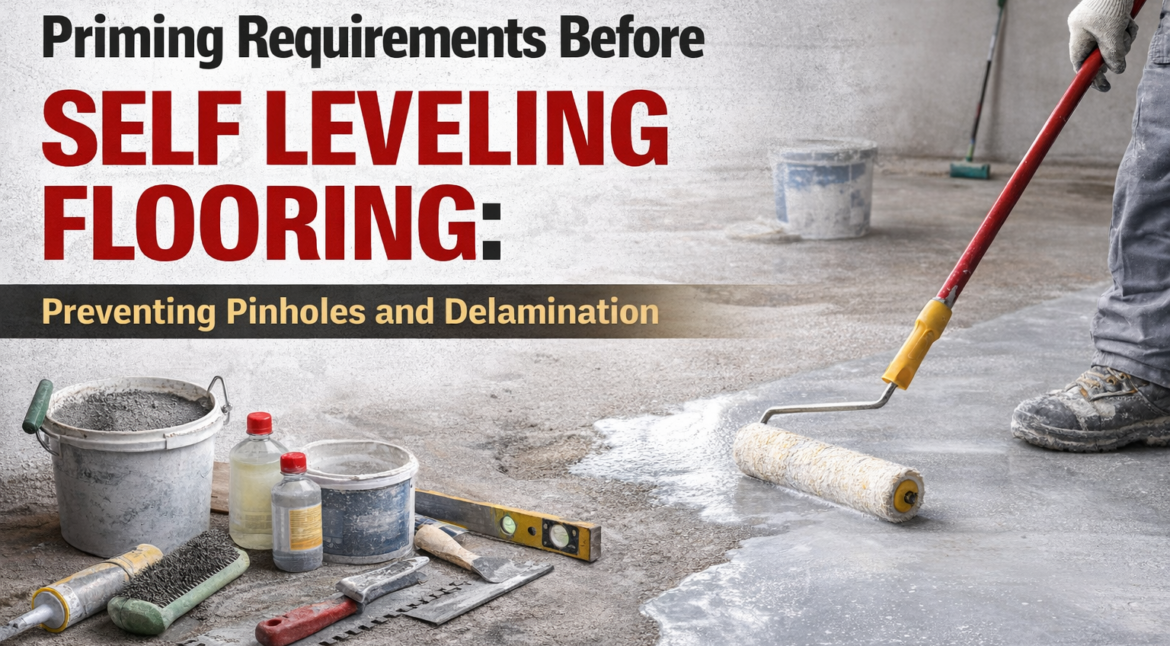
Priming Requirements Before Self Leveling Flooring: Preventing Pinholes and Delamination
Self leveling systems are designed to create smooth, flat, and durable floor surfaces. However, many flooring failures are not caused by the topping layer itself; they originate at the substrate interface. Pinholes, bubbling, surface craters, and even full delamination are often the result of improper priming.
Before installing self leveling flooring, the substrate must be properly prepared and primed. Skipping or misapplying primer can compromise bond strength and lead to premature flooring failure, especially in industrial and commercial environments.
Whether the final finish is epoxy, cementitious, or polyurethane, priming is not optional. It is a structural step in the flooring system.
Common Question Asked:
Q.1 Is primer necessary before applying self leveling flooring?
Yes, primer is essential before self leveling flooring to improve adhesion, prevent air entrapment, and reduce the risk of pinholes and delamination.
Why Priming Matters in Self Leveling Flooring
Self leveling flooring is flowable by design. When poured over unprimed concrete:
- Air escapes from pores and creates pinholes
- Rapid absorption reduces bond strength
- Moisture imbalance causes surface defects
- Delamination may occur under load
Concrete substrates are porous. Without primer, the self leveling layer cannot achieve uniform adhesion.
Primer acts as:
- A bonding bridge
- A pore sealer
- A moisture regulator
- A surface stabilizer
Common Failures When Primer Is Ignored
1. Pinholes and Surface Bubbles
Unsealed concrete releases trapped air during placement. This air rises through the leveling compound, forming pinholes.
2. Delamination
Without primer, the topping layer does not chemically or mechanically anchor to the substrate. Traffic stress can cause separation.
3. Uneven Curing
Highly absorbent substrates pull moisture from the leveling compound, leading to inconsistent curing and cracking.
Priming Before Epoxy Flooring Systems
In many industrial applications, self leveling compounds are used beneath or as part of epoxy flooring systems.
Epoxy flooring requires strong substrate bonding. A primer like Redwop’s Primer 25 is commonly used to prepare concrete surfaces before epoxy application.
Epoxy systems such as:
Redwop’s EPFLOOR MM2 & EPFLOOR NF40(SL) perform best when applied over properly primed and sealed substrates.
Without primer, epoxy layers may show blistering or bond failure.
Priming Requirements for Cementitious Flooring
In projects using cementitious flooring, priming controls substrate absorption and improves interface bonding.
Redwop’s cementitious flooring systems are available here:
Products such as:
MATTCEM CL30 P & MATTCEM SL are designed for controlled leveling and smooth finishing. However, substrate preparation remains critical.
Cementitious leveling systems are particularly sensitive to:
- Rapid moisture loss
- Porous substrates
- Weak surface laitance
Proper primer application minimizes shrinkage stress and ensures uniform curing.
Priming for PU and Polyurethane Flooring Systems
In high-impact industrial zones, PU flooring systems are widely used.
A product example is:
PUFLOOR 400 is a self-levelling, four-component polyurethane resin-based smoothing and leveling compound.
Polyurethane systems require stable substrate bonding because they are often used in:
- Food processing units
- Cold storage areas
- Heavy traffic warehouses
Without primer:
- Moisture vapor pressure may cause blistering
- Adhesion strength reduces
- Surface defects increase
PU systems are particularly sensitive to moisture imbalance, making priming even more critical.
How to Properly Apply Primer Before Self Leveling Flooring
Correct primer application includes:
- Surface cleaning and dust removal
- Mechanical grinding to create a surface profile
- Ensuring moisture levels are within limits
- Applying primer uniformly with roller or brush
- Allowing proper drying time before topping application
Skipping drying time or applying excessive primer can also create problems.
Moisture Control and Primer Compatibility
Before installing self leveling flooring, always test:
- Substrate moisture content
- Relative humidity
- Vapor emission rate
Primer selection must match the flooring system:
- Epoxy primers for epoxy flooring
- Cement-compatible primers for cementitious flooring
- PU-compatible primers for polyurethane flooring
Compatibility ensures interlayer bonding performance.
Signs of Poor Priming Before Self Leveling Flooring
Warning indicators include:
- Uneven gloss patches on the substrate
- Powdery concrete surface
- Visible dust after cleaning
- Primer soaks instantly into the surface
- The sticky primer is not drying properly
Addressing these signs before the topping application prevents failure.
Integrated Flooring System Approach
Self leveling flooring should not be viewed as a standalone layer. It is part of a complete flooring system that may include:
- Primer
- Leveling compound
- Base coat
- Intermediate coat
- Top coat
Ignoring the primer compromises the entire system.
Whether using epoxy flooring, cementitious flooring, or polyurethane flooring, substrate priming remains the foundation of performance.
Practical Checklist Before Installing Self Leveling Flooring
Before starting work:
- Is the concrete surface mechanically prepared?
- Is all dust removed?
- Is substrate moisture tested?
- Is primer compatible with the final flooring system?
- Has the primer fully cured before pouring the leveling compound?
System discipline prevents long-term failure.
Conclusion
Failures in self leveling flooring, such as pinholes, bubbling, and delamination, are often traced back to improper priming. Primer acts as a bonding bridge, moisture regulator, and pore sealer, stabilizing the substrate before the leveling layer is applied.
Whether the final finish is epoxy flooring, cementitious flooring, or polyurethane flooring, priming is a non-negotiable step in achieving long-term durability.
A well-primed substrate ensures strong adhesion, uniform curing, and reliable floor performance under traffic and environmental stress.
Proper preparation does not just improve the finish; it protects the entire flooring investment. Contact Us for more information.
FAQs
-
1. Why does self leveling flooring develop pinholes?
Pinholes usually occur due to trapped air escaping from unprimed concrete substrates.
-
2. Is primer required before epoxy flooring?
Yes, primer improves bond strength and prevents delamination in epoxy flooring systems.
-
3. Can self leveling flooring be applied without primer?
Applying without primer increases the risk of poor adhesion and surface defects.
-
4. Does polyurethane flooring require special primer?
Yes, polyurethane flooring systems require compatible primers to control moisture and ensure bonding.
-
5. How long should primer dry before leveling compound?
Drying time depends on product type and temperature but must be fully respected before pouring.