


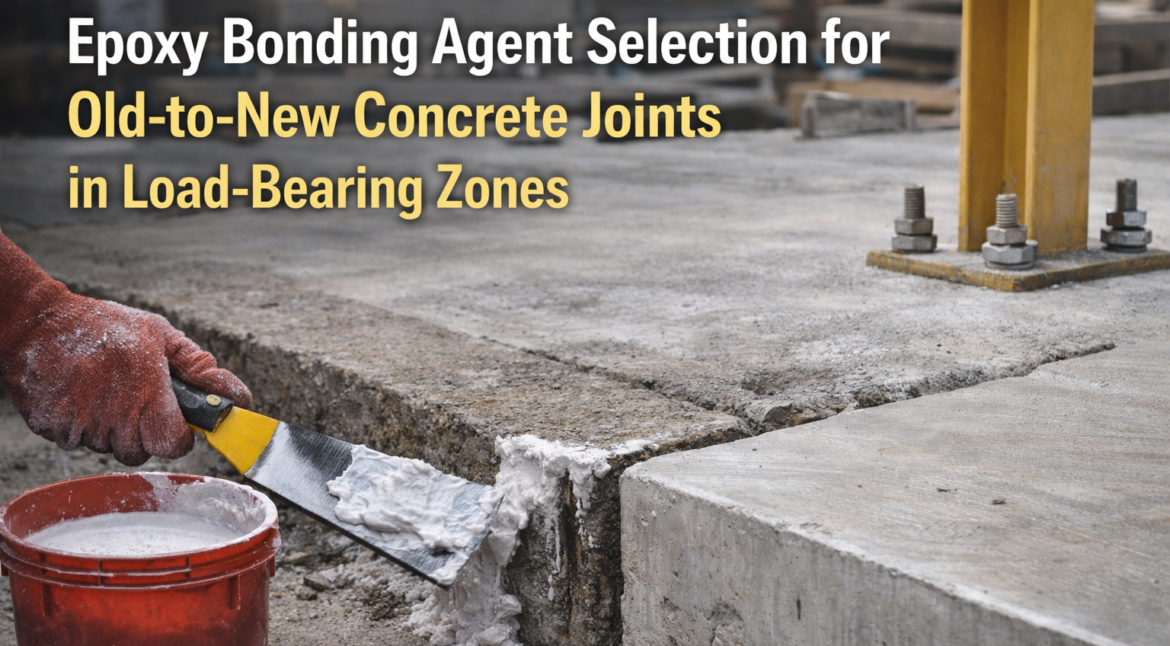
Epoxy Bonding Agent Selection for Old-to-New Concrete Joints in Load-Bearing Zones
Concrete repairs are rarely just about filling a damaged area. In structural zones, the real challenge is ensuring that the new repair concrete behaves as one with the old substrate. If the bond between old and new concrete fails, the repair patch may crack, separate, or debond under load, sometimes within months.
This is why selecting the right epoxy bonding agent becomes critical in load-bearing applications. Old-to-new concrete joints are among the weakest points in any repair system, especially when subjected to structural stress, vibration, or dynamic loading.
Unlike cement slurry bonding, epoxy systems are designed to create a strong adhesive interface that transfers load across the joint. But selection is not automatic; the wrong epoxy type, poor surface preparation, or incorrect application can still lead to bond-line weakness.
This guide explains how to choose the right epoxy bonding agent for concrete joints in structural repair zones.
Common Question Asked:
Q.1 Can an epoxy bonding agent improve the strength in old-to-new concrete joints?
Yes, an epoxy bonding agent can significantly improve bond strength and load transfer when repairs involve old and new concrete interfaces in structural zones.
Why Bonding Fails in Old-to-New Concrete Joints
Old concrete and new repair mortar do not naturally bond well without assistance. Several site realities create weak interfaces:
- Smooth laitance layers on existing concrete
- Dust, oil, or curing compounds on the surface
- Shrinkage of repair mortar away from the substrate
- Microcracking under early loading
In load-bearing repairs, even a small debonded area can become a failure point.
This is why engineers often specify a bonding agent for old and new concrete rather than relying on slurry bonding alone.
What Makes an Epoxy Bonding Agent Different
An epoxy bonding agent is not just a surface adhesive. It is a high-strength resin system designed to form a durable bond between two hardened materials.
Chemical Bonding vs Mechanical Bonding
Cement slurry provides mostly mechanical grip. Epoxy systems provide:
- Adhesion at the molecular level
- High tensile and shear bond strength
- Better performance under dynamic loads
Load Transfer Across the Joint
In structural repairs, the bond line must transfer stress across the interface. Epoxy bonding agents are preferred because they maintain bond integrity even under:
- Heavy compressive loads
- Vibration from machinery
- Repeated thermal expansion cycles
This is why epoxy is often the first choice for load-bearing old-to-new joints.
Key Selection Factors in Load-Bearing Zones
Choosing the right epoxy bonding agent depends on the repair environment and structural demand.
Substrate Condition and Moisture Sensitivity
Most epoxy systems require dry or surface-dry substrates. If moisture is present, bond strength may reduce.
Before selection, evaluate:
- Dampness in concrete
- Presence of seepage
- Surface absorption rate
Joint Type: Horizontal vs Vertical Repairs
Bonding agents behave differently depending on orientation:
- Horizontal joints (slabs, toppings) require open time and spreadability
- Vertical joints (columns, beams) require non-sag properties
Structural Load and Vibration Exposure
Load-bearing zones include:
- Beam-column joints
- Bridge deck repairs
- Machine base strengthening
- Precast joint repairs
In these areas, epoxy bonding must withstand long-term stress, not just initial adhesion.
Surface Preparation Requirements
Even the best epoxy bonding agent will fail if surface preparation is weak.
Proper prep includes:
- Removing loose concrete and laitance
- Roughening the substrate mechanically
- Cleaning dust with air blowers or a vacuum
- Removing oil or grease contamination
A clean, sound surface ensures epoxy penetrates micro pores and achieves maximum bond.
Application Mistakes That Reduce Bond Strength
Epoxy bonding agents are performance products, but they are sensitive to handling.
Common site errors include:
Incorrect Mixing Ratio
Two-component epoxies must be mixed exactly. Improper proportioning leads to:
- Soft curing
- Weak bond strength
- Incomplete polymerization
Delayed Placement After Mixing
Epoxy has a limited pot life. If applied after thickening begins, bond performance drops.
Applying Over Wet or Dusty Surfaces
Moisture or dust acts as a barrier layer. Even high-quality epoxy cannot bond through contamination.
Recommended Redwop Epoxy Bonding Agent for Structural Repairs
For old-to-new concrete joints in demanding load-bearing repairs, Redwop offers specialized epoxy bonding solutions.
A commonly specified product is EPBOND EP, designed to provide strong adhesion and structural bonding performance in concrete repair zones.
This type of epoxy bonding agent is used where high bond strength and durability are required across repair interfaces.
Where Epoxy Bonding Agents Are Commonly Used
Epoxy bonding agents are widely applied in:
- Structural patch repairs in beams and slabs
- Concrete jacketing and strengthening works
- Bridge deck overlay bonding
- Precast element joint repairs
- Anchor bolt and base plate bonding zones
In many of these applications, epoxy bonding is not optional; it is part of the structural design requirement.
Epoxy Bonding Agent for Wood and Mixed Substrates
In some construction and industrial repair cases, bonding may involve mixed materials such as wood and concrete.
An epoxy bonding agent for wood is often used in:
- Timber-to-concrete connections
- Industrial flooring edge repairs
- Hybrid structural retrofit systems
Epoxy resins provide strong adhesion across multiple substrates when selected correctly.
Practical Checklist for Selecting the Right Epoxy Bonding Agent
Before choosing a bonding system, confirm:
- Is the repair load-bearing or cosmetic?
- Is the substrate dry and properly roughened?
- Will vibration or movement occur?
- Is the joint horizontal, vertical, or overhead?
- Does the epoxy provide sufficient working time?
Correct selection ensures that the bond line becomes a structural interface, not a weak plane.
Conclusion
Old-to-new concrete joints are the most vulnerable zones in structural repair work. Without proper bonding, repairs may debond, crack, or fail prematurely under load.
A high-performance epoxy bonding agent provides the strength, adhesion, and durability required in load-bearing applications where cement slurry bonding is not enough.
When combined with correct surface preparation and disciplined application, epoxy systems like EPBOND EP help ensure that repaired concrete behaves as one continuous structural element, delivering long-term reliability and performance. For more information, Contact Us.
FAQs
-
1. What is the best bonding agent for old and new concrete?
Epoxy bonding agents are typically the best option for structural repairs requiring high bond strength.
-
2. Can an epoxy bonding agent be used for load-bearing repairs?
Yes. Epoxy bonding agents are designed for load transfer in structural zones.
-
3. Does epoxy bonding agent work on wood and concrete?
Yes, epoxy bonding agents can bond mixed substrates such as wood-to-concrete interfaces when applied correctly.
-
4. How long does epoxy bonding take to cure?
Curing depends on product type and temperature, but most systems gain strength within 24 hours.
-
5. What causes debonding even with epoxy bonding agents?
Poor surface preparation, moisture contamination, incorrect mixing, or delayed placement are the most common causes.