


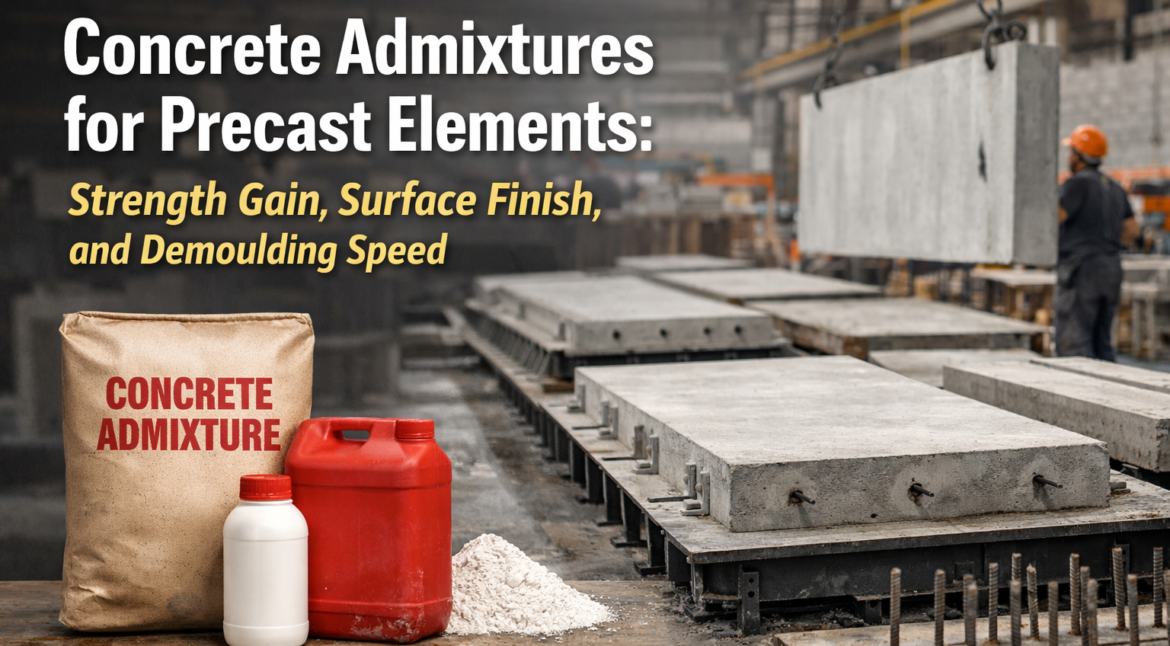
Concrete Admixtures for Precast Elements: Strength Gain, Surface Finish, and Demoulding Speed
Precast concrete manufacturing is all about consistency, speed, and quality. Unlike site concrete, precast elements are produced in controlled environments where early strength, surface finish, and faster demoulding directly affect productivity and cost.
A small delay in strength gain can slow down mould rotation. Poor workability can lead to honeycombing. Excess water can damage durability. That’s why precast plants rely heavily on well-selected concrete admixtures to optimize performance without compromising structural integrity.
From achieving smooth finishes to reducing curing time, concrete admixtures play a central role in modern precast production.
Common Question Asked:
Q.1 Can concrete admixtures really improve demoulding speed and surface finish in precast production?
Yes, the right concrete admixtures can accelerate strength gain, improve workability, reduce defects, and allow faster demoulding cycles in precast elements.
Why Precast Concrete Needs Specialized Admixture Design
Precast elements demand tighter control than conventional site concrete because:
- Mould turnaround time impacts output
- Surface finish affects aesthetics and rejection rates
- Early strength determines the demoulding schedule
- Low permeability is critical for long-term durability
In precast production, admixtures are not optional add-ons; they are process tools that control concrete behavior from mixing to curing.
Redwop offers a complete range of concrete admixtures designed to enhance strength, durability, workability, and curing efficiency for precast applications.
Strength Gain and Faster Demoulding in Precast Elements
One of the biggest drivers in precast plants is early strength development. Faster strength gain means:
- Earlier mould stripping
- Higher daily production cycles
- Reduced storage time
- Better dimensional stability
Role of Water Reducer Admixtures
Early strength is strongly linked to water–cement ratio. Excess water delays strength gain and increases porosity.
This is why Water Reducer admixtures are widely used in precast concrete. They lower water demand while maintaining flow and compaction quality.
Redwop’s Water Reducer admixtures are formulated to improve strength and density in precast mixes.
A product example commonly used in strength-focused mixes is REDBRAWN 400, which helps reduce water content while supporting better early performance.
For precast applications requiring controlled workability retention, solutions like BLOCKFAST AC 300 are also used to improve placing and finishing without increasing water.
Surface Finish Quality: Preventing Honeycombing and Voids
Precast elements often have exposed faces where finish quality matters. Surface defects such as:
- Bug holes
- Honeycombing
- Segregation
- Poor edge definition
lead to rework or rejection.
Role of Air Entrained Admixture in Finish and Durability
In many precast mixes, an air entrained admixture is used to introduce controlled micro air bubbles. These improve:
- Workability
- Cohesion
- Freeze–thaw resistance
- Surface stability
Redwop provides a dedicated air entrained admixture system for concrete applications.
A key product example is Plastcone Airent, designed to stabilize microscopic air bubbles and improve concrete performance in demanding precast environments.
This is particularly useful in architectural precast panels exposed to temperature cycling.
Integral Waterproofing in Precast: Long-Term Durability Advantage
Precast elements are often used in:
- Water tanks
- Boundary walls
- Basement panels
- Marine structures
- Drainage systems
In these applications, permeability becomes a major durability risk. Even minor capillary pores allow moisture ingress over time.
This is where Redwop’s integral waterproofing compound systems provide long-term protection from within the concrete.
Integral waterproofing solutions reduce permeability and improve durability without surface membranes.
A powder-based solution like Plastcone AP90 is often selected for dense precast mixes requiring internal waterproofing.
For liquid dosing systems in batching plants, Plastcone AW+ Liquid offers consistent waterproofing performance.
Integral waterproofing is especially valuable in precast elements exposed to continuous moisture.
Workability Control Without Excess Water
Precast mixes require flow and compaction efficiency, especially in:
- Thin sections
- Congested reinforcement
- High-density moulds
Water reducers and admixtures allow high workability while keeping the mix dense.
Redwop offers additional water-reduction systems, such as:
- Procrete NPL S15 for optimized placing behavior.
- Redbrawn 400, used where strength gain and reduced permeability are required in industrial mixes
These admixtures help precast producers maintain quality without compromising performance.
Key Benefits of Using Concrete Admixtures in Precast Production
When correctly selected, concrete admixtures provide:
- Faster demoulding cycles
- Improved early and ultimate strength
- Better surface finish and reduced defects
- Lower permeability and enhanced durability
- Reduced cement and water demand
- Consistent batch-to-batch performance
Precast success depends on repeatability, and admixtures are central to that repeatability.
Practical Selection Guide for Precast Plants
Precast Requirement | Recommended Admixture Type |
Faster strength gain | Water reducing admixtures |
Smooth surface finish | Air entrained admixture |
Low-permeability panels | Integral waterproofing compound |
Dense structural precast | Water reducers + waterproofing |
Freeze–thaw durability | Air entrainment systems |
Conclusion
Modern precast production relies heavily on performance-driven concrete admixtures. From accelerating early strength for faster demoulding to improving surface finish and long-term durability, admixtures are essential tools in precast concrete manufacturing.
Systems such as water reducing admixtures, air entrained admixture solutions, and integral waterproofing compound additives allow precast plants to produce stronger, denser, and more reliable elements with fewer defects and faster production cycles.
When admixtures are selected based on precast requirements, not generic site concrete practices, precast quality and efficiency improve dramatically. For more information, Contact Us.
FAQs
-
1. Why are concrete admixtures important in precast production?
They improve early strength, workability, surface finish, and mould turnaround efficiency.
-
2. Which admixture helps in faster demoulding?
Water reducing admixtures support early strength gain by lowering water–cement ratio.
-
3. What is the role of air entrained admixture in precast concrete?
It improves workability, cohesion, and freeze–thaw durability while reducing surface defects.
-
4. Can integral waterproofing compounds be used in precast panels?
Yes. They reduce permeability and enhance durability in moisture-exposed precast elements.
-
5. How do water reducers improve precast concrete strength?
They reduce water demand, resulting in denser concrete with higher strength and lower porosity.