


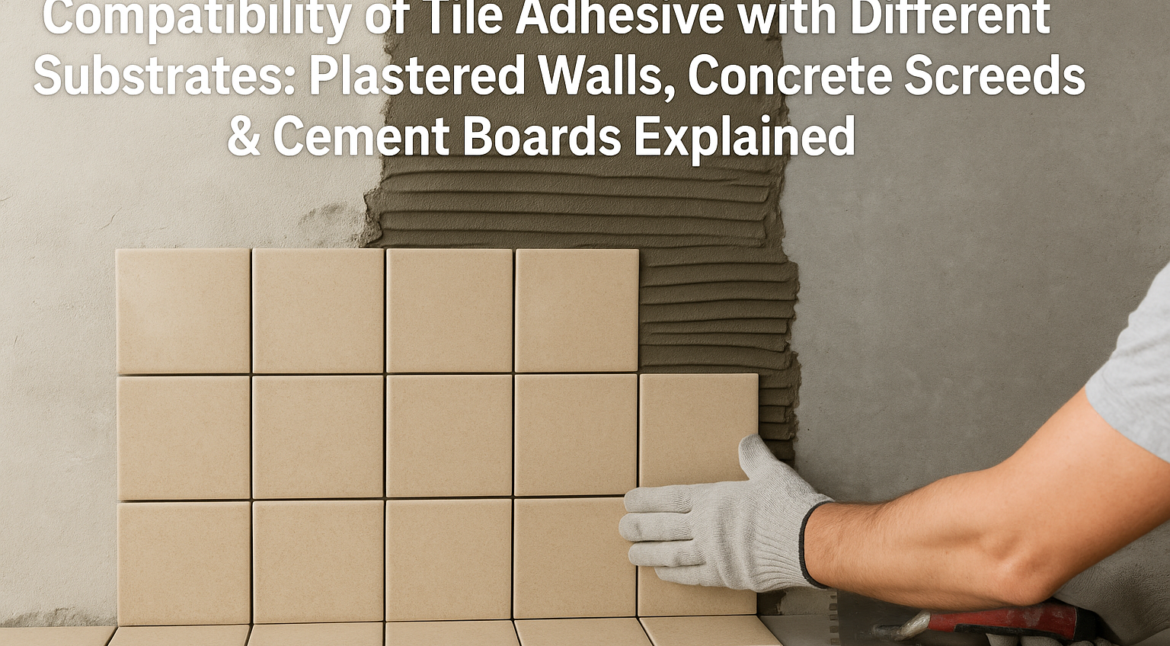
Compatibility of Tile Adhesive with Different Substrates: Plastered Walls, Concrete Screeds & Cement Boards Explained
Tile installation is only as strong as the surface it’s bonded to. While tiles often receive most of the visual attention, the real performance depends on the tile adhesive and how well it interacts with the underlying substrate. Plastered walls, concrete screeds, and cement boards each behave differently, absorb moisture differently, and require different bonding responses from an adhesive. Understanding tile adhesive compatibility is essential for preventing tile debonding, cracks, hollow sounds, and long-term installation failures.
Common Question Asked:
Q.1 Is the same tile adhesive suitable for all types of substrates?
No, the same tile adhesive is not suitable for all substrates. Each surface—whether plaster, concrete screed, or cement board—has different absorption levels, movement characteristics, and bonding requirements. Selecting the right tile adhesive ensures proper adhesion, durability, and long-term performance.
Why Substrate Compatibility Matters in Tile Installation
Tile adhesive must adapt to the texture, porosity, and stability of the substrate. When adhesive and substrate are mismatched, issues such as weak bonding, debonding due to moisture, and cracks from movement become inevitable.
Here’s why substrate behaviour impacts adhesive selection:
- Some surfaces absorb water quickly (e.g., plastered walls)
- Some are dense and rigid (e.g., concrete screeds)
- Some expand and contract more frequently (e.g., cement boards)
- Some require stronger polymer modification or epoxy chemistry
Choosing the right adhesive ensures tiles remain firmly bonded and resist environmental stress, foot traffic, moisture exposure, and structural movement.
Tile Adhesive Performance on Plastered Walls
Plastered walls are lighter, smoother, and more porous compared to floors or cement boards. They require adhesives that can bond quickly yet remain flexible enough to handle surface irregularities.
Key Characteristics of Plastered Walls
- High absorption rate
- Smooth surface with low mechanical grip
- Minor surface undulation
- Sensitive to moisture during installation
Which Adhesive Works Best for Plastered Walls?
1. Standard Polymer-Modified Wall Tile Adhesive
A light to medium polymer-modified wall tile adhesive is generally used on plastered surfaces because it sticks well to smoother substrates and prevents sagging during installation.
Products such as TERATILE GP are commonly used in day-to-day wall tiling because they provide balanced adhesion for ceramic tiles in dry interior areas.
2. For Heavier Tiles or Larger Formats
When installing large-format tiles or vitrified tiles on walls, a stronger adhesive becomes necessary. Installers often choose formulations like TERATILE PLATINUM, as it offers better slip resistance and higher polymer content for vertical applications.
3. For Wet Area Walls
Bathrooms, kitchens, and washing zones require moisture-resistant adhesion. Here, installers may shift to stronger polymer tile adhesives such as TERATILE PROLIX.
Tile Adhesive Performance on Concrete Screeds
Concrete screeds are the most commonly tiled surfaces. They are dense, strong, and stable—but can vary drastically depending on curing, moisture content, and leveling.
Characteristics of Concrete Screeds
- Low porosity (dense structure)
- Strong mechanical grip
- Stable base for heavy tiles
- Requires proper curing before tiling
Adhesive Selection for Concrete Screeds
1. Standard Floor Tile Adhesive for Ceramic & Vitrified Tiles
For regular flooring in homes or offices, a high-quality floor tile adhesive performs well. Adhesives with moderate polymer content bond effectively with concrete while handling minor surface movement.
Formulations like TERATILE SILVER are used widely for everyday floors
2. For High Load, Heavy Traffic, or Industrial Floors
Industrial floors, hypermarkets, and logistics areas need stronger bonding to withstand rolling loads and impact. Installers commonly use adhesives like TERATILE PROLIX EXTRA, which offer superior bond strength and flexibility
3. For Stone, Granite, or Heavy Material Flooring
Natural stones require a stronger grip due to their weight. For this purpose, contractors often use adhesives like TERATILE DIAMOND, designed specifically for stone’s density and load-bearing requirements.
Tile Adhesive Performance on Cement Boards
Cement boards (also known as fibre cement boards) are commonly used in moisture-prone install zones such as bathrooms, balconies, kitchens, exterior cladding, and renovation projects.
Characteristics of Cement Boards
- Flexible and slightly absorbent
- Expand and contract with temperature
- Light but structurally stable
- Ideal for overlay installations
Adhesive Compatibility with Cement Boards
1. High-Polymer Tile Adhesive
Cement boards need adhesives that move with the substrate without cracking. A flexible polymer tile adhesive is essential for maintaining long-lasting adhesion.
Products like TERATILE PLATINUM or TERATILE PROLIX are frequently used because they bond well even when the board flexes.
2. For Exterior or Sun-Exposed Cement Boards
Outdoor cladding, balconies, and façades require an adhesive that can withstand UV and moisture exposure. Installers often rely on exterior-grade formulations such as TERATILE SINEX, which offers strong bonding under outdoor conditions.
3. When High Chemical Resistance or Moisture Resistance Is Needed
Epoxy tile adhesives may be used in commercial kitchens, laboratories, or industrial areas where chemical exposure is expected. While not required everywhere, epoxy adhesives exceed polymer adhesives in performance for speciality environments.
How to Ensure Proper Adhesion Across All Substrates
Regardless of the surface, a few installation practices dramatically improve bonding performance:
1. Proper Substrate Preparation
- Remove dust, loose particles, and laitance
- Ensure the surface is level
- Fix cracks before installation
2. Correct Trowel Size
Larger tiles need deeper notches to ensure adequate adhesive bed thickness.
3. Back-Buttering for Large Format Tiles
This minimizes voids and increases the contact area.
4. Respect Curing Times
Tile adhesive must set and gain strength before grouting or allowing traffic.
5. Use Primer Where Required
Highly absorbent or very smooth substrates may need priming for improved adhesion.
Conclusion
Tiles may be the visible part of the installation, but the adhesive and substrate decide whether the surface lasts months or decades. Understanding how tile adhesive interacts with different substrates—plastered walls, concrete screeds, and cement boards—helps installers choose the right formulation for long-term performance. Polymer tile adhesives, epoxy adhesives, and specialized wall or floor tile adhesives all play distinct roles based on substrate type and installation conditions.
When substrate compatibility is matched correctly with the adhesive, tile installations remain durable, safe, and visually consistent for years. For more information, Contact Us.
FAQs
-
1. Can the same tile adhesive be used on both walls and floors?
Not always. Walls require anti-sag properties, while floors need higher compressive strength.
-
2. Do cement boards need special tile adhesive?
Yes. Cement boards expand and contract, so flexible, polymer-modified adhesives work best.
-
3. Is epoxy tile adhesive necessary for all installations?
No. Epoxy adhesives are used only in environments needing high chemical or moisture resistance.
-
4. Can tiles be fixed directly on newly plastered walls?
It’s better to wait until the plaster cures to avoid moisture-related bonding issues.
-
5. Which substrate offers the best adhesion?
Concrete screeds provide the strongest base, but proper preparation improves adhesion on all substrates.