


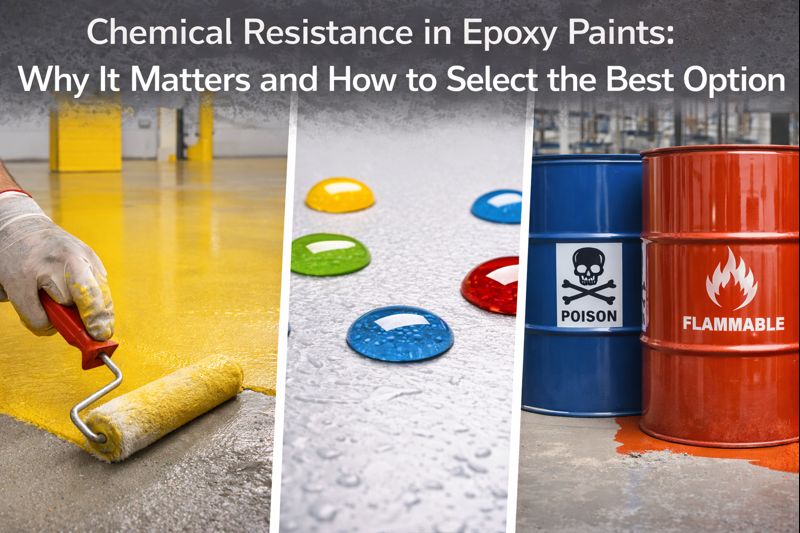
Chemical Resistance in Epoxy Paints: Why It Matters and How to Select the Best Option
In factories, commercial kitchens, basements, swimming pools, and water tanks, paint failure is rarely about appearance. It is about chemical exposure. Oils, acids, detergents, salts, and cleaning agents slowly attack ordinary coatings, leading to peeling, staining, corrosion, and surface breakdown.
This is why epoxy paints are widely used in demanding environments. Their purpose is not just to coat a surface, but to protect it from chemical attack. However, not every epoxy system performs the same way. Choosing the wrong product for the wrong exposure condition still results in early failure.
Understanding why chemical resistance matters and how to select the right epoxy paint system is essential for long-term surface protection.
Common Question Asked:
Q.1 Can epoxy paints truly protect surfaces from chemical damage?
Yes, properly selected and applied epoxy paints form a dense, cross-linked film that resists acids, alkalis, oils, salts, and cleaning chemicals far better than conventional paint systems.
Why Chemical Resistance Matters in Real-World Environments
Chemical exposure is not limited to heavy industry. It exists in:
- Commercial kitchens are exposed to grease and detergents
- Parking garages exposed to fuel and oil
- Manufacturing plants exposed to solvents and process chemicals
- Swimming pools exposed to chlorine and treatment agents
- Hospitals exposed to disinfectants
- Water tanks and treatment facilities
In these environments, ordinary paints soften, blister, or peel. Once the protective layer fails, concrete or metal underneath begins to deteriorate. Repair costs quickly exceed the cost of choosing the right coating system at the start.
What Makes Epoxy Paints Chemically Resistant
Epoxy paints cure through a chemical reaction that forms a hard, tightly bonded molecular structure. This structure:
- Has very low porosity
- Resists liquid penetration
- Bonds strongly to concrete and metal
- Maintains integrity under chemical exposure
Redwop’s epoxy paint systems are formulated specifically for industrial and commercial protection where long-term chemical resistance is required.
Where Standard Paints Fail Under Chemical Exposure
Softening and Film Breakdown
Ordinary paints soften when exposed to oils, detergents, or solvents. Over time, the coating loses adhesion and peels.
Staining and Discoloration
Standard pigments react with cleaning chemicals or pool treatment agents, causing fading and yellowing.
Corrosion Under Coating
When chemicals pass through weak coatings, they reach the substrate and trigger rust or concrete erosion.
Frequent Repainting Cycles
Non-resistant paints require repeated recoating, increasing downtime and maintenance costs.
These failures are common when general industrial paints are used without considering chemical exposure.
Key Application Areas for Epoxy Paint Systems
Epoxy Floor Paint for Industrial and Commercial Spaces
Floors experience oil spills, forklift traffic, chemical splashes, and heavy cleaning routines. Epoxy floor paint creates a seamless, non-porous surface that resists oils, solvents, and abrasion.
High-build floor systems such as EPKOTE PE140 are commonly used where strong film thickness and durability are required in factories, warehouses, and parking structures.
Epoxy Wall Paint in Hygiene-Critical Areas
Walls in hospitals, laboratories, kitchens, and wash areas are cleaned frequently with strong disinfectants. Epoxy wall paint provides smooth, washable, and chemical-resistant surfaces.
Medium-build coating systems such as Redopoxy 240 and Redopoxy 250 are suitable for wall and structural applications requiring reliable chemical protection.
Epoxy Paint for Continuous Immersion and Water Exposure
Swimming pools, water tanks, and treatment plants expose coatings to constant water contact and chlorine-based chemicals. Epoxy paint and immersion-grade epoxy coatings are designed to remain stable under submerged conditions.
Systems such as EPKOTE PE408 are commonly selected for water-retaining and treatment structures where long-term immersion resistance is essential.
Protective Clear and Topcoat Systems
In many coating systems, a protective finishing layer is applied to enhance durability, gloss, and chemical resistance. Redopoxy Clearcoat is used to seal decorative or functional epoxy floors, while Redopoxy Topcoat provides additional protection against abrasion and chemical exposure.
These finishing layers extend service life and improve cleanability in demanding environments.
Anti-corrosive treatment for Industrial machineries
Epoxy paint is widely used in industries and on steel structures due to its excellent adhesion, high mechanical strength, and superior resistance to corrosion, chemicals, and moisture. It forms a hard, durable coating that protects steel surfaces from rust, abrasion, and harsh environmental conditions. Because of its long service life and strong protective properties, epoxy paint is commonly applied on industrial machinery, pipelines, storage tanks, and structural steel in plants, warehouses, and infrastructure projects.
High-build paint systems such as Redopoxy 240HB and Redopoxy 630HB are commonly used where strong film thickness and durability are required in factories, warehouses, and parking structures.
How to Select the Right Epoxy Paint for Chemical Resistance
Selecting the right epoxy system depends on real exposure conditions, not just appearance.
Identify the Chemical Environment
- Mild detergents → standard epoxy systems
- Oils and fuels → high-build epoxy coatings
- Acids or alkalis → chemical-resistant epoxy formulations
- Continuous immersion → immersion-grade epoxy coatings
Consider Surface Type
- Concrete floors → self-leveling or high-build epoxy floor systems
- Metal structures → corrosion-protective epoxy coatings
- Walls and masonry → medium-build epoxy wall systems
Assess Mechanical Load
- Light traffic → standard epoxy
- Heavy machinery and forklifts → high-build reinforced epoxy
Matching the epoxy system to both chemical and mechanical demands is critical for long-term performance.
Best Practices for Long-Term Chemical Resistance
- Selecting epoxy based only on gloss or color
- Ignoring surface preparation requirements
- Using wall-grade epoxy on heavy-duty floors
- Applying non-immersion epoxy in pools or tanks
- Allowing early exposure before full curing
Even the best epoxy paint fails if the system selection and application process are incorrect.
Best Practices for Long-Term Chemical Resistance
- Identify actual chemicals present on site
- Choose epoxy systems rated for those chemicals
- Ensure proper surface preparation
- Maintain correct mixing ratios
- Apply recommended film thickness
- Allow full curing before exposure
Chemical resistance comes from the complete system, not from the paint alone.
Conclusion
Chemical exposure is one of the fastest ways to destroy ordinary paint systems. Oils, cleaning agents, chlorine, solvents, and industrial chemicals quickly break down conventional coatings, leading to corrosion and surface damage.
Epoxy paints solve this problem by forming a dense, chemically resistant barrier that protects concrete and metal in aggressive environments. Whether used as epoxy floor paint, epoxy wall paint, or epoxy pool paint, selecting the right epoxy system for the specific exposure conditions ensures long-lasting protection and reduced maintenance costs.
When chosen correctly and applied properly, epoxy paint systems deliver reliable performance even in the harshest chemical environments. For more information, Contact Us.
FAQs
-
1. Are epoxy paints resistant to acids and cleaning chemicals?
Yes. Properly formulated epoxy paints resist many acids, alkalis, oils, and detergents.
-
2. Can epoxy wall paint be used in hospitals and kitchens?
Yes. Epoxy wall coatings are widely used in hygiene-critical environments due to their washable and chemical-resistant surfaces.
-
3. Is epoxy floor paint suitable for factories and garages?
Yes. High-build epoxy floor systems handle oil spills, abrasion, and heavy traffic effectively.
-
4. Can epoxy paint be used inside swimming pools?
Yes. Immersion-grade epoxy systems are designed for continuous water and chlorine exposure.
-
5. Why does ordinary paint fail under chemical exposure?
Standard paints soften and become porous under chemical attack, leading to peeling and corrosion beneath the coating.