


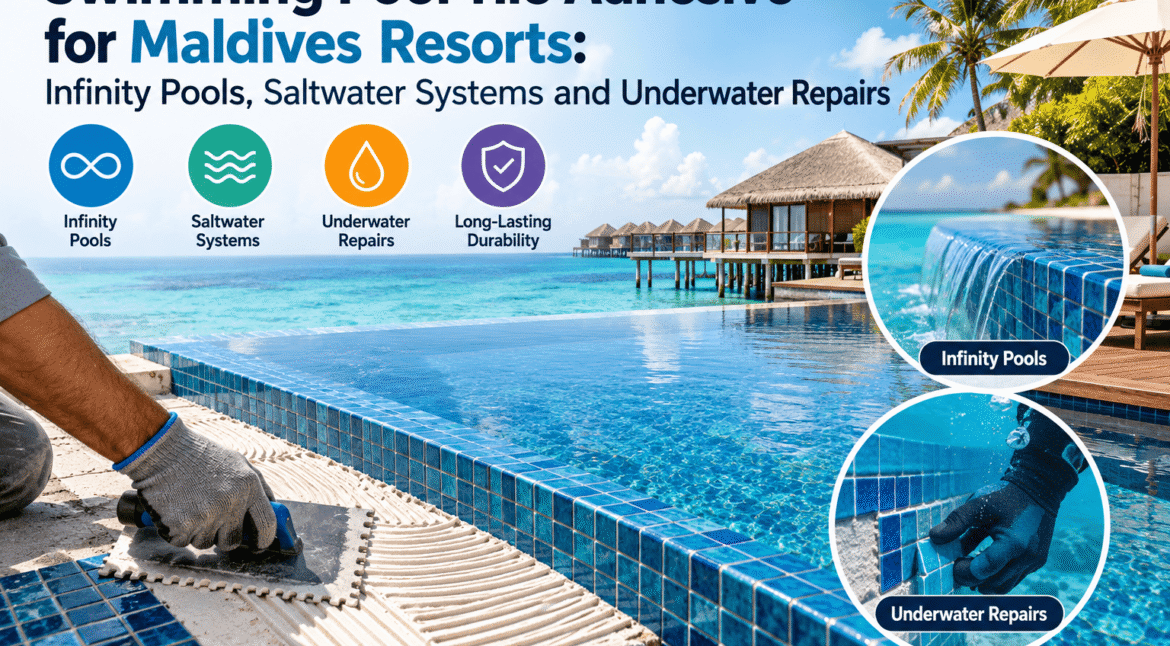
Swimming Pool Tile Adhesive for Maldives Resorts: Infinity Pools, Saltwater Systems and Underwater Repairs
In a Maldives resort, the pool is often the first photo a guest takes, and the first thing they notice when something goes wrong. One lifted mosaic sheet on an infinity edge can close a pool for days, and every bag, tile, and fixer has to come in by sea.
Choosing the right swimming pool tile adhesive, and the system around it, is what keeps tiles on the shell through constant immersion, chlorine or salt, tropical heat and tight refurbishment windows. This guide covers the adhesive grade for each part of a resort pool, the Redwop products behind them, and how to handle underwater repairs.
Why Pool Tiling Is Tougher in the Maldives
Resort pools in the Maldives test every layer of the tiling system:
- Permanent immersion: adhesive and grout stay wet for years, under chlorine or salt
- Soft, aggressive water: many islands make their water by desalination, and water low in calcium can leach lime from cement-based grouts and adhesives if the pool chemistry isn’t balanced
- Heat and UV: decks, copings and infinity edges swing between hot sun and cool water every day
- Salt air: surrounding decks, walls and steelwork face constant salt spray
- Island logistics: materials arrive by sea and boat, so a wrong or missing product can stall a job for weeks
- Occupancy pressure: every day a pool is closed costs revenue and guest reviews
Getting the pool tile system wrong usually ends in:
- Hollow tiles and lifted mosaic sheets, often first at the waterline
- Grout that powders, stains, or washes out of the joints
- Leaks through the shell and into plant rooms
- Unplanned closures in peak season
What Makes a Swimming Pool Tile Adhesive Different
A pool tile adhesive has to keep its grip after long immersion, flex with the shell, and survive pool chemicals. Under EN 12004 and ISO 13007-1, an improved C2 adhesive must hold at least 1.0 N/mm² after water immersion, double the C1 minimum.
For pools, specify at least a C2TE S1 grade, a white version for glass mosaic, and a waterproofing membrane underneath. Standard C1 adhesives are not made for permanent immersion (wet-area tile adhesive guide).
Types of Swimming Pool Tile Adhesive
Polymer-Modified Cement Adhesive (C2TE S1)
Teratile Diamond and Teratile Platinum are Type III, C2TES1 adhesives that Redwop lists for glass mosaic, vitrified tiles, and all stones. Redwop Polymer Plus is also made for swimming pools and wet areas, for tiles up to 600 × 600 mm.
Highly Deformable Adhesive (C2TE S2)
Teratile Prolix and Teratile Prolix Extra are Type IV, C2TES2 adhesives for larger tiles and areas that move more, such as sun-baked copings, infinity edges and pool decks.
Epoxy Glue for Tiles
Epoxy glue for tiles is a two-component reaction-resin adhesive. Redwop Epoxy Pro is a 100% solids epoxy with zero shrinkage, high chemical and stain resistance, and a rating up to 120°C, and Redwop lists it for underwater applications. It suits saltwater pools, heated spas, and repairs.
Waterproof Tile Adhesive vs a Waterproofing Membrane
A waterproof tile adhesive keeps its bond in water, but it doesn’t make the shell watertight. Pools still need a membrane such as Redwop’s 2K Elastic Waterproofing, which Redwop lists for swimming pools.
Common Question Asked:-
Can I use normal tile adhesive in a swimming pool?
No. Standard C1 adhesives aren’t designed for permanent immersion in chlorinated or salt water. Use at least a C2TE S1 grade such as Teratile Diamond, or an epoxy such as Epoxy Pro.
Choosing Pool Tile Adhesive by Area of the Pool
Pool Shell Walls and Floors
Use Teratile Diamond or Platinum (C2TES1) over a cured 2K membrane, with every tile fully bedded. Back-butter mosaic sheets and larger tiles so no voids are left for water to fill.
Glass Mosaic and Waterline Tiles
Glass mosaic is translucent, so voids and grey adhesive show through. Use a white C2TES1 adhesive with full coverage, and consider face-mounted (paper-faced) sheets for submerged areas, because back-mesh glue reduces the true contact area.
Infinity Edges and Overflow Channels
Infinity edges are wet one moment and sun-baked the next, and they move more than the rest of the shell. Use Teratile Prolix (C2TES2) or Epoxy Pro here, with epoxy grout in the joints.
Pool Decks and Surrounds
Decks take full sun, bare feet, and salt spray. Fix slip-resistant tiles with Teratile Prolix (C2TES2), keep falls running away from the pool, and put movement joints at the coping line.
Spa Pools, Jacuzzis and Plunge Pools
Heated water and strong sanitisers favour epoxy. Plunge pools on overwater villa decks can also see more structural movement, so use Epoxy Pro or a deformable adhesive and ask the structural engineer about deflection.
Saltwater and Seawater Pools
Salt chlorinators run at a few thousand ppm of salt, and seawater pools at around 35,000 ppm. Use Epoxy Pro with epoxy grout in these pools, and protect the shell’s steel with a corrosion inhibiting admixture.
Underwater Tile Glue: Repairs Without Draining
Redwop lists Epoxy Pro for underwater applications, which makes it the product to discuss when a few tiles come loose in a pool that can’t close. Treat underwater tile glue as a spot-repair tool:
- Use it for a few loose tiles, not for widespread failure
- Clean the bed and the tile back, remove loose grout, and follow the TDS for underwater placement and cure
- If many tiles sound hollow, lower the water, find the cause, and rebuild that area properly
The Full Resort Pool System, Layer by Layer
- Watertight shell: add a crystalline admixture or integral waterproofing compound to the concrete, plus a corrosion inhibiting admixture for salt exposure.
- Water-test the shell before any finishes, so structural leaks are found early.
- Level and repair with polymer repair mortar.
- Membrane: apply Redwop 2K Elastic Waterproofing, reinforcing corners, fittings, and pipe entries with fiber mesh.
- Tiles: fix with Teratile Diamond or Platinum (C2TES1), Prolix (C2TES2) or Epoxy Pro, depending on the area.
- Grout: use Redwop Epoxy Tile Grout, which Redwop lists for swimming pools and describes as inherently waterproof (source). More on grout for pools.
- Movement joints: at the coping line, changes of plane, and structural joints, closed with a sealant suited to immersion.
- Cure before filling: follow each layer’s TDS. Immersion needs longer than the 48–72 hours quoted for dry areas, often two weeks or more, so fill slowly.
- Balance the water: keep pH, alkalinity, and calcium hardness in range (a Langelier index near zero) so the water doesn’t eat into grout and adhesive.
How to Apply Swimming Pool Tile Adhesive Correctly
- Mix powder adhesive at about 3–4 parts powder to 1 part water, and use it within 60 minutes.
- Work in the cooler part of the day. In tropical heat, spread small areas and adjust tiles within 15 minutes.
- Back-butter every tile and mosaic sheet. ANSI A108’s 95% contact for wet areas is the minimum, and pools should aim for full coverage.
- Keep joints clean and even; Redwop grouts suit joints of 1–10 mm.
- Wipe fresh adhesive off tile faces straight away, because cured residue is far harder to remove.
- Grout once the adhesive has set, and protect the pool from rain and direct sun while it cures.
Planning Supply for an Island Resort
- Order the whole system at once: membrane, adhesive, grout, sealant and primer, plus spares for repairs
- Store bags off the floor, in shade and sealed against humidity, and use the oldest stock first
- Plan for shipping to Malé and then by boat to the island, and build that lead time into the refurbishment window
- Ask for TDS, MSDS and batch certificates with every consignment
- Request a landed-cost quote to Malé for the full bill of materials
Redwop Products for Resort Pools
Redwop product | Role in a resort pool |
Teratile Diamond and Platinum (C2TES1) | Pool shell tiles, glass mosaic and waterline |
Teratile Prolix and Prolix Extra (C2TES2) | Infinity edges, copings, decks and larger tiles |
Pools and wet areas with tiles up to 600 × 600 mm | |
Saltwater pools, spas, chemical exposure and underwater repairs | |
Waterproof, chemical-resistant joints | |
Membrane under the pool tiles | |
Watertight shell concrete | |
Rebar protection in salt exposure | |
Shell repairs, levelling and reinforcement at fittings | |
Movement joints at copings and changes of plane | |
Removing stubborn deposits; test a small area first |
Why Redwop Offers the Best Pool Tiling Systems for Maldives Resorts
Redwop makes every layer of a pool build-up, from shell admixtures and 2K membranes to Teratile adhesives, Epoxy Pro and epoxy grout, so one supplier answers for compatibility. Its tile adhesives carry a BIS licence for IS 15477, and the company holds ISO 9001, ISO 14001, ISO 45001, and GEV-EMICODE EC1 PLUS certification.
For resorts and contractors, Redwop ships from India with TDS and MSDS for approvals, and quotes landed costs to Malé.
How to Choose: A Quick Reference
Pool area | Recommended Redwop system |
Shell walls and floor | Polycote 2K membrane + Teratile Diamond or Platinum + epoxy tile grout |
Glass mosaic and waterline | White C2TES1 adhesive + epoxy tile grout |
Infinity edge and overflow channel | Teratile Prolix or Epoxy Pro + epoxy tile grout |
Pool deck and coping | Teratile Prolix (C2TES2) + movement joints |
Spa, jacuzzi or heated plunge pool | Epoxy Pro + epoxy tile grout |
Saltwater or seawater pool | Epoxy Pro + epoxy tile grout + corrosion-inhibited shell |
A few loose tiles, pool in use | Epoxy Pro spot repair, following the TDS |
Final Thoughts
A resort pool only looks effortless when every layer under the water was chosen for it. Pick the swimming pool tile adhesive by area and water type, bed every tile fully, grout with epoxy, and give the system its full cure before filling.
For your next build or refurbishment in the Maldives, Redwop’s tile adhesive range and pool system products give you one supplier for the whole build-up, with technical help to match each layer to the job.
FAQS:-
-
1. What is the best swimming pool tile adhesive?
At least a C2TE S1 grade such as Teratile Diamond or Platinum, C2TE S2 (Teratile Prolix) for edges and decks, and Epoxy Pro for saltwater pools and spas.
-
2. Is epoxy glue for tiles better than cement-based adhesive in pools?
Epoxy is stronger and more chemical-resistant, so it suits salt or heated water and repairs. A C2TES1 cement-based adhesive suits most chlorinated freshwater pools and is easier to apply.
-
3. Can pool tiles be fixed underwater?
Redwop lists Epoxy Pro for underwater applications. Use it for spot repairs, following the TDS.
-
4. Do I need waterproofing under pool tiles?
Yes. A membrane such as Polycote 2K Elastic keeps water out of the shell; the adhesive alone does not.
-
5. Which grout should I use in a swimming pool?
Epoxy tile grout. Redwop lists its Epoxy Tile Grout for swimming pools and describes it as inherently waterproof.
-
6. How long before I can fill a newly tiled pool?
Follow each layer’s TDS. Immersion needs much longer than dry-area curing, often two weeks or more, and the pool should be filled slowly.
-
7. How do I clean thinset off pool tiles?
Wipe fresh adhesive off with a damp sponge straight away. For cured residue, use a suitable cleaner, test a small area first, and avoid harsh chemicals on grout.
-
8. Can I tile over old pool tiles?
It is rarely worth the risk in a submerged area. Remove loose or hollow tiles, and when regrouting, rake out at least 2–3 mm of old grout first.
-
9. Do glass mosaic pool tiles need a white adhesive?
Yes. Glass is translucent, so a white adhesive with full coverage keeps the colour clean and hides no voids.
-
10. Does Redwop supply pool tiling products to the Maldives?
Redwop exports from India and quotes landed costs to Malé, with TDS and MSDS for approvals.