


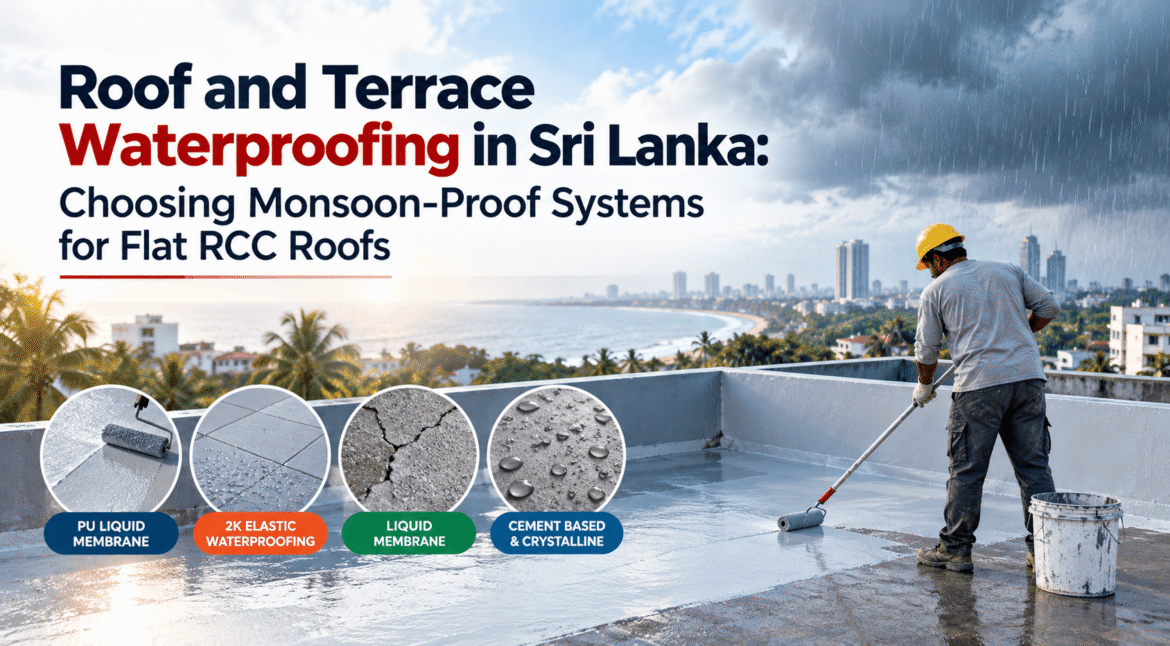
Roof and Terrace Waterproofing in Sri Lanka: Choosing Monsoon-Proof Systems for Flat RCC Roofs
The first heavy shower after a dry spell tells you the truth about a flat roof in Sri Lanka. If a brown stain spreads across the top-floor ceiling by evening, water has already found a hairline crack, a tired joint, or a puddle that never drains.
Choosing the right waterproofing chemical for terrace and roof slabs has less to do with the brand on the bucket and more to do with how the roof is used, how it drains, and how much sun it takes. This guide walks through each system, the Redwop products behind them, and how to get the job right before the next monsoon.
Why Roof and Terrace Waterproofing Matters in Sri Lanka
Sri Lanka’s Department of Meteorology describes four rain seasons: the southwest monsoon from mid-May to September, the northeast monsoon from December to February, and two inter-monsoon periods in between. Annual rainfall ranges from about 900 mm in the driest areas to more than 5,000 mm in parts of the southwest.
For a flat RCC roof, that climate brings:
- Rain in most months, so slabs rarely dry out completely
- Strong sun between showers, which makes exposed concrete expand and contract every day
- Ponding on roofs laid without enough slope
- Salt-laden air along the coast that weakens poorly bonded coatings
Getting the waterproofing chemical for roof slabs right the first time avoids:
- Damp patches and peeling paint on top-floor ceilings
- Rusting reinforcement and spalling concrete inside the slab
- Terrace tiles lifting because water is trapped underneath
- Paying for the same repair every monsoon
Types of Waterproofing Chemicals for Terrace and Roof Slabs
PU Liquid Membrane Waterproofing
A PU liquid membrane is a single-component polyurethane coating that cures with moisture in the air into a seamless, elastic film. Redwop’s PU Liquid Membrane Waterproofing bridges cracks and accommodates surface movement. It is formulated to resist UV, standing water and pollutants, which makes it the strongest choice for exposed roofs and terraces that pond. The range includes Rediseal 250, Rediseal 270 and Rediseal 650.
2K Elastic Waterproofing
2K elastic waterproofing combines a liquid polymer with a cement-based powder to form a flexible, crack-bridging membrane. Redwop’s 2K Elastic Waterproofing Chemicals, such as Polycote BB Flex, are made for terraces, balconies and wet areas, and are the natural choice under tiles, screeds and pavers.
Liquid Membrane Coatings
Water-based liquid membrane coatings are quick to apply and UV-stable, so they suit well-drained roofs and refurbishment work. Avoid them on roofs where water stands for days, because prolonged ponding weakens most acrylic films. Check the TDS of Redwop’s Liquid Membrane Waterproofing range for ponding resistance before you specify it.
Polyurea Waterproofing
Polyurea is sprayed with a plural-component rig and cures within minutes, so large podiums and commercial roofs return to service quickly. It needs a trained applicator and the right equipment.
Cement-Based and Crystalline Waterproofing Compound
A cement-based coating or waterproofing compound is a budget-friendly layer for protected slabs, sunken areas, and tanks; see Redwop’s Cement Based Waterproofing. Crystalline waterproofing grows crystals inside the concrete’s pores and works well as a back-up in new slabs. On its own, it cannot bridge cracks that keep moving under the sun.
Bituminous Membranes
Torch-on and self-adhesive bituminous products are used on insulated roofs and budget re-roofing. Seam quality depends on the crew, and the sheet needs a mineral or reflective finish in strong sun.
Common Questions Asked:-
Is PU or acrylic better for a terrace that floods in heavy rain?
- A PU membrane such as Rediseal tolerates standing water, while most acrylic coatings soften when water sits on them for days.
Choosing Waterproofing by Roof and Terrace Type
Terraces That Will Be Tiled
Lay a 2K elastic membrane such as Polycote BB Flex, let it cure, then fix tiles with Teratile Diamond or Teratile Platinum (Type III, C2TES1). For large-format tiles or terraces in full sun, step up to Teratile Prolix (Type IV, C2TES2); here’s why deformability matters on terraces.
Exposed Roofs with Foot Traffic
Use a PU membrane from the Rediseal range, reinforced at every junction. Finish with a UV-stable aliphatic acrylic coating where a lighter, cooler surface is wanted.
Roofs with Water Tanks, Solar Heaters and AC Units
Build plinths before waterproofing and wrap the membrane up each one. Seal around pipes and bolts with sealant and reinforce with fiber mesh.
Old Roofs with Existing Coatings or Tiles
Remove anything loose or hollow. Repair spalled concrete with polymer repair mortar, fill static cracks with crack filler, and prime cementitious systems with an SBR bonding coat such as Butabond SBR.
Getting the Details Right: Falls, Outlets and Joints
No best waterproofing chemical can save a roof that holds water. UK flat-roof practice (BS 6229) designs falls of about 1:40 so the finished surface stays at 1:80 or steeper after deflection and site tolerances.
- Flood the bare slab before waterproofing and correct every low spot with a bonded screed
- Fit at least two outlets per roof area, plus an overflow through the parapet
- Take the membrane at least 150 mm up parapets and upstands, the BS 6229 figure
- Reinforce corners, outlets and cracks with fiber mesh or polyester reinforcing fabric, as Redwop’s application guide recommends
- Treat building joints as movement joints with a sealant and backer rod, and never coat straight over them
How to Apply Waterproofing Chemical on a Terrace
- Check the slab: it must be cured, sound, and dry enough for the system. PU needs a dry surface, so check moisture with a meter against the TDS.
- Prepare: grind off laitance and loose coatings, repair with polymer repair mortar, then vacuum.
- Prime: use the primer the TDS specifies. For cementitious coatings, Redwop recommends an SBR primer allowed to go tacky.
- Reinforce details first: embed fiber mesh or polyester fabric at junctions in the first coat.
- Apply two coats crosswise: Redwop’s cementitious coatings are mixed at a 3:1 ratio, rested 5–10 minutes and recoated after 4–6 hours.
- Pick a dry window: the south-west is usually drier from December to February, the east and north mid-year. In inter-monsoon months, work mornings.
- Cure: keep cementitious coats damp for 48–72 hours.
- Flood test: after 7 days, plug the outlets and hold about 25–50 mm of water for at least 24 hours (ASTM D5957 describes the method), then tile or topcoat.
Waterproof Chemical for Roof Price in Sri Lanka
Waterproof chemical for roof price in Sri Lanka depends on the system, the thickness specified, surface repairs, detailing, access and freight. As a general guide:
- Acrylic coatings usually have the lowest material cost but need recoating more often
- 2K elastic cementitious membranes sit in the middle and are the standard under tiles
- PU and polyurea cost more per square metre but handle ponding and foot traffic best
Compare cost per square metre at the specified thickness, not price per bucket. Redwop’s cementitious coatings cover roughly 4–5 m² per 10 kg pack for two coats at 1–1.5 mm (source).
Because prices move with raw materials and freight, ask for a current landed-cost quote to Colombo instead of relying on old price lists.
Redwop Products for Roof and Terrace Waterproofing
Redwop product | Role on a roof or terrace |
Main membrane for exposed roofs, terraces and balconies that pond or carry foot traffic | |
Flexible membrane under tiles, screeds and pavers on terraces, balconies and wet areas | |
Fast-draining roofs and refurbishment | |
Large podiums and commercial roofs that need fast return to service | |
Protected slabs, sunken areas and tanks; back-up layer in new slabs | |
Reinforcement at corners, cracks, outlets and upstands | |
Bonding primer and polymer additive for repairs and cementitious coats | |
UV-stable, lighter topcoat over membranes | |
Crack Filler and Sealant | Static cracks and movement joints |
Repairing spalled or honeycombed slabs before waterproofing | |
Fixing tiles over the cured membrane (C2TES1 and C2TES2) |
Why Redwop Offers the Best Terrace Waterproofing Solutions in Sri Lanka
Redwop makes every layer of a roof system: primers, PU and 2K membranes, reinforcement, repair mortars, sealants, topcoats and the tile adhesives that go on top. Using one maker’s system means the layers are designed to work together, and one technical team answers for the whole build-up.
For Sri Lankan buyers, Redwop supplies distributors, contractors and project teams from its plants in India, with TDS, MSDS and certificates for approvals and landed-cost quotes to Colombo (Sri Lanka page). Its management systems are certified to ISO 9001, ISO 14001 and ISO 45001, and its laboratory to ISO/IEC 17025.
How to Choose: A Quick Reference
Roof or terrace situation | Recommended Redwop system |
Terrace to be tiled | Polycote 2K elastic membrane + Teratile Diamond or Platinum (C2TES1) |
Sun-exposed terrace with large tiles | Polycote 2K elastic membrane + Teratile Prolix (C2TES2) |
Exposed roof with ponding or foot traffic | Rediseal PU membrane + aliphatic acrylic topcoat |
Fast-draining roof needing refurbishment | Liquid membrane coating, recoated on schedule |
Large podium or commercial roof | Polyurea waterproofing |
New slab being cast | Crystalline waterproofing as a back-up + surface membrane |
Cracked old roof | Crack filler + fiber mesh, then the membrane |
Final Thoughts
A dry top floor through two monsoons starts with the slope of the slab and ends with the right membrane for how the roof is used. Choose the waterproofing chemical for terrace areas by exposure and finish, detail every junction, and test with water before anyone tiles.
If you are planning a roof or terrace in Sri Lanka, Redwop’s waterproofing range covers PU, 2K elastic, polyurea and crystalline systems, with technical guidance to match the right one to your project.
FAQS:-
-
1. What is the best waterproofing chemical for a terrace in Sri Lanka?
It depends on use: a 2K elastic membrane such as Polycote under tiles, or a PU membrane such as Rediseal on exposed terraces that pond.
-
2. Which waterproofing chemical for roof slabs handles standing water?
PU membranes and polyurea handle ponding best. Most acrylic coatings should not sit under standing water.
-
3. What is a waterproofing compound?
It is a general term for any product that stops water, from integral admixtures mixed into concrete to coatings and membranes applied on top.
-
4. Can I waterproof a roof during the monsoon?
Only in a confirmed dry window with a dry enough slab. Plan most roof work for the drier months in your region.
-
5. How long does terrace waterproofing last?
Redwop states that a well-applied system can last 8–10 years or more, depending on product, preparation and exposure.
-
6. Do I need waterproofing under terrace tiles?
Yes. Tiles and grout let water through, so a membrane underneath protects the slab and the rooms below.
-
7. What affects waterproof chemical for roof price?
The system, thickness, surface repairs, detailing, access and freight. Compare cost per square metre, not per bucket.
-
8. Can new waterproofing go over an old coating?
Only if the old coating is sound and compatible. Remove anything loose and prime with a bonding coat such as Butabond SBR.
-
9. How soon can I tile over a 2K elastic membrane?
Redwop recommends waiting 7 days before a pond test or tiling over its cementitious coatings.
-
10. Does Redwop supply waterproofing chemicals in Sri Lanka?
Yes. Redwop supplies distributors, contractors and project buyers, with TDS, MSDS and landed-cost quotes to Colombo.