


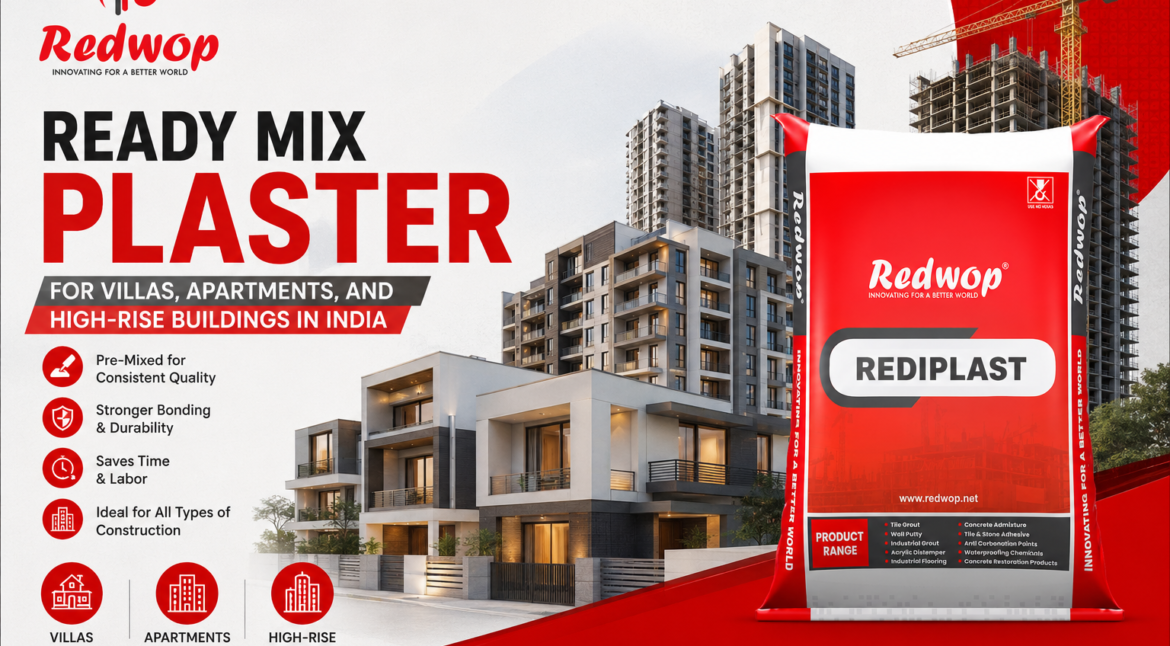
Ready Mix Plaster for Villas, Apartments, and High-Rise Buildings in India
Introduction:-
Walk through any active construction site in India a luxury villa project in Bengaluru, a mid-rise apartment complex in Pune, or a 40-storey tower in Mumbai and you’ll find plastering crews dealing with the same recurring headaches: inconsistent mortar mixes, shrinkage cracks appearing within weeks of finishing, walls that need multiple coats of putty to hide an uneven surface, and significant material wastage from poorly gauged site mixes. These aren’t skill problems. They’re system problems and they’re exactly what Ready Mix Plaster was designed to solve.
India’s construction sector is evolving fast. Developers are under pressure to deliver faster, architects are specifying tighter surface tolerances, and building owners are demanding finishes that last beyond one monsoon cycle. Traditional sand-cement plastering mixed on-site, dependent on the availability of good river sand, and entirely reliant on the judgement of individual masons struggles to consistently meet those demands. Pre-engineered, factory-controlled plaster systems are no longer a premium option. For projects that care about quality, schedule, and long-term finish, they’ve become the practical standard.
This guide covers why that shift is happening, what problems it solves on real Indian construction sites, and how REDWOP’s plaster product range REDIPLAST, REDIPLAST NC, and EP-PLAST delivers on each of those fronts for villas, apartments, and high-rise buildings alike.
Common Question Asked:
- What is ready mix plaster and how is it different from site-mixed plaster? Ready mix plaster is a factory-controlled, pre-blended plastering system combining cement, graded processed sand, and polymer additives in fixed proportions. On site, only water is added. Unlike site-mixed mortar where ratios vary with each batch, the factory mix is consistent bag-to-bag delivering predictable strength, workability, and finish quality every time.
The Problem with Traditional On-Site Plastering
Before looking at the benefits of factory-mixed plaster systems, it’s worth being specific about where conventional site-mix plastering actually fails because understanding the failure mode is what makes the solution make sense.
Inconsistent mix ratios are the starting point for most plaster-related problems. When sand and cement are batched by volume on-site, the actual cement mix ratio varies with every batch sometimes significantly depending on the mason’s judgement, the moisture content of the sand, and the time pressure of the workday. This inconsistency shows up later as variable compressive strength across different sections of the same wall, uneven absorption when paint is applied, and patchwork repairs that never quite match the surrounding surface.
Shrinkage cracking is directly connected to mix quality and curing. Traditional cement-sand plaster has a natural tendency to shrink as it dries, and when the mix is too rich in cement, too dry, or applied too thick in a single coat, hairline cracks appear across the surface within weeks. In Indian conditions where walls often face direct sun during summer and sustained humidity during monsoon the thermal and moisture cycling accelerates this cracking significantly.
Poor sand quality is an underappreciated problem. As river sand becomes increasingly scarce and regulated across India, many construction sites are working with crusher dust, manufactured sand, or variable-quality supply from different sources. The particle size distribution in these sands affects water demand, workability, surface finish, and long-term durability in ways that are difficult to control when mixing on-site without laboratory-tested inputs.
Labour dependency and supervision costs add a hidden cost layer to traditional plastering that rarely appears in material comparisons. Maintaining consistent mortar ratios across a large site, supervising water addition, managing wastage, and correcting batch-to-batch variation all require active QC that adds time and supervisory overhead especially on large apartment or high-rise projects running multiple plastering crews simultaneously.
What Makes Premix Plaster Different
A premix plaster system is factory-controlled, pre-blended plastering system. Cement, graded processed sand, and carefully selected water-soluble polymer additives are combined at the manufacturing stage in precise proportions, tested for consistency, and supplied in sealed bags. On-site, the only variable is water and even that is specified to a defined range (typically 6.8 to 7.6 litres per 40 kg bag) rather than left to judgement.
This factory control changes the entire quality picture. The particle size distribution is optimised and consistent bag-to-bag. The polymer additives improve workability, water retention, and adhesion in ways that cannot be replicated by adding admixtures to a site mix. The shrinkage behaviour is engineered and tested to minimise cracking. And the surface finish achieved in a single coat is consistently smooth enough to reduce or eliminate the putty coats needed before painting a significant saving on larger projects.
For villas, where the focus is on premium surface quality and finish, this consistency is the primary value. For apartment projects, where dozens of identical units need to be delivered to the same standard, it’s about repeatability and reduced rework. For high-rise buildings, where plastering has to meet structural code requirements, perform across multiple climate zones on the same facade, and be applied by different crews across many floors, the engineering control of a factory-mixed system is simply more reliable than any on-site mixing protocol.
REDWOP’s Plaster Range for Every Application
REDWOP offers three plastering products that together cover the full range of needs across different building types and application contexts from standard internal and external wall finishing to specialist structural leveling and concrete repair.
REDIPLAST — Ready Mix Plaster Non Curable
REDIPLAST is REDWOP’s core ready mix plaster cement and premixed plaster product for general internal and external wall applications across all standard masonry substrates. It’s a ready made plaster and ready made plaster mix system in the most practical sense — the factory does the blending as a plaster ready mix cement system, and the site crew adds only water.
It works on AAC block walls, fly ash block walls, clay brick walls, stone walls, concrete block walls, and concrete surfaces covering the full range of substrates found in modern Indian residential and commercial construction. This bonding plaster ready mixed system’s substrate versatility matters on apartment and villa projects where different structural systems (RCC frame with AAC infill, load-bearing brick, precast concrete) might be used in different parts of the same building.
What sets REDIPLAST apart from a site mix:
The polymer additives engineered into REDIPLAST give it a water retentivity of 99.80% meaning it retains moisture during the curing phase far more effectively than ordinary cement-sand mortar. This directly reduces the risk of shrinkage cracking, which is one of the most common complaint points in Indian construction projects. Water absorption is just 0.03% a figure that speaks directly to the surface density and long-term weather resistance of the finished plaster, particularly relevant for external walls on villas and high-rise facades.
The compressive strength of minimum 15.0 N/mm² and pull of adhesion of 0.5 N/mm² ensure the plaster isn’t just a finish layer it actively contributes to the masonry’s load-bearing performance. And because the material achieves a smooth plaster finish delivering a ready mixed finishing plaster quality in a single coat for internal applications, it reduces the time and material cost typically spent on putty coating before painting.
Technical specifications at a glance:
Property | Specification |
Appearance | Grey powder |
Mixing ratio | 17–19% of powder weight in water |
Initial setting time | Min. 45 minutes |
Final setting time | Max. 600 minutes |
Water retentivity | 99.80% |
Water absorption | 0.03% |
Compressive strength | Min. 15.0 N/mm² |
Flexural strength | 1.90 N/mm² |
Coverage | 10–15 ft² per 40 kg at 10–12mm thickness |
Shelf life | 2 years in cool, dry, shaded storage |
Application:
- Internal walls: 8–10 mm single coat
- External walls: base coat 8–12 mm + finish coat 8–12 mm, total 18–20 mm
- Mix 6.8–7.6 litres of water per 40 kg bag for consistent workability
Packaging: 40 kg bags practical for both villa-scale and large apartment projects.
REDIPLAST NC — Ready Mix Plaster Self Curable
REDIPLAST NC is REDWOP’s self-curing variant of the same premixed wall plaster system — sharing the same substrate compatibility, mixing procedure, application thicknesses, and technical performance profile as REDIPLAST, but formulated to cure without requiring the intensive wet-curing protocol that standard cement-based plasters demand.
On large apartment and high-rise projects, this self-curing capability has significant practical value. Wet curing of plastered walls spraying or keeping the surface damp for 7 days after application is labour-intensive, difficult to manage consistently across multiple floors, and often skipped under schedule pressure, directly causing the curing-related cracks and surface defects that owners complain about later. REDIPLAST NC removes that variable from the equation entirely.
The technical specifications mirror REDIPLAST exactly same 99.80% water retentivity, same 0.03% water absorption, same minimum 15.0 N/mm² compressive strength, same 17–19% mixing ratio, and the same 2-year shelf life in proper storage. The practical difference is in the site workflow: crews can move to the next operation without waiting for and managing a wet-curing cycle, which improves overall floor-cycle times on high-rise projects where schedule compression is a constant pressure.
Both REDIPLAST and REDIPLAST NC REDWOP’s proven ready mix cement plaster systems carry comprehensive product standard compliance: IS 1661:1972, IS 2645:2003, IS 15477:2019/ASTM C482, IS 4031 (Part 5):1988/ASTM C191, IS 2250:1981, IS 516 (Part 2/Sec 2):2018/ASTM C348, and IS 15477:2019/ASTM C1583 a compliance profile that satisfies structural and finishing specifications on both residential and commercial projects.
EP-PLAST — Epoxy Plaster
EP-PLAST is a two-component, solvent-free epoxy plaster for structural leveling, surface profiling, and concrete repairs a specialist plaster material for situations where a standard cement-based ready plaster system doesn’t have the chemical or mechanical performance required.
Formulated with high-grade epoxy resins and selected mineral aggregates, EP-PLAST provides compressive strength of ≥ 80 N/mm², tensile strength of ≥ 15 N/mm², and flexural strength of ≥ 20 N/mm² performance levels that are an order of magnitude above standard wall plaster cement systems and appropriate for structural concrete repair, industrial floor leveling, and surface preparation in high-demand environments.
Its water absorption is ≤ 0.5%, and it is resistant to water exposure, oils, and chemical cleaners making it the right choice for surface rendering in industrial areas, commercial kitchens, and laboratories where a standard concrete plaster or wall plaster would not stand up to chemical exposure or heavy cleaning regimes.
For villa and apartment projects, EP-PLAST finds its use in specific problem areas: honeycomb filling and blowhole patching in concrete panels and columns, leveling irregular masonry walls before high-end paint or cladding application, repairing damaged edges, steps, kerbs, and walkways, and jointing and profiling precast concrete units. It cures without cracking a key property for repair applications where the surrounding structure may have minor movement and bonds securely to concrete, stone, and masonry without primers on properly prepared substrates.
Technical specifications:
Property | Specification |
Mixed appearance | Light brown |
Density | 1.70–1.80 kg/L |
Compressive strength | ≥ 80 N/mm² |
Tensile strength | ≥ 15 N/mm² |
Flexural strength | ≥ 20 N/mm² |
Water absorption | ≤ 0.5% |
Bond strength | ≥ 2 N/mm² |
Shear strength | ≥ 3 N/mm² |
Application: Combine resin and hardener at 1:2 ratio until uniform colour is achieved. Mix approximately 7 kg silica per 1.5 kg of resin-hardener mix. Apply with a clean steel trowel or spatula to required thickness. Shelf life is 12 months under dry storage conditions.
Packaging: 30 and 150 kg packs suited to both targeted repair work and larger-scale surface profiling applications.
Choosing the Right REDWOP Plaster for Your Project
Project Type | Recommended Product | Primary Reason |
Villas — internal walls | REDIPLAST or REDIPLAST NC | Smooth single-coat finish; reduces putty requirement |
Villas — external facades | REDIPLAST | Low water absorption for weather resistance |
Apartment buildings | REDIPLAST NC | Self-curing reduces floor-cycle time across multiple units |
High-rise buildings | REDIPLAST NC | Schedule-critical workflow; consistent quality across all floors |
Concrete repair & patching | EP-PLAST | High-strength epoxy for structural and cosmetic concrete defects |
Industrial / commercial surfaces | EP-PLAST | Chemical and abrasion resistance for demanding environments |
Pre-paint wall leveling | REDIPLAST or EP-PLAST | Surface density eliminates need for heavy putty coats |
Why Consistent Plastering Matters More Than Most Builders Realise
The plastering work stage is one of the most underestimated contributors to long-term building quality. A poorly plastered wall doesn’t just look bad it affects how paint adheres and how long it lasts, whether cracks appear and spread over time, how the wall responds to moisture during monsoon, and ultimately how the owner perceives the quality of the entire building. On a villa where the client has paid premium rates and expects premium finish, a single cracking plaster panel is a disproportionate problem relative to its actual repair cost.
The shift to factory-controlled pre mixed plaster systems removes the variability that causes most of these problems at source. When the sand grading, cement content, and polymer additives are locked in at the manufacturing stage, the site crew is simply adding water and applying and the result is consistent from the first wall to the last, from the ground floor to the top floor, and from summer to monsoon. For developers and contractors who have experienced the cost of plastering rework and warranty claims, this consistency alone justifies the shift.
Why Choose REDWOP for Plastering in India
REDWOP Chemicals Pvt. Ltd. is a Rajkot-based manufacturer with a product range built around the specific conditions that Indian construction projects face variable substrates, challenging climate, and the need for materials that perform in both premium residential and large-scale commercial applications. As a trusted name among ready mix plaster manufacturers offering the best ready made plaster systems in India, REDWOP backs its plaster range with ISO 9001:2015, ISO 14001:2015, ISO 45001, and GEV Ec1 Plus (low-VOC) certifications, alongside comprehensive Indian and international product standard compliance.
The REDIPLAST and EP-PLAST range is designed to work as part of a broader REDWOP construction chemicals system compatible with REDWOP’s bonding agents, waterproofing products, and protective coatings for contractors and developers who want a single-source technical solution across the full building envelope. Visit redwop.net to explore the range, access product data sheets, application guides, and technical support across India.
-
1.Is ready mix plaster suitable for both internal and external walls?
Yes. REDIPLAST and REDIPLAST NC serve as a complete ready mix plaster for walls designed for both internal and external plastering. For internal walls, an 8–10 mm single coat is sufficient. For external walls, two coats (base 8–12 mm + finish 8–12 mm) are recommended for a total thickness of 18–20 mm, providing better weather resistance and durability.
-
2.What substrates can REDIPLAST be applied on?
Both REDIPLAST and REDIPLAST NC are compatible with AAC block walls, fly ash block walls, clay brick walls, stone walls, concrete block walls, and concrete surfaces the full range of substrates used in modern Indian residential and commercial construction.
-
3.What is the difference between REDIPLAST and REDIPLAST NC?
Both products share the same formulation, performance specs, mixing ratios, and application thicknesses. The key difference is that REDIPLAST NC is self-curing it does not require the intensive wet-curing protocol (keeping the surface damp for several days) that standard cement plaster needs. This makes REDIPLAST NC particularly practical for large apartment and high-rise projects where curing management across multiple floors is logistically challenging.
-
4.How does ready mix plaster reduce shrinkage cracking?
REDIPLAST achieves 99.80% water retentivity meaning it holds moisture far more effectively than ordinary cement-sand mortar during the critical early curing phase. This sustained internal moisture prevents the rapid drying that causes shrinkage cracks. The polymer additives also improve flexibility and bonding, further reducing the risk of cracking under thermal and moisture cycling.
-
5.How much water should be added to REDIPLAST per bag?
Generally 6.8 to 7.6 litres of water per 40 kg bag is recommended for good working consistency. The exact amount may vary slightly based on site temperature and humidity the product's 17–19% mixing ratio guideline should be followed for best results. Adding excess water weakens the final plaster.
-
6.What is the coverage rate for REDIPLAST?
One 40 kg bag covers approximately 10–15 sq. ft. at a 10–12 mm application thickness. Actual coverage depends on surface texture, substrate porosity, and application technique.
-
7. Does REDIPLAST reduce the need for wall putty before painting?
Yes because REDIPLAST achieves a smooth, dense surface finish in a single coat for internal applications, the quantity of wall putty needed before painting is significantly reduced compared to conventional site-mixed plaster. This translates directly to time and material savings on apartment and villa finishing schedules.
-
8.What is EP-PLAST and when should it be used instead of REDIPLAST?
EP-PLAST is a two-component solvent-free epoxy plaster for structural leveling, surface profiling, and concrete repairs. It should be used when the application requires very high mechanical strength (compressive strength ≥ 80 N/mm²), chemical resistance, or repair of structural concrete defects like honeycombs, blowholes, or damaged edges situations where a standard cement-based plaster system doesn't have adequate performance.
-
9.Can EP-PLAST be used for patching honeycombs in RCC columns and slabs?
Yes honeycomb filling and patching blowholes in concrete panels is one of EP-PLAST's primary listed applications. Its non-shrink formulation and high bond strength (≥ 2 N/mm²) make it well suited for structural concrete repair where shrinkage or adhesion failure in the patch would create further problems.
-
10. Is EP-PLAST suitable for industrial areas and commercial kitchens?
Yes EP-PLAST is specifically listed for surface rendering in industrial areas, commercial kitchens, and laboratories. Its resistance to water exposure, oils, and chemical cleaners makes it the appropriate plaster material for these environments where standard cement plaster would deteriorate under chemical or mechanical exposure.