


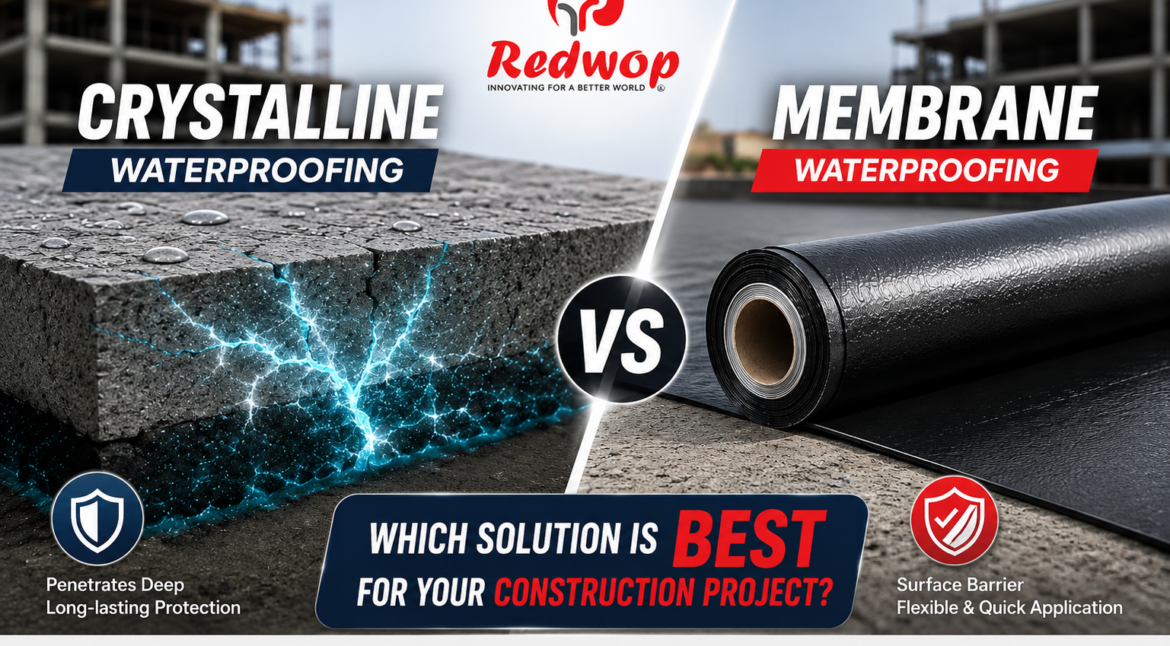
Crystalline vs Membrane Waterproofing: Which Solution Is Best for Your Construction Project?
Water is the single greatest threat to any concrete structure over its lifetime. In India where buildings face everything from sustained monsoon downpours to high-humidity coastal conditions and aggressive soil chemistry choosing the right waterproofing system at the design or repair stage isn’t just a technical detail, it’s a structural decision that affects how long a building performs and how much it costs to maintain.
Two approaches dominate modern construction waterproofing: crystalline waterproofing and membrane waterproofing. Both are proven. Both are widely used. But they work in fundamentally different ways, suit different substrates and site conditions, and have real differences in long-term performance that matter enormously to architects, structural engineers, contractors, and homeowners alike.
This guide breaks down exactly how each system works, where each performs best, and critically when you might need both on the same project. We’ve built this around the actual products from REDWOP’s waterproofing range, so the guidance here translates directly to practical on-site decisions.
Common Question Asked:
What does crystalline admixture for concrete mean in new construction?
Ans:- 3
A crystalline admixture for concrete is added directly to the concrete mix at the batching plant or at the site mixer before pouring. Rather than being a surface treatment applied after the fact, it integrates the waterproofing chemistry into the concrete itself, so every poured section has the crystalline waterproofing capability built in from day one.
How Crystalline Waterproofing Works
Crystalline waterproofing is a chemistry-driven approach that works from within the concrete itself rather than on its surface. A crystalline waterproofing admixture typically a blend of Portland cement, quartz aggregate, and specially active chemicals is applied as a slurry coat to cementitious substrates. In the presence of moisture, the active ingredients penetrate the capillary network of the concrete and react chemically with the free lime in the cement matrix to produce insoluble crystals.
These crystals grow inside the pores and capillaries of the concrete, blocking water passage and filling hairline non-structural cracks caused by shrinkage or thermal expansion. What makes crystalline concrete protection fundamentally different from surface-applied systems is that it becomes a permanent part of the structure it cannot peel, delaminate, or be mechanically damaged. Importantly, it continues forming crystals whenever moisture is present, meaning it is self-sealing to a meaningful degree throughout the life of the structure.
REDWOP’s POLYCOTE CWP is a crystalline capillary waterproofing system that operates on exactly this principle. It contains Portland cement, quartz aggregate, and proprietary active chemicals; when applied to damp concrete, it penetrates deeply and reacts to seal capillary tracts and cracks up to 0.4 mm wide. In tacky condition, it can resist hydrostatic pressure of up to 13 bar from both positive and negative sides a performance specification that few other waterproofing types can match. It contains no chloride, resists chemical attack from sewage and industrial waste, is carbonation-reducing, and is approved for use in contact with potable water . Its compliance with IS 2645:2003, DIN 1048, and ACI-212-3R-2010 reflects a product designed for serious structural applications.
Where POLYCOTE CWP is used:
- Sewage treatment plants, water treatment plants, tanks, foundations, tunnels, and manholes
- Industrial and office buildings, reservoirs, and water-holding structures
- Balconies, sunshades, and horizontal exposed surfaces
- Against both positive and negative hydrostatic heads of water
- Damp-proofing, repairing cracks, plugging active leaks, and sealing wall-to-floor joints
Application in brief: For existing concrete, the surface is water-blasted clean and kept damp. The powder is mixed 3 parts to 1 part clean water using a paddle mixer. Application temperature should stay between 5°C and 35°C. After application, the surface is kept moist by fog-spraying 3–4 times daily for 48 hours to allow proper crystal formation. A minimum of 7 days air curing is required before immersing in water.
How Membrane Waterproofing Works
Membrane waterproofing takes a different approach entirely instead of becoming part of the substrate, it forms a continuous, impermeable physical barrier on the surface of the structure that water simply cannot penetrate. A liquid membrane waterproofing system is applied as a coating or spray that cures to form an elastomeric, seamless film over the substrate.
The practical advantage of a well-formulated liquid membrane is its flexibility. Unlike rigid coatings that crack when the substrate moves, elastomeric membranes can bridge cracks, accommodate thermal movement, and maintain an unbroken seal across corners, joints, and irregular surfaces. A quality waterproof liquid for cement and masonry surfaces also bonds strongly to a range of substrates old concrete, new concrete, RCC, masonry walls, brick and resists UV exposure, aggressive soils, and soluble salts on exterior-facing applications.
REDWOP offers three membrane waterproofing products covering different performance levels and application types:
SMARZKOT Waterguard
A single-component, spray-applied elastomeric membrane based on special co-polymers and fillers, SMARZKOT Waterguard is the high-performance end of REDWOP’s membrane range. It is highly elastic and tough, designed specifically to resist aggressive soils and soluble salts making it well suited as a vapor and salt barrier behind granite, marble, stone cladding, and curtain wall façade elements. Its tensile strength exceeds 2.5 N/mm² at 7 days, with elongation at break between 900–1,350% and a crack-bridging capability of up to 2 mm. It is applied in four coats using an airless spray, with a 24-hour cure time. For extended life performance on exposed terraces, it can be combined with a Glass Reinforcement Sheet (GRS) embedded into the first wet coat before the remaining coats are applied.
Key uses: Reservoirs, canals, water tanks, terraces, podiums, and building façades where a seamless, highly elastic, UV-resistant waterproof liquid cement barrier is required.
SMARZKOT Advanced
An acrylic-modified elastomeric liquid membrane waterproofing system for both horizontal and vertical surfaces, SMARZKOT Advanced is a 1K (single-component) brush or roller-applied product that can be applied directly to damp concrete and masonry a significant practical advantage on Indian construction sites where surfaces are rarely perfectly dry. It withstands up to 3 bars of waterproofing pressure on vertical surfaces and 5 bars on horizontal surfaces. With a 36-month shelf life, anticarbonation properties, resistance to algae, fungus, and moss, and no toxic content (lead, arsenic, and mercury free), it is also suitable for potable water tanks and food-manufacturing industrial masonry.
Key uses: Roofs, balconies, terraces, verandas, bridge decks, tunnels, stadium stands, leaking brick, and masonry walls requiring a flexible, easy-to-apply waterproof liquid cement coating.
SUPERKOT
A heavy-duty, reinforced acrylic waterproofing system specifically developed for terraces, SUPERKOT is a three-layer system applied in different-colored coats to ensure proper build-up to a minimum dry film thickness of 1 mm. It is composed of highly elastic and resilient acrylic polymers, weather-durable pigments, and best-quality fungicidal additives. With elongation exceeding 450%, excellent UV resistance, abrasion resistance (no additional protective coating needed even for foot-traffic roofs), and a temperature reduction of up to 10°C from the surface temperature, SUPERKOT is purpose-engineered for Indian terrace conditions. It meets, BS 6920:2000 (suitable for contact with potable water), and JIS A 6021.
Key uses: Flat and sloped building roofs and terraces, RCC structures, masonry walls on low- and high-rise buildings, cooling towers, bridges, and as an overcoat on existing cementitious waterproofing treatments including brick-bat coba and concrete screeds.
Crystalline vs Membrane Waterproofing: Direct Comparison
Understanding the difference between the two systems is straightforward once you look at how they perform across the criteria that actually matter on Indian construction projects:
Criteria | Crystalline (POLYCOTE CWP) | Membrane (SMARZKOT / SUPERKOT) |
How it works | Penetrates concrete, forms insoluble crystals internally | Forms a continuous flexible barrier on the surface |
Self-sealing | Yes reactivates in presence of moisture | No physical continuity of the membrane must be maintained |
Negative side waterproofing | Yes up to 13 bar from negative side | Limited primarily positive-side pressure |
Crack bridging | Up to 0.4 mm (non-structural hairline cracks) | Up to 2 mm (SMARZKOT Waterguard); 0.5 mm (SMARZKOT Advanced) |
Applied to damp surface | Yes requires damp concrete for crystallisation | SMARZKOT Advanced: yes; SMARZKOT Waterguard: requires dry, clean substrate |
UV resistance | Not designed for UV-exposed surfaces alone | Excellent all three membrane products rated for exterior UV |
Flexibility | Rigid (cementitious product) | High elasticity accommodates structural movement |
Potable water contact | Approved (ANSI/NSF Std61, DVGW) | SMARZKOT Waterguard & SUPERKOT: suitable; verify per application |
Best for | Underground, tanks, foundations, tunnels, negative-side repair | Terraces, roofs, façades, balconies, exposed RCC, vertical walls |
Application complexity | Moderate — surface must stay moist during curing | Low to moderate — brush, roller, or spray depending on product |
Long-term permanence | Becomes part of the concrete permanently | Subject to UV, mechanical, and chemical degradation over time |
Overcoating | Can be overcoated with compatible systems | Ready-to-paint / overcoat after full cure |
When to Choose Crystalline Waterproofing
A crystalline waterproofing system is the right choice when water access is coming from inside or below the structure — situations where a surface membrane either can’t be applied or would be under positive hydrostatic pressure from the non-application side:
- Underground basements and foundations where soil moisture exerts pressure from the outside
- Water tanks, reservoirs, and sewage treatment structures where the waterproofing must work from the inside face
- Tunnels, manholes, and metro construction where the substrate is permanently damp
- Structural cracks in concrete that need to be sealed from within
- Situations where a future repair of a failed surface membrane would be difficult or inaccessible
- New concrete pours where a crystalline admixture for concrete can be added directly to the mix at the batching stage
The key diagnostic question: Is the waterproofing expected to work against water coming from the other side of the structure? If yes, a crystalline product like POLYCOTE CWP is the technically correct solution. No membrane applied on the positive (wet) face will maintain adhesion under sustained negative hydrostatic pressure.
When to Choose Membrane Waterproofing
A liquid membrane system is the right choice when the waterproofing is applied to the surface that will be exposed to water, where UV exposure is a factor, or where the substrate is irregular or subject to movement:
- Terraces and flat roofs exposed to Indian monsoon, UV, and thermal cycling SUPERKOT’s three-coat system with minimum 1 mm DFT is specifically engineered for this
- Building façades and exterior walls behind cladding or directly exposed SMARZKOT Waterguard’s spray application delivers a seamless, continuous waterproof liquid cement barrier across large areas quickly
- Balconies, verandas, and sunshades where a flexible, crack-bridging coating is needed
- Bridge decks, tunnels (exterior face), and stadium structures SMARZKOT Advanced’s 5-bar pressure resistance and anticarbonation properties suit heavy-civil applications
- Remedial waterproofing over existing cementitious treatments like brick-bat coba, where SUPERKOT can be applied directly over the existing surface
The key diagnostic question: Is the waterproofing applied to the same face that water will contact, and does the surface face UV, thermal movement, or physical traffic? If yes, a quality elastomeric membrane is the right call.
Using Both: When Your Project Needs a Combined Approach
The most demanding waterproofing challenges large water-retaining structures, underground car parks with exposed terraces above, water treatment infrastructure often require both approaches applied in a planned, complementary system. The crystalline coating handles the structural, below-grade waterproofing against negative-side hydrostatic pressure, while an elastomeric membrane handles the exposed above-grade surfaces where UV, crack bridging, and flexibility are the dominant requirements.
This is one of the genuine advantages of working with a manufacturer that supplies the complete range the compatibility between systems is known, tested, and engineered rather than guessed at. Among construction chemicals manufacturers in India, REDWOP’s position as a supplier of both crystalline and multiple membrane products means a project team can specify a coherent, compatible waterproofing strategy from a single technical source rather than stitching together products from competing brands.
REDWOP's Complete Waterproofing Range: A Technical Summary
Product | Type | Primary Use | Key Standard |
Crystalline capillary coating | Underground, tanks, foundations, negative-side | IS 2645:2003, DIN 1048, ACI-212-3R-2010 | |
Spray elastomeric membrane | Reservoirs, canals, terraces, façades | ASTM D412, ASTM G154, IS 2645 | |
Acrylic liquid membrane | Roofs, balconies, bridges, tunnels, masonry | Company ISO standards | |
Heavy-duty acrylic terrace coating | Terraces, roofs, RCC walls, over brick-bat coba | BS 6920:2000, JIS A 6021 |
REDWOP Chemicals Pvt. Ltd., headquartered in Rajkot, Gujarat, brings multi-standard certifications — ISO 9001:2015 for quality management, ISO 14001:2015 for environmental systems, ISO 45001 for occupational health and safety, and GEV Ec1 Plus for low-VOC emissions to a product range designed specifically for Indian construction conditions. As one of the prominent construction chemicals manufacturers in India, REDWOP’s approach is built on integrated systems rather than standalone products, which matters most on projects where multiple waterproofing layers must work together without compatibility issues.
For contractors, engineers, and homeowners across India evaluating which waterproofing system is right for their project, the answer lies in understanding the site-specific challenge: where is the water coming from, what substrate is being treated, and what long-term conditions will the waterproofing face? REDWOP’s range, backed by detailed technical data sheets and on-ground support, provides the complete answer — whether the project calls for a crystalline waterproofing admixture at the batching stage, a penetrating crystalline coating on existing concrete, or a high-performance elastomeric membrane on an exposed terrace. Visit redwop.net to explore the full product catalogue and connect with the technical team.
Frequently Asked Questions
-
1. What is the main difference between crystalline and membrane waterproofing?
Crystalline waterproofing works from within the concrete by forming insoluble crystals inside the pores and capillaries, making it a permanent, integral part of the structure. Membrane waterproofing creates a physical barrier on the concrete surface. The core difference is whether the protection is internal and chemical or external and physical.
-
2. Can crystalline waterproofing be used on the negative side (inside face) of a water-retaining structure?
Yes this is one of crystalline waterproofing's most significant advantages. POLYCOTE CWP is specifically designed to resist hydrostatic pressure of up to 13 bar from both positive and negative sides, making it highly suitable for tanks, reservoirs, and underground structures where access to the positive face is not possible.
-
3. Is a liquid membrane suitable for underground waterproofing?
Liquid membrane systems perform best when applied to the face directly exposed to water (positive side). For underground structures where water pressure pushes from outside in, a crystalline or cementitious system that works on the negative side is more appropriate. A membrane applied to an interior face under sustained outward hydrostatic pressure may delaminate over time.
-
4. How long does POLYCOTE CWP take to fully activate?
Initial crystalline formation begins within 48 hours, but full activation and maximum effectiveness can take 2–3 weeks following application, especially in cooler conditions. During the initial 48 hours, the surface must be kept continuously damp by fog-spraying 3–4 times daily to ensure proper crystal growth.
-
5. What surface preparation is needed before applying POLYCOTE CWP?
The surface must be clean, sound, and left damp — not dry. All oil, dirt, laitance, and contaminants should be removed by water blasting. For existing concrete, a damp saturated surface is ideal. For new concrete, forms are stripped, then acid-etched or water-blasted to remove form oils and laitance.
-
6. Can SMARZKOT Waterguard be applied to a damp surface?
SMARZKOT Waterguard requires a sound, clean, dry, and smooth substrate for best results curing agents, paint, oil, and biological growth will impair adhesion. SMARZKOT Advanced, however, can be directly applied to damp concrete and masonry, which makes it more practical for sites where perfectly dry conditions are difficult to achieve.
-
7. How many coats does SUPERKOT require, and why?
SUPERKOT is a three-coat system applied in different colors so applicators can visually verify that each layer has been fully applied before the next coat goes on. This multi-color approach ensures a minimum total dry film thickness of 1 mm is achieved consistently across the entire surface a critical quality control mechanism for terrace waterproofing.
-
8. What makes SMARZKOT Waterguard suitable for use behind stone cladding and façade systems?
Its high resistance to aggressive soils and soluble salts, combined with its vapor and salt barrier properties, makes it specifically suited as a substrate membrane behind granite, marble, stone cladding, and curtain wall elements where trapped moisture and salt migration can cause long-term deterioration of the cladding fixings and substrate.
-
9. Which REDWOP waterproofing product is best for a flat terrace in India?
SUPERKOT is purpose-built for Indian terrace conditions — it provides a minimum 1 mm dry film thickness, excellent UV resistance, crack bridging, abrasion resistance under foot traffic, and a surface temperature reduction of up to 10°C. For extended-life terrace protection, SMARZKOT Waterguard applied with a Glass Reinforcement Sheet (GRS) is also a high-performance option.
-
10. Is POLYCOTE CWP safe for drinking water storage tanks?
Yes. POLYCOTE CWP meets ANSI/NSF Std61 requirements for suitability for potable water and is also suitable for drinking water per DVGW worksheets W-347 and W-270. It contains no chloride and resists chemical attack from sewage and industrial waste.