


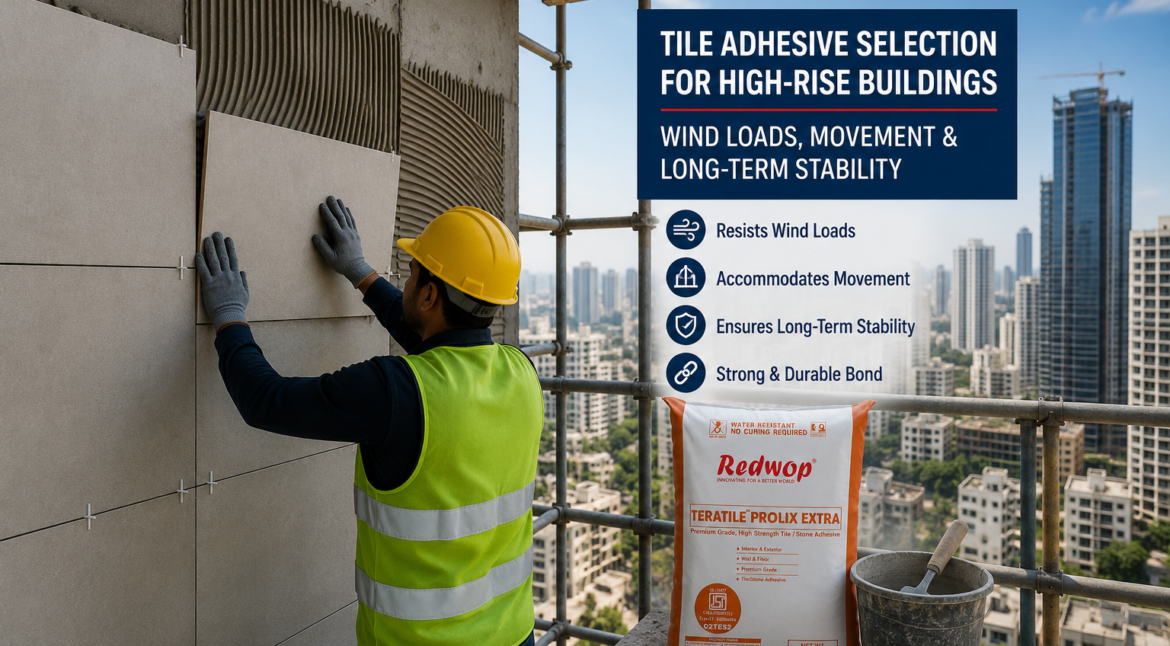
Tile Adhesive Selection for High-Rise Buildings: Wind Loads, Movement & Long-Term Stability
High-rise buildings create installation conditions that are very different from low-rise residential or commercial projects. As building heights increase, tiled surfaces are exposed to structural movement, wind pressure, thermal expansion, and long-term loading conditions that can affect tile performance over time.
A tile installation that performs well in a two-story building may not necessarily perform the same way on the 20th or 40th floor. This is one of the reasons why selecting the right
tile adhesive is critical for high-rise construction.
When adhesive selection is based only on tile size or project cost, problems such as debonding, hollow tiles, cracking, and tile detachment can appear years before the expected service life of the building.
Common Question Asked:
Q.1 Can the wrong tile adhesive cause tile failures in high-rise buildings even when installation quality is good?
Yes, even well-installed tiles can fail if the adhesive does not accommodate structural movement, wind-related stresses, moisture exposure, or thermal expansion commonly found in high-rise buildings.
Why High-Rise Buildings Place More Stress on Tiled Surfaces
Unlike low-rise structures, high-rise buildings experience constant movement throughout their service life.
These movements may be small, but they occur repeatedly and affect tiled surfaces over time.
Common sources of movement include:
- Wind-induced building sway
- Thermal expansion and contraction
- Structural deflection
- Concrete shrinkage
- Live load movement
- Settlement differences between structural elements
Tiles themselves are rigid materials. When movement occurs beneath them, the adhesive layer becomes responsible for absorbing and distributing those stresses.
If the adhesive lacks flexibility or bonding strength, failures become more likely.
How Wind Loads Affect Tile Performance at Height
Wind pressure increases significantly as building height increases.
External walls, balconies, terraces, podiums, and façade areas experience continuous wind loading throughout the life of the structure.
While the building frame is designed to handle these forces, tiled finishes must also accommodate the resulting movement.
Common problems caused by wind-related movement include:
- Cracked grout joints
- Tile debonding
- Hollow sounding tiles
- Detached façade tiles
This is especially important for large-format tiles because larger tile sizes reduce the number of joints available to absorb movement.
A suitable tile adhesive must provide sufficient flexibility while maintaining bond strength under changing environmental conditions.
Building Movement and Differential Deflection
High-rise buildings rarely remain completely static.
Structural components move differently under load.
For example:
- Beams deflect under occupancy loads
- Slabs expand and contract
- Columns shorten over time
- Façade systems move independently
This creates differential movement between building elements.
When tiled surfaces bridge these areas without adequate flexibility, stresses are transferred directly into the tile assembly.
Many tile failures blamed on workmanship are actually caused by movement that the adhesive system was unable to accommodate.
This is one of the reasons why builders increasingly prefer polymer tile adhesive systems in high-rise projects rather than traditional fixing methods.
Why Thermal Expansion Matters More in High-Rise Structures
Temperature variations can be much more severe at higher elevations.
External surfaces are exposed to:
- Direct sunlight
- Rapid cooling during rainfall
- Day-night temperature fluctuations
- Seasonal weather changes
As temperatures change, both the substrate and the tile expand and contract.
If movement is restricted, stress builds within the tiled assembly.
Over time this can lead to:
- Cracked tiles
- Tile lifting
- Corner debonding
- Hollow areas beneath tiles
Adhesives used in high-rise applications must be capable of accommodating these movements without losing bond integrity.
Choosing the Right Tile Adhesive for High-Rise Applications
Selecting adhesive solely based on tile type is rarely sufficient for high-rise construction.
Factors that should be considered include:
- Building height
- Exposure conditions
- Tile size
- Substrate type
- Moisture exposure
- Expected movement
Different adhesive technologies serve different purposes.
Polymer Tile Adhesive for High-Rise Construction
For most high-rise applications, polymer tile adhesive systems are preferred because they provide improved flexibility and bond strength compared to conventional cement-based fixing methods.
These adhesives help accommodate movement while maintaining adhesion to both the tile and substrate.
They are commonly used in:
- Residential towers
- Commercial buildings
- External wall tiling
- Balconies
- Podiums
- Large-format tile installations
For demanding high-rise applications, products such as TERATILE PLATINUM, TERATILE DIAMOND, and TERATILE PROLIX EXTRA are often considered where enhanced bonding performance and durability are required.
Waterproof Tile Adhesive in Moisture-Prone Areas
Many high-rise projects include areas that are continuously exposed to moisture.
Examples include:
- Balconies
- Bathrooms
- Service areas
- Podium decks
- Utility zones
In these environments, a waterproof tile adhesive helps reduce the risk of moisture-related bond deterioration.
Adhesives such as TERATILE GOLD and TERATILE SINEX are commonly selected for installations where moisture resistance and long-term performance are important considerations.
Moisture management becomes particularly critical when tiled areas are located several floors above occupied spaces.
When Epoxy Tile Adhesive Becomes Necessary
Certain high-rise applications require performance beyond conventional cementitious systems.
Examples include:
- Chemical exposure
- Industrial service areas
- Food processing facilities
- Utility rooms
- Areas requiring high chemical resistance
In such situations, epoxy tile adhesive systems provide advantages through their exceptional bonding strength and resistance to moisture and chemicals.
Products such as FLEXOPLUS are often specified where project conditions demand an epoxy-based bonding solution.
While epoxy adhesives are not required for every high-rise project, they can be valuable in specialized environments.
Common Tile Failures Seen in High-Rise Buildings
Many failures observed in high-rise projects can be traced back to inappropriate adhesive selection.
Tile Debonding
Occurs when bond strength is insufficient to withstand movement or environmental stress.
Hollow Sounding Tiles
Usually caused by inadequate adhesive coverage, poor application practices, or bond failure.
Cracked Grout and Tiles
Often linked to movement that was not accommodated within the tile system.
Tile Lifting
Common in external areas exposed to thermal expansion.
Water Ingress Behind Tiles
Can occur when moisture-resistant systems are not used in exposed areas.
Most of these issues develop gradually rather than immediately after installation.
Site Practices That Improve Long-Term Stability
Even the best adhesive cannot compensate for poor installation practices.
Builders and contractors should pay attention to:
Surface Preparation
Substrates must be clean, stable, and properly cured before tiling begins.
Adhesive Coverage
Adequate coverage helps eliminate voids and improves load distribution.
Movement Joints
Expansion and movement joints should never be ignored in high-rise projects.
Tile Size Considerations
Large-format tiles often require back-buttering and higher-performance adhesives.
Moisture Control
Waterproofing and moisture management should be coordinated with the tiling system.
Proper installation practices work together with adhesive performance to achieve long-term stability.
Conclusion
High-rise buildings create unique challenges that are rarely encountered in low-rise construction. Wind loads, structural movement, thermal expansion, and moisture exposure all place additional stress on tiled surfaces throughout the life of the building.
Selecting the right tile adhesive is therefore not simply a matter of matching the adhesive to the tile type. The adhesive must also accommodate building movement, environmental exposure, and long-term service conditions.
Whether the project requires a polymer tile adhesive, waterproof tile adhesive, or epoxy tile adhesive, the selection should always be based on the actual demands of the installation rather than cost alone. A well-chosen adhesive system helps reduce future maintenance, minimize failures, and improve the long-term performance of tiled surfaces in high-rise buildings. For more information, Contact Us.
FAQs
-
1. Why is tile adhesive selection more important in high-rise buildings?
High-rise buildings experience greater movement, wind pressure, and thermal stresses, requiring adhesives that can accommodate these conditions.
-
2. Can standard tile adhesive be used in high-rise projects?
It depends on the application. Many high-rise installations require higher-performance adhesive systems due to movement and environmental exposure.
-
3. What type of tile adhesive is commonly used for external high-rise applications?
Polymer-modified tile adhesives are commonly used because of their improved flexibility and bond strength.
-
4. When should epoxy tile adhesive be used?
Epoxy tile adhesive is often selected for areas exposed to chemicals, moisture, or demanding service conditions.
-
5. Does waterproof tile adhesive help in balconies and wet areas?
Yes. Waterproof tile adhesive can improve moisture resistance and help maintain long-term bonding performance in exposed areas.