


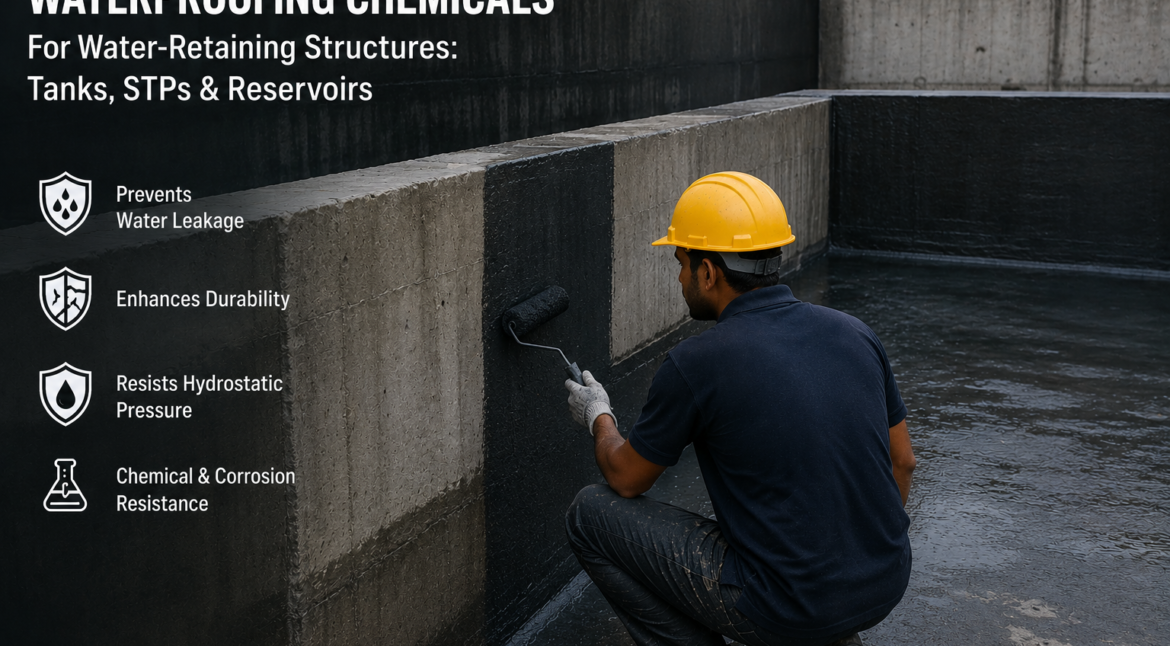
Waterproofing Chemicals for Water-Retaining Structures: Tanks, STPs & Reservoirs
Water-retaining structures are expected to perform continuously for years while remaining watertight under constant exposure to water. Whether it is an overhead water tank, underground reservoir, sewage treatment plant (STP), fire water tank, or industrial water storage structure, leakage is not just a maintenance issue—it can affect structural durability, operational efficiency, and long-term service life.
Unlike terraces or bathrooms, these structures remain exposed to continuous water pressure. Even a small crack, construction joint, or porous section of concrete can become a pathway for water seepage. Once leakage starts, repairs are often difficult because many of these structures remain operational and cannot be easily taken out of service.
This is why selecting the right waterproofing chemicals during construction is one of the most important decisions for engineers, contractors, and project owners.
Common Question Asked:
Q.1 Can waterproofing chemicals permanently prevent leakage in tanks, STPs, and reservoirs?
Yes, waterproofing chemicals can significantly reduce the risk of leakage when the correct waterproofing system is selected based on the structure type, water pressure conditions, and concrete quality.
Why Water-Retaining Structures Fail Even When Concrete Looks Sound
Many water-retaining structures begin leaking even though the concrete appears visually intact. In most cases, the problem starts within the concrete itself.
Capillary Pores in Concrete
Concrete is not completely waterproof. It contains microscopic capillaries that allow moisture to move through the structure over time. Under continuous water pressure, these pathways become active channels for seepage.
Construction Joints
Large tanks and reservoirs are usually cast in multiple stages. The interface between two concrete pours often becomes a weak point if proper waterproofing measures are not incorporated.
Shrinkage Cracks
Concrete naturally shrinks during curing. If shrinkage stresses are not properly managed, fine cracks can develop and allow water penetration.
Honeycombing and Voids
Poor compaction during concreting creates honeycombs and voids. These defects significantly increase the possibility of leakage.
Pipe Penetrations and Service Openings
Areas around pipes, sleeves, and service entries frequently become leakage points due to differential movement and inadequate sealing.
Because of these vulnerabilities, relying on concrete alone is rarely enough for long-term watertight performance.
Why Waterproofing Chemicals Are Essential for Tanks, STPs & Reservoirs
Water-retaining structures operate under conditions that are very different from normal buildings.
They are continuously exposed to:
- Positive water pressure
- Constant moisture
- Wet-dry cycles
- Chemical exposure in STPs
- Hydrostatic pressure
- Long-term durability requirements
Without proper waterproofing, water gradually penetrates the concrete and begins affecting the reinforcement, eventually leading to corrosion and structural deterioration.
The purpose of waterproofing chemicals is not only to stop visible leakage but also to improve the durability of the entire structure.
Where Crystalline Waterproofing Fits Best
For structures where water pressure acts directly through the concrete, crystalline waterproofing is often one of the most effective solutions.
Unlike surface coatings, crystalline systems react with moisture and cement particles within the concrete. The reaction forms insoluble crystals that block capillaries and micro-pores, reducing water movement through the concrete matrix.
This approach is particularly useful for:
- Underground reservoirs
- Water tanks
- Lift pits
- Basement water-retaining structures
- STPs exposed to continuous moisture
In such applications, products such as POLYCOTE CWP are commonly used because they work within the concrete rather than simply forming a surface barrier.
One of the key advantages of crystalline waterproofing is that protection remains active within the concrete itself, making it suitable for long-term water-retaining structures.
Where Cement Based Waterproofing Works Best
Many engineers prefer cement based waterproofing systems for internal tank surfaces because they bond well with concrete and become part of the substrate.
These systems are commonly used for:
- Potable water tanks
- Internal reservoir walls
- Concrete chambers
- Treatment plant structures
- Sump tanks
The main benefits include:
- Excellent compatibility with concrete
- Good resistance to positive water pressure
- Ease of application on prepared surfaces
- Durable cementitious protection layer
Depending on the project requirements, contractors frequently use systems such as POLYCOTE WH, POLYCOTE WH CRETE, and for cementitious waterproofing applications.
These products are often selected when the waterproofing layer must integrate closely with the concrete surface rather than remain as an independent membrane.
When Liquid Membrane Waterproofing Becomes Necessary
While crystalline and cement-based systems are commonly used within the structure, there are situations where external waterproofing protection becomes equally important.
This is where liquid membrane waterproofing systems play a valuable role.
Liquid membranes form a seamless waterproof layer over concrete surfaces and help prevent water ingress from the exposed side of the structure.
Typical applications include:
- Externally exposed water-retaining structures
- Roof slabs above water tanks
- Treatment plant structures
- Concrete surfaces exposed to weathering
- Ancillary water management structures
The main advantages include:
- Seamless coverage
- Flexibility
- Ability to accommodate minor movement
- Coverage over irregular surfaces
For such applications, contractors often specify systems such as SUPERKOT and
SUPERKOT N, where a flexible waterproof membrane is required.
Liquid membrane waterproofing is especially useful where movement, weather exposure, or complex surface geometry makes traditional systems difficult to apply.
Choosing Waterproofing Chemicals Based on Structure Type
Not all water-retaining structures face the same challenges.
Water Storage Tanks
Water tanks require waterproofing systems that can resist continuous water contact and maintain watertightness over long periods.
Typical solutions include:
- Crystalline waterproofing within concrete
- Cement-based waterproofing on internal surfaces
- Joint treatment systems
Sewage Treatment Plants (STPs)
STPs present additional challenges because the structure is exposed to moisture, chemicals, and biological activity.
Waterproofing systems must therefore provide:
- Moisture resistance
- Concrete protection
- Long-term durability
A combination of crystalline and cementitious waterproofing is often used in these environments.
Reservoirs
Reservoirs generally involve large concrete surfaces subjected to varying water levels and pressure conditions.
Key considerations include:
- Crack management
- Hydrostatic pressure resistance
- Durability under long-term exposure
Many reservoir projects use multiple waterproofing systems together to address different risk areas.
Common Waterproofing Mistakes Contractors Make
Even the best waterproofing chemicals cannot compensate for poor execution.
Some of the most common mistakes include:
Ignoring Surface Preparation
Loose particles, laitance, and contamination reduce adhesion and waterproofing performance.
Waterproofing After Leakage Starts
Preventive waterproofing is always more effective and economical than repair work.
Poor Joint Treatment
Most water-retaining structure failures originate at construction joints and service penetrations.
Using One System Everywhere
Different areas of the structure often require different waterproofing approaches.
Inadequate Curing
Improper curing can affect both concrete quality and waterproofing performance.
Conclusion
Water-retaining structures face continuous exposure to water pressure, moisture, and environmental stress. Leakage rarely occurs because of a single defect; it is usually the result of porous concrete, cracks, joints, or inadequate waterproofing protection.
Selecting the appropriate waterproofing chemicals during construction helps reduce these risks and improves the durability of tanks, STPs, and reservoirs. Whether the project requires crystalline waterproofing, cement based waterproofing, or liquid membrane waterproofing, the choice should be based on the structure’s design, exposure conditions, and long-term performance requirements.
A well-planned waterproofing system is often the difference between a structure that performs reliably for decades and one that requires repeated repairs. For more information, Contact Us.
FAQs
-
1. Which waterproofing chemicals are suitable for water tanks?
Crystalline waterproofing, cement-based waterproofing, and liquid membrane systems are commonly used depending on the tank design and exposure conditions.
-
2. Is crystalline waterproofing effective for underground reservoirs?
Yes. Crystalline waterproofing helps reduce concrete permeability and is widely used in underground water-retaining structures.
-
3. Can cement based waterproofing be applied to existing concrete surfaces?
Yes. Cement-based waterproofing systems can be applied to properly prepared concrete substrates.
-
4. Why do STPs require specialized waterproofing systems?
STPs remain exposed to continuous moisture and aggressive conditions, making durable waterproofing essential for long-term performance.
-
5. Where is liquid membrane waterproofing commonly used in water-retaining structures?
Liquid membrane waterproofing is commonly used on exposed concrete surfaces, roof slabs above tanks, and external areas requiring flexible waterproof protection.