


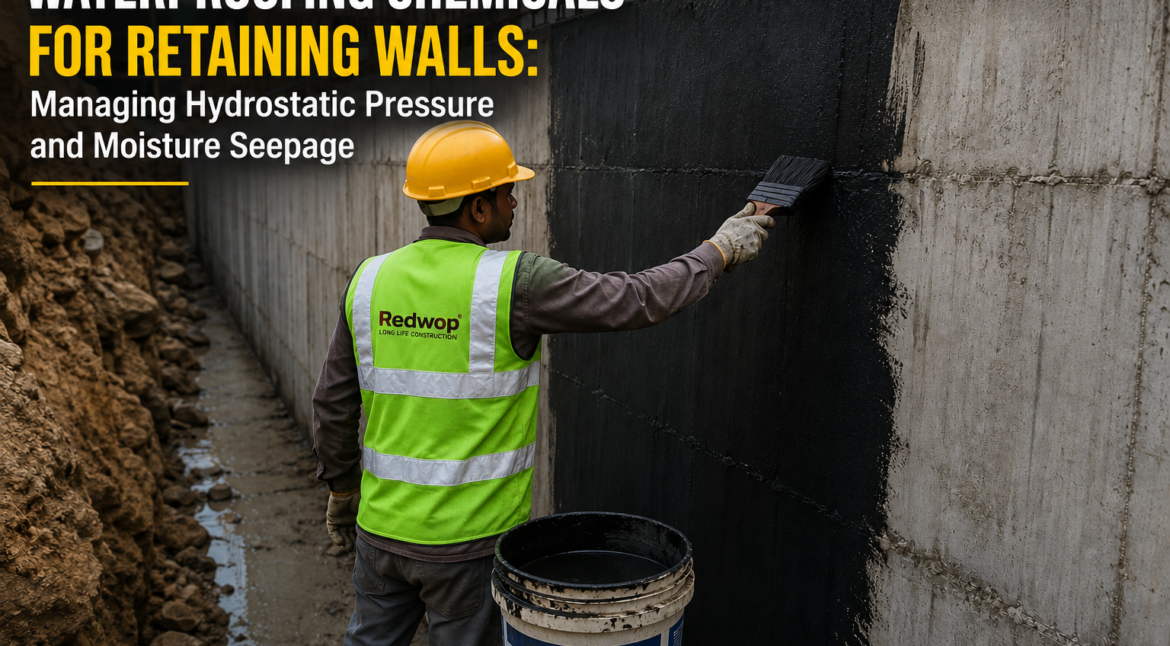
Waterproofing Chemicals for Retaining Walls: Managing Hydrostatic Pressure and Moisture Seepage
Retaining walls are continuously exposed to soil moisture, groundwater pressure, and changing environmental conditions. Unlike exposed walls, retaining structures remain in constant contact with damp soil, making them highly vulnerable to seepage, water penetration, and long-term structural deterioration.
If waterproofing is not properly designed, hydrostatic pressure gradually forces water through pores, joints, cracks, and weak concrete zones. Over time, this can lead to damp patches, coating failure, reinforcement corrosion, and structural damage.
This is why selecting the correct Waterproofing Chemicals becomes essential for maintaining retaining wall durability and moisture resistance.
Common Question Asked:
Q.1 Why do retaining walls develop seepage and dampness over time?
Retaining walls develop seepage mainly because of hydrostatic pressure, inadequate waterproofing, poor drainage systems, concrete porosity, and water penetration through cracks and joints.
Why Retaining Walls Face Severe Waterproofing Challenges
Unlike normal external walls, retaining walls continuously resist:
- groundwater pressure
- moisture migration
- soil saturation
- capillary water movement
This constant exposure increases the risk of:
- dampness
- coating debonding
- concrete deterioration
- reinforcement corrosion
Without proper waterproofing systems, moisture eventually penetrates through weak areas in the structure.
What Is Hydrostatic Pressure in Retaining Walls?
Hydrostatic pressure develops when groundwater accumulates behind the retaining wall.
As water pressure increases:
- moisture pushes against the concrete surface
- water penetrates through pores and cracks
- leakage paths develop gradually
Higher pressure often causes failure in low-quality or improperly applied waterproofing systems.
Common Causes of Moisture Seepage in Retaining Walls
Concrete Porosity
Poorly compacted concrete contains capillary pores that allow water migration.
Cracks and Construction Joints
Shrinkage cracks and weak joints become direct pathways for moisture intrusion.
Inadequate Drainage
Without proper drainage, water accumulates behind the wall and increases hydrostatic pressure.
Waterproofing Failure
Weak or damaged waterproofing layers lose adhesion over time.
Why Waterproofing Chemicals Are Essential for Retaining Walls
High-performance waterproofing chemicals help:
- reduce water penetration
- improve concrete durability
- resist hydrostatic pressure
- protect reinforcement from corrosion
A properly selected waterproofing system significantly improves long-term structural performance.
Role of Liquid Membrane Waterproofing in Retaining Walls
Flexible liquid membrane waterproofing systems create a seamless protective barrier that helps prevent moisture ingress.
Liquid membranes are particularly useful because they:
- accommodate minor structural movement
- cover irregular surfaces effectively
- reduce leakage through hairline cracks
For retaining walls exposed to continuous moisture and external soil contact, SUPERKOT provides flexible waterproofing protection that helps resist water penetration and surface seepage.
In areas where enhanced weather resistance and external durability are required, SUPERKOT N helps improve waterproofing performance under demanding site conditions.
For structures requiring durable moisture protection with improved surface coverage, SMARZKOT WATERGUARD helps create a protective waterproof layer against external water exposure.
How Crystalline Waterproofing Improves Concrete Protection
Unlike surface coatings, crystalline waterproofing systems work within the concrete matrix itself.
These systems react with moisture and cement particles to:
- block capillary pores
- reduce water permeability
- improve internal waterproofing performance
For RCC retaining walls where deep moisture resistance is required, POLYCOTE CWP helps improve internal concrete waterproofing and long-term resistance against water seepage.
This becomes especially useful in:
- basement retaining walls
- underground structures
- water-retaining RCC systems
Importance of Cement Based Waterproofing for RCC Retaining Walls
In many retaining wall applications, cement based waterproofing systems provide strong adhesion with concrete surfaces while improving moisture resistance.
These systems help:
- seal concrete pores
- improve substrate compatibility
- resist moisture penetration
- enhance surface durability
For retaining walls requiring cementitious waterproof protection, POLYCOTE WH helps improve resistance against moisture seepage and dampness.
Where higher bonding strength and enhanced waterproof durability are required, POLYCOTE WH CRETE supports stronger waterproof performance on RCC surfaces.
For structures exposed to continuous damp conditions and water pressure, POLYCOTE WH100 helps improve waterproof protection and long-term surface durability.
Why Drainage Is Critical Along with Waterproofing
Even the best waterproofing systems can fail if hydrostatic pressure becomes excessive.
Proper retaining wall drainage helps:
- reduce water accumulation
- lower pressure buildup
- improve waterproofing lifespan
- minimize seepage risk
Common drainage solutions include:
- drainage boards
- weep holes
- perforated pipes
- filter media systems
Common Site Mistakes That Cause Waterproofing Failure
Applying Waterproofing on Weak Surfaces
Loose or contaminated substrates reduce adhesion performance.
Ignoring Cracks and Joints
Unsealed cracks become major leakage paths.
Poor Surface Preparation
Dust and laitance weaken waterproof coating bonding.
Inadequate Drainage Provision
Water buildup increases hydrostatic pressure against the wall.
Improper Coating Thickness
Thin application layers reduce waterproofing effectiveness.
Best Practices for Retaining Wall Waterproofing
Prepare the Surface Properly
Ensure surfaces are clean, sound, and free from contaminants.
Repair Cracks Before Waterproofing
Seal joints and damaged areas properly.
Select the Correct Waterproofing System
Choose waterproofing based on pressure exposure and substrate condition.
Ensure Uniform Application Thickness
Avoid weak areas and discontinuities.
Provide Proper Drainage
Reduce hydrostatic pressure buildup behind the wall.
Why Waterproofing System Selection Matters
Retaining walls operate under constant moisture exposure and structural stress.
Using suitable waterproofing chemicals helps:
- improve moisture resistance
- reduce seepage problems
- protect reinforcement
- enhance RCC durability
- extend structural service life
Proper waterproofing significantly reduces long-term maintenance and repair costs.
Conclusion
Retaining walls are continuously exposed to groundwater pressure, soil moisture, and water seepage risks. Without proper protection, hydrostatic pressure gradually damages concrete and weakens structural durability.
Using high-performance waterproofing chemicals helps improve moisture resistance and protect retaining wall structures from long-term deterioration. Flexible liquid membrane waterproofing systems like SUPERKOT, SUPERKOT N, and SMARZKOT WATERGUARD help resist external moisture ingress, while crystalline waterproofing solutions such as POLYCOTE CWP improve internal concrete protection.
Additionally, cement based waterproofing systems including POLYCOTE WH, POLYCOTE WH CRETE, and POLYCOTE WH100 help improve waterproof durability on RCC retaining walls.
Combined with proper drainage and surface preparation, the correct waterproofing system ensures durable and long-lasting retaining wall performance. For more information, Contact Us.
FAQs
-
1. Why do retaining walls leak over time?
Retaining walls leak mainly due to hydrostatic pressure, cracks, poor drainage, and waterproofing failure.
-
2. What is hydrostatic pressure in retaining walls?
It is the pressure created by accumulated groundwater behind the wall structure.
-
3. Why is liquid membrane waterproofing useful for retaining walls?
Liquid membranes create flexible seamless protection against moisture penetration.
-
4. How does crystalline waterproofing work?
It blocks internal concrete pores and reduces water permeability from within the concrete.
-
5. Why is drainage important along with waterproofing?
Drainage reduces water buildup and lowers hydrostatic pressure on retaining walls.