


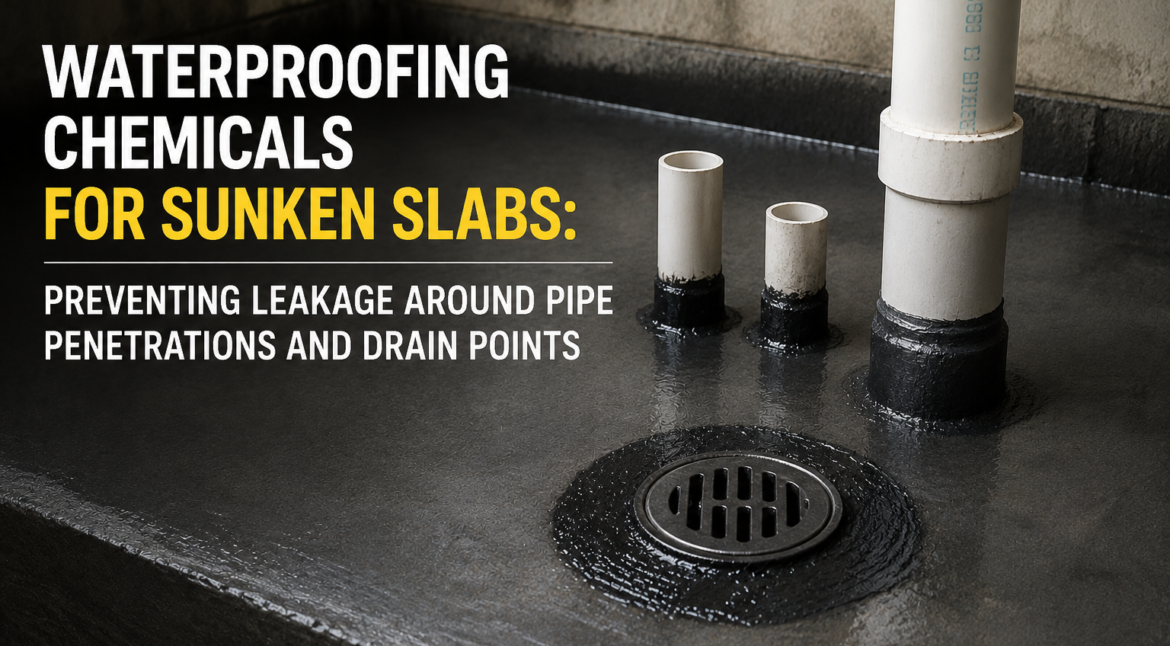
Waterproofing Chemicals for Sunken Slabs: Preventing Leakage Around Pipe Penetrations and Drain Points
Sunken slabs are one of the most leakage-prone areas in residential and commercial construction. Bathrooms, toilets, utility areas, and wet zones contain multiple pipe penetrations, drainage outlets, and construction joints that create vulnerable points for water ingress.
In many projects, leakage does not occur because the slab itself is weak. The actual problem usually starts around pipe sleeves, drain points, and improperly treated waterproofing transitions. Once water begins penetrating these areas, it gradually damages plaster, ceilings, finishes, and structural components below.
This is why selecting the right waterproofing chemicals and applying them correctly is critical for long-term protection in sunken slab areas.
Common Question Asked:
Q.1 Why do sunken slabs leak around pipes and drain outlets?
Sunken slabs commonly leak due to improper waterproofing around pipe penetrations, weak drain detailing, poor surface preparation, and cracking caused by movement or shrinkage.
Why Sunken Slabs Are Highly Vulnerable to Leakage
Unlike standard floor slabs, sunken slabs contain multiple interruptions in the concrete surface.
These include:
- plumbing pipe penetrations
- floor traps and drain outlets
- construction joints
- slope transitions
- repair patches
Each of these locations becomes a potential leakage path if waterproofing continuity is not maintained.
Common Leakage Areas in Sunken Slabs
1. Pipe Penetration Zones
Pipes passing through concrete create gaps and weak interfaces where water can travel.
2. Drain and Floor Trap Areas
Improper sealing around floor drains allows water seepage below tiles and screed.
3. Wall-to-Floor Junctions
Corners and junctions experience movement stress and often crack over time.
4. Screed Cracks and Surface Voids
Shrinkage cracks in screed layers allow moisture to penetrate downward.
Why Waterproofing Fails Around Pipe Penetrations
Pipe penetrations are one of the most difficult areas to waterproof because:
- pipes and concrete expand differently
- movement occurs during usage
- small gaps form around sleeves
If the waterproofing layer is rigid or discontinuous, leakage begins around these weak points.
Role of Waterproofing Chemicals in Sunken Slabs
Modern waterproofing systems are designed to:
- create seamless barriers
- reduce water absorption
- seal pores and microcracks
- improve durability under wet conditions
Different waterproofing technologies work together to provide complete protection.
Cement Based Waterproofing for Wet Areas
One of the most widely used systems for sunken slabs is cement based waterproofing.
These coatings bond strongly with concrete and masonry surfaces while forming a protective waterproof layer.
Products like:
are suitable for:
- internal wet areas
- bathroom waterproofing
- sunken slab applications
- screed and masonry surfaces
These systems help reduce water penetration and improve resistance to dampness.
Liquid Membrane Waterproofing for Flexible Protection
Areas around pipe penetrations and drain outlets require waterproofing systems that can tolerate slight movement.
This is where liquid membrane waterproofing becomes highly effective.
Liquid membranes create:
- seamless waterproof layers
- flexible protection around corners and penetrations
- continuous coverage over complex shapes
Redwop’s Products, such as:
Provide flexible protection that helps maintain waterproofing continuity around difficult detailing areas.
Crystalline Waterproofing for Internal Protection
Even with surface coatings, moisture can still travel through concrete pores and microcracks.
Crystalline waterproofing systems work internally within the concrete structure.
They react with moisture and cement particles to form crystals that:
- block capillary pores
- seal microcracks
- reduce permeability
A product like POLYCOTE CWP helps improve internal waterproofing performance and long-term durability in wet structures.
Why Drain Points Need Special Attention
Drain outlets are subjected to:
- continuous water flow
- movement stress
- cleaning chemical exposure
If waterproofing is not properly integrated into the drain system:
- Leakage develops around the outlet
- water reaches lower slabs
- dampness spreads into the surrounding areas
Proper detailing around drain points is one of the most important parts of sunken slab waterproofing.
Common Site Mistakes That Cause Leakage
Inadequate Surface Preparation
Dust, laitance, and loose particles reduce waterproofing adhesion.
Improper Pipe Sealing
Small gaps around pipes are often left untreated.
Discontinuous Waterproofing Layer
Breaks in the membrane create leakage paths.
Poor Corner Treatment
Wall-floor junctions crack easily if not reinforced properly.
Insufficient Waterproofing Thickness
Thin or uneven coating application reduces effectiveness.
Best Practices for Waterproofing Sunken Slabs
Prepare the Surface Properly
Ensure concrete is clean, sound, and free from loose particles.
Treat Pipe Penetrations Carefully
Seal gaps and reinforce vulnerable areas before coating.
Reinforce Corners and Junctions
Movement-prone zones require additional protection.
Use Compatible Waterproofing Systems
Combine cementitious and flexible membrane systems where needed.
Conduct Ponding Test
Always verify waterproofing performance before tiling.
Why Waterproofing System Selection Matters
Sunken slabs remain under continuous moisture exposure throughout their service life.
Using the right waterproofing system helps:
- prevent leakage
- protect lower floors
- improve durability
- reduce maintenance costs
Selecting suitable waterproofing chemicals ensures long-term performance and reliability.
Conclusion
Sunken slabs are among the most sensitive waterproofing areas in construction due to multiple pipe penetrations, drain points, and wet exposure conditions. Leakage often begins at these vulnerable details when waterproofing continuity is compromised.
Using the correct combination of cement based waterproofing, liquid membrane waterproofing, and crystalline waterproofing systems helps create durable and long-lasting protection.
Products like POLYCOTE WH, SUPERKOT, and POLYCOTE CWP provide different layers of protection that work together to reduce leakage risk and improve waterproofing performance in wet areas.
With proper detailing, surface preparation, and application practices, sunken slab leakage can be effectively controlled. For more information, Contact Us.
FAQs
-
1. Why do sunken slabs leak around pipes?
Leakage occurs due to improper sealing, movement around penetrations, and weak waterproofing continuity.
-
2. Is cement based waterproofing suitable for bathrooms?
Yes, cementitious systems are widely used for internal wet area waterproofing.
-
3. What is the advantage of liquid membrane waterproofing?
Liquid membranes provide seamless and flexible waterproof protection.
-
4. How does crystalline waterproofing work?
It forms crystals inside concrete pores and blocks water pathways internally.
-
5. Why is a ponding test important?
A ponding test helps verify waterproofing performance before final finishing work begins.