

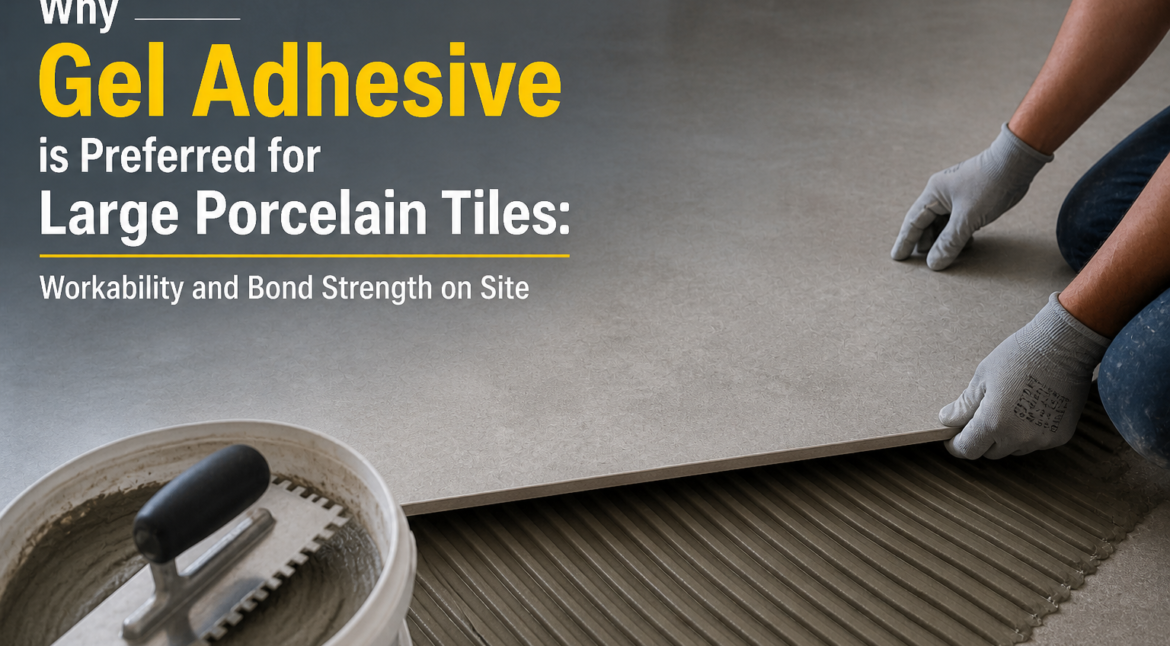
Why Gel Adhesive is Preferred for Large Porcelain Tiles: Workability and Bond Strength on Site
Large porcelain tiles have become a preferred choice in modern construction due to their aesthetics, minimal joints, and premium finish. However, installing these tiles is far more demanding than standard tile applications. Their size, weight, and low water absorption create serious bonding challenges on-site.
Many failures, such as tile slippage, hollow sound, edge lifting, or debonding, are directly linked to the wrong adhesive selection. This is where gel adhesive stands out as a more reliable solution for large-format tiles.
Unlike conventional cement-based adhesives, gel adhesives are designed to provide better workability, improved coverage, and stronger bonding under real site conditions.
Common Question Asked:
Q.1 Is gel adhesive necessary for large porcelain tiles?
Yes, gel adhesive provides better workability, higher bond strength, and improved handling, making it more suitable for large porcelain tiles compared to standard adhesives.
Why Large Porcelain Tiles Are Difficult to Install
Large tiles behave differently from smaller formats due to:
- low porosity (very low water absorption)
- higher weight
- increased surface area
- sensitivity to uneven bonding
These factors require an adhesive that can:
- provide full coverage
- maintain a strong grip
- allow sufficient working time
- prevent void formation
What Makes Gel Adhesive Different
Gel adhesives are engineered to combine flowability with stability. They have a unique consistency that allows easy spreading while maintaining thickness under tiles.
A product like PROLIX GEL demonstrates this behavior by offering:
- smooth application
- better coverage under large tiles
- improved workability on site
- strong and consistent bonding
This makes it highly effective for handling large-format porcelain tiles.
Workability Advantages of Gel Adhesive
1. Easy Spreading and Better Coverage
One of the biggest challenges with large tiles is achieving full adhesive contact. Gel adhesive spreads more easily across the surface, ensuring:
- uniform adhesive layer
- better tile back coverage
- reduced chances of voids
This directly improves bonding performance.
2. Longer Open Time
Large tiles require more time for placement and adjustment. Gel adhesive provides longer open time, allowing:
- proper tile alignment
- correction during installation
- reduced risk of premature drying
This is especially useful in hot weather or large-area installations.
3. Non-Sag Performance on Walls
When used on vertical surfaces, large tiles tend to slip due to their weight.
Gel adhesive helps:
- control tile movement
- maintain alignment
- reduce rework
This makes it ideal for wall applications.
Bond Strength Benefits for Large Tiles
1. Strong Adhesion on Low-Absorption Tiles
Porcelain tiles have very low absorption, which makes bonding difficult for standard adhesives.
Gel adhesive improves adhesion by:
- enhancing the contact area
- improving bonding strength
- reducing the risk of tile detachment
2. Reduced Hollow Sound and Voids
Incomplete adhesive coverage leads to hollow sound and weak bonding.
With gel adhesive:
- coverage improves
- The void formation reduces
- load distribution becomes uniform
3. Better Performance Under Stress
Large tiles experience thermal expansion and movement.
Gel adhesive accommodates this by:
- providing flexibility
- reducing stress concentration
- preventing cracks and debonding
Comparison with Other Adhesive Types
Standard Tile Adhesive
While tile adhesive works well for smaller tiles, it may not perform effectively for large porcelain tiles due to:
- limited workability
- lower flexibility
- reduced coverage control
Epoxy Tile Adhesive
In high-performance or industrial applications, epoxy tile adhesive offers:
- very high bond strength
- chemical resistance
- durability
However, epoxy systems are more complex to apply and are typically used in specialized environments rather than general tiling.
Use of Gel Adhesive for Natural Stone and Large Tiles
Gel adhesive is also suitable as a natural stone adhesive, where:
- tile weight is higher
- bonding requirements are critical
- Uniform support is necessary
It ensures proper support and reduces stress on stone surfaces.
Common Site Problems Solved by Gel Adhesive
Gel adhesive helps address common issues such as:
- tile slippage on walls
- hollow sound under tiles
- uneven adhesive distribution
- premature drying during installation
This makes it a preferred choice for contractors handling large-format tiles.
Best Practices for Using Gel Adhesive
Surface Preparation
Ensure the substrate is:
- clean
- level
- structurally sound
Proper Troweling Technique
Use the correct notch size to ensure:
- full coverage
- uniform thickness
Back Buttering for Large Tiles
Apply adhesive on both:
- substrate
- tile back
This ensures better bonding.
Avoid Excess Water Addition
Maintain proper mix consistency to retain adhesive performance.
Why Gel Adhesive Is Considered the Best Tile Adhesive Option
Gel adhesive combines:
- ease of application
- strong bonding
- flexibility
- improved coverage
These properties make it one of the best tile adhesive options for modern tile installation, especially for large porcelain tiles.
Conclusion
Large porcelain tiles demand more than standard installation methods. Their size, weight, and low absorption require adhesives that can deliver consistent performance under real site conditions.
Gel adhesive provides the right balance of workability and bond strength, making it a reliable choice for both floor and wall applications. With solutions like PROLIX GEL, contractors can achieve better coverage, reduce installation errors, and improve long-term durability.
Choosing the right adhesive not only improves tile performance but also minimizes rework and maintenance issues. For more information, Contact Us.
FAQs
-
1. Why is gel adhesive used for large tiles?
Gel adhesive provides better workability, coverage, and bonding strength required for large-format tiles.
-
2. Can standard tile adhesive be used for porcelain tiles?
It can be used for small tiles, but large porcelain tiles require higher-performance adhesives like gel adhesive.
-
3. What causes hollow sound in large tiles?
Hollow sound occurs due to incomplete adhesive coverage and voids under tiles.
-
4. Is gel adhesive suitable for wall applications?
Yes, it provides non-sag performance and better grip for vertical surfaces.
-
5. When should epoxy tile adhesive be used?
Epoxy adhesive is used in industrial or high-performance environments requiring chemical resistance and high strength.