


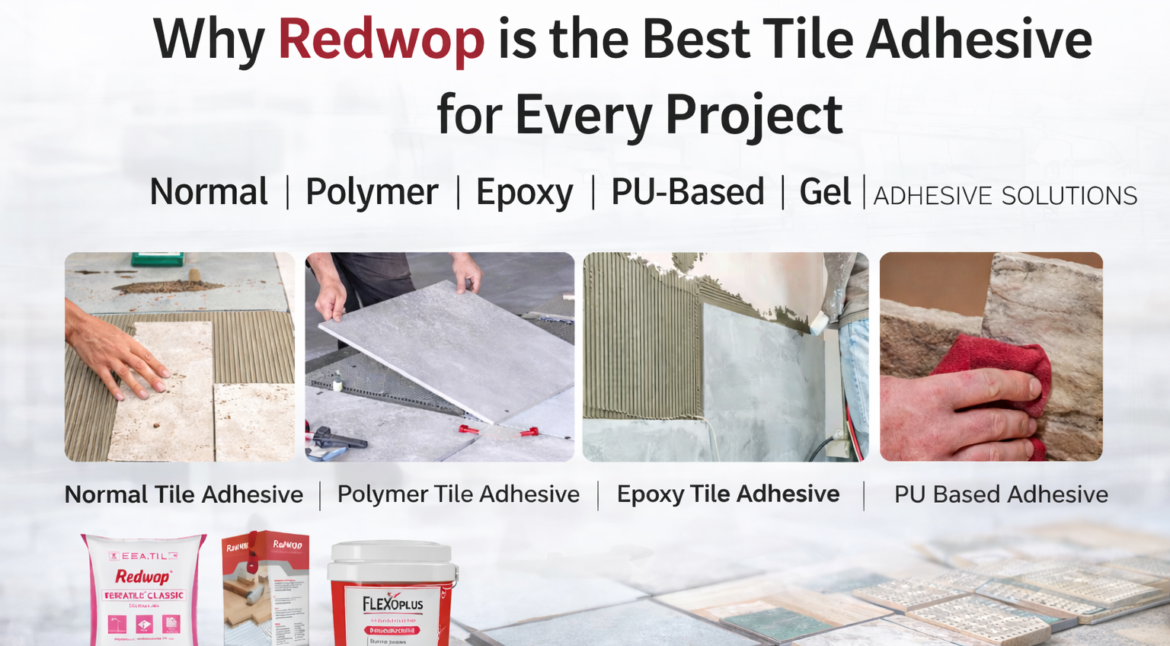
What Makes Redwop the Best Tile Adhesive for Every Project?
Tile fixing is no longer a simple installation activity it is a performance-driven process where bonding strength, flexibility, and durability directly impact the life of the surface. Failures such as tile debonding, hollow sounds, or cracks are often not caused by tiles themselves, but by the wrong selection of adhesive.
In modern construction, different environments demand different adhesive systems. From residential flooring to industrial kitchens and exterior façades, each application requires a specific bonding solution. This is where choosing the right tile adhesive manufacturer becomes critical.
Redwop stands out as a leading tile adhesive manufacturer in India, offering a complete range of solutions engineered for Indian construction conditions. With advanced polymer-modified formulations and specialized systems, Redwop ensures reliable performance across all types of tiling applications.
Common Question Asked:
Q.1 Is one tile adhesive suitable for all types of tiles and applications?
No. Different tiles and site conditions require different adhesive types. Using the wrong adhesive can lead to bond failure, cracks, or tile detachment.
What Tile Adhesives Are Supposed to Do
Tile adhesives are designed to create a strong and durable bond between tiles and substrates such as concrete, plaster, screed, or existing surfaces.
A high-performance tile adhesive should:
- Provide strong adhesion to both tile and substrate
- Accommodate thermal expansion and structural movement
- Resist water penetration and environmental exposure
- Prevent tile slippage during installation
- Ensure long-term durability without debonding
Redwop offers a complete system of tile adhesives—ranging from standard cement-based solutions to high-performance epoxy and PU-based systems—ensuring the right solution for every project requirement.
Types of Tile Adhesives and Their Applications
1. Type 1Tile Adhesive (C1 Adhesive)
Normal tile adhesive is a cement-based solution made from cement, graded sand, and additives. It is suitable for standard indoor applications where conditions are stable and moisture exposure is minimal.
Best suited for:
- Ceramic and porcelain tiles
- Indoor wall and floor applications
- Residential and light commercial projects
Key Benefits:
- Easy to apply
- Good initial grab
- Cost-effective solution
Redwop’s TERATILE CLASSIC is designed for reliable performance in standard tiling conditions where high flexibility is not required.
2. Polymer Tile Adhesive
Polymer tile adhesives are enhanced with EVA, acrylic, or vinyl-based polymers to improve bonding strength, flexibility, and resistance properties.
These adhesives significantly outperform conventional cement adhesives, especially in demanding conditions.
Best suited for:
- External walls and façades
- Wet areas like bathrooms and showers
- Large-format tiles and stone
- High-rise and vibration-prone structures
Key Benefits:
- High bond strength
- Reduced water permeability
- Improved flexibility and crack resistance
- Slip resistance and deformability
Redwop’s range such as Teratile Silver, Teratile Gold, Teratile Diamond, POLYMIX, and others comply with standards like IS 15477 and EN 12004, making them suitable for both indoor and outdoor applications.
3. Epoxy Tile Adhesive
Epoxy tile adhesive is a high-performance system consisting of resin and hardener, designed for extreme conditions where standard adhesives fail.
Best suited for:
- Industrial kitchens
- Swimming pools
- Laboratories and hospitals
- High-traffic commercial areas
Key Benefits:
- Exceptional tensile and shear strength
- Chemical and water resistance
- Non-porous and highly durable
- Fast curing
Unlike cement-based adhesives, epoxy systems provide superior resistance to chemicals, oils, and thermal stress. Redwop’s FLEXOPLUS is ideal for heavy-duty and specialized applications.
4. PU-Based Adhesive
PU (Polyurethane) tile adhesive is a ready-to-use, moisture-curing system that offers high flexibility and strong adhesion across various substrates.
Best suited for:
- High-humidity areas (bathrooms, saunas)
- Tiling over unconventional surfaces
- Wall applications requiring strong grip
Key Benefits:
- No mixing required
- Excellent initial tack
- High water resistance
- Strong bonding on multiple substrates
Redwop’s FLEXO PU delivers consistent performance in challenging environments where flexibility and moisture resistance are critical.
5. Gel Adhesive
Gel adhesives are advanced formulations designed to combine strength, flexibility, and ease of application with a thixotropic yet fluid consistency.
Best suited for:
- Large-format tiles
- Vertical and horizontal applications
- Ceramic, porcelain, and natural stone
Key Benefits:
- High structural strength
- Excellent workability
- Non-sag performance
- Suitable for all tile sizes
Redwop’s PROLIX GEL ensures uniform application and strong bonding across a wide range of tile types.
Why Redwop Stands Out
Redwop is not just a product supplier—it provides a complete tiling solution system designed for real site conditions.
Key Differentiators:
- Wide range of adhesive technologies (TYPE 1, TYPE 2, TYPE 3, TYPE 4, TYPE 5)
- Products compliant with industry standards (IS & EN)
- Solutions for both basic and high-performance applications
- Trusted by contractors, architects, and engineers across India
Whether the requirement is economical tiling or heavy-duty industrial bonding, Redwop offers a targeted solution instead of a one-size-fits-all approach.
Practical Guidelines for Choosing the Right Tile Adhesiv
To ensure long-lasting tile performance:
- Match adhesive type with tile size and material
- Consider environmental exposure (indoor, outdoor, wet area)
- Use polymer or epoxy systems for high-stress conditions
- Ensure proper surface preparation before application
- Follow manufacturer guidelines for mixing and application
Selecting the correct adhesive system significantly reduces failure risks and improves durability.
Conclusion
Tile installation success depends largely on selecting the right adhesive system. Different applications demand different bonding technologies, and using the wrong type can lead to costly failures.
Redwop offers a complete range of tile adhesives, from standard cement-based solutions to advanced polymer, epoxy, PU, and gel systems, ensuring every project gets the right product for its specific requirement.
With a strong focus on performance, durability, and real-world application needs, Redwop continues to be a trusted choice for tile adhesive solutions across India.
FAQs
-
1. Which tile adhesive is best for large tiles?
Polymer-modified or gel adhesives are recommended due to their high bond strength and flexibility.
-
2. Can TYPE 1 tile adhesive be used in bathrooms?
It is not recommended. Polymer-modified adhesives are better suited for wet areas.
-
3. When should epoxy tile adhesive be used?
In industrial, chemical, or high-moisture environments where maximum durability is required.
-
4. What is the advantage of PU-based tile adhesive?
It is ready-to-use, highly flexible, and performs well in moisture-prone and complex substrates.
-
5. Is one adhesive enough for all applications?
No. Each application requires a specific adhesive type for optimal performance and durability.