


Why Crack Fillers Fail in Repairs: Surface Issues, Application Errors, and Material Limitations
Crack repair is one of the most common maintenance activities in construction, yet it is also one of the most frequently repeated. Cracks often reappear, widen, or allow moisture ingress even after repair, leading to ongoing damage and increased maintenance costs.
In most cases, the failure is not due to the crack filler itself, but due to improper application, incorrect material selection, or untreated underlying causes. The effectiveness of a crack repair system depends heavily on how well the filler integrates with the substrate and performs under environmental and structural stress.
Understanding why crack fillers fail is essential for achieving long-lasting repairs in concrete, masonry, plaster, and tile surfaces.
Common Question Asked:
Q.1 Can cracks reappear even after using a crack filler?
Yes, cracks can reappear if the root cause is not addressed, or if the wrong filler type, poor surface preparation, or incorrect application methods are used.
What Crack Fillers Are Supposed to Do
Crack fillers are designed to seal, repair, and protect surfaces by filling gaps and preventing further deterioration.
A high-performance crack filler should:
- Penetrate deep into cracks and fissures
- Provide strong adhesion to multiple substrates
- Remain flexible to accommodate movement
- Prevent water ingress and environmental damage
- Deliver a smooth, paintable surface finish
Redwop offers advanced crack filler solutions engineered for both structural protection and aesthetic repair across residential, commercial, and industrial applications.
Types of Crack Fillers and Their Applications
1. Moisture-Curing Crack Filler
This type of crack filler is designed for deep penetration and long-term sealing performance. Its low-viscosity formulation allows it to enter fine cracks and form a durable, flexible barrier.
Best suited for:
- Concrete and masonry cracks
- Outdoor surfaces exposed to weather
- Structural joints and moving cracks
Key Benefits:
- Deep penetration (0.5 mm to 10 mm cracks)
- Waterproof and chemical-resistant
- Resistant to freeze-thaw cycles
- High durability under stress
Redwop’s crack filler systems provide long-lasting protection by sealing cracks and preventing further damage from moisture and environmental exposure.
2. Acrylic-Based Crack Filler
Acrylic crack fillers are ready-to-use compounds designed for surface-level repairs where flexibility, finish, and ease of application are important.
Best suited for:
- Interior and exterior walls
- Plaster and masonry cracks
- Hairline and non-structural cracks
Key Benefits:
- Excellent adhesion to multiple substrates
- Non-shrink and crack-resistant
- Smooth, paintable finish
- Easy application without sagging
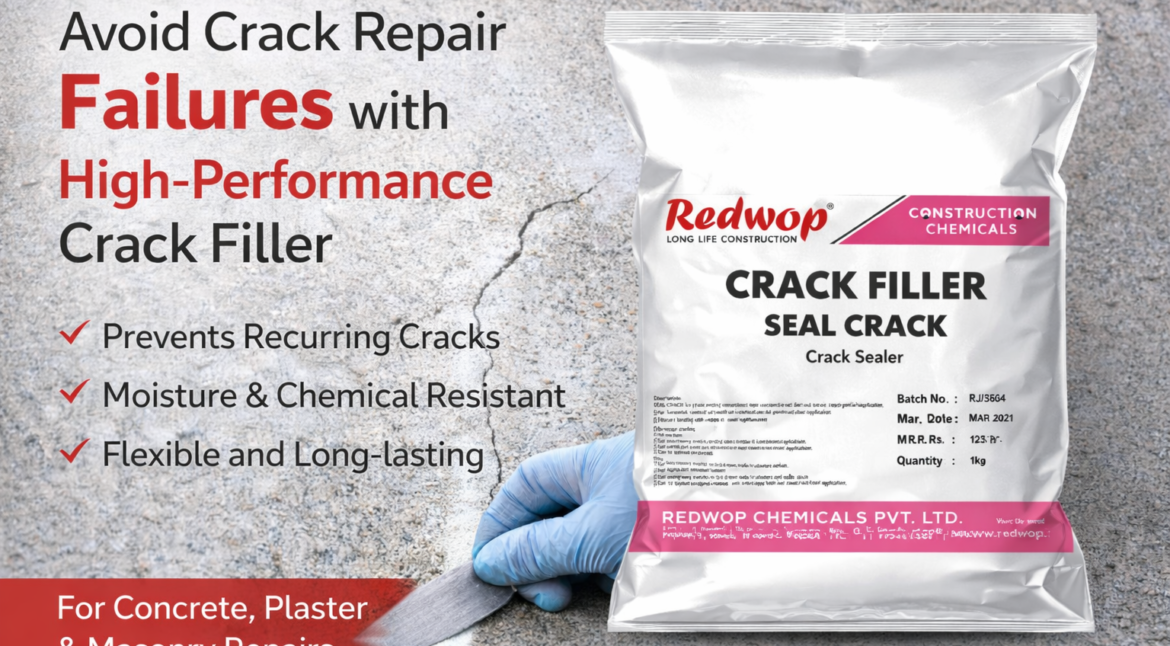
Redwop’s Crack Filler-1 (SEALCRACK) is specifically formulated for minor surface repairs, offering both aesthetic improvement and functional protection.
Failure Cause 1: Poor Surface Preparation
Crack fillers rely on proper bonding with the substrate. If the surface is not prepared correctly, adhesion failure is inevitable.
Common Site Errors:
- Applying filler on dusty or loose surfaces
- Not cleaning debris from cracks
- Ignoring oil, grease, or moisture contamination
Best Practice:
- Clean cracks thoroughly
- Remove loose particles
- Ensure a dry and stable substrate before application
Even the best crack filler cannot bond effectively to an unstable surface.
Failure Cause 2: Ignoring Crack Type and Movement
Not all cracks are the same. Some are static, while others are dynamic and continue to move.
Common Mistake:
- Using rigid filler for moving cracks
- Treating structural cracks as cosmetic issues
Impact:
- Cracks reopen
- Filler detaches or splits
Best Practice:
Use flexible, high-performance fillers that can accommodate movement and prevent recurrence.
Failure Cause 3: Incorrect Application Thickness
Applying too much or too little filler affects performance.
Too Thin:
- Incomplete sealing
- Weak protection
Too Thick:
- Improper curing
- Surface cracking
Best Practice:
Apply filler in controlled layers based on crack width and depth.
Failure Cause 4: Improper Curing and Environmental Conditions
Environmental factors play a major role in crack repair performance.
Common Issues:
- Application during high humidity or rain
- Exposure to extreme temperatures during curing
Impact:
- Reduced adhesion
- Weak bonding and premature failure
Best Practice:
Apply crack filler under recommended environmental conditions and allow proper curing time.
Failure Cause 5: Using the Wrong Product for the Application
Different surfaces and conditions require different types of crack fillers.
Examples:
- Using acrylic filler for deep structural cracks
- Using non-waterproof filler in wet areas
Best Practice:
Select the crack filler based on:
- Crack size and type
- Exposure conditions (indoor/outdoor)
- Structural vs non-structural requirements
Practical Guidelines for Effective Crack Repair
For durable crack repair results:
- Identify the type and cause of cracks
- Clean and prepare the surface thoroughly
- Choose the correct filler (acrylic or moisture-curing)
- Apply evenly using proper tools
- Allow sufficient curing time
- Protect repaired areas from early exposure
Following these steps ensures long-term performance and reduces the risk of recurring damage.
Conclusion
Crack repair failures are rarely caused by the filler alone. Most issues arise from improper surface preparation, incorrect product selection, or ignoring crack behavior.
Redwop Crack Fillers are engineered to provide reliable, long-lasting repair solutions whether for deep structural cracks or minor surface imperfections. With the right application practices and product selection, crack repairs can be both durable and visually seamless.
FAQs
-
1. What is the best crack filler for walls?
Acrylic-based crack fillers like SEALCRACK are ideal for wall cracks due to their smooth finish and paintability.
-
2. Can crack fillers be used outdoors?
Yes, moisture-curing crack fillers are suitable for outdoor applications due to their waterproof and durable properties.
-
3. Do crack fillers prevent water leakage?
Yes, high-quality crack fillers form a waterproof barrier that prevents moisture ingress.
-
4. Are crack fillers flexible?
Yes, advanced crack fillers are designed to accommodate minor structural movement without cracking.
-
5. How long does crack filler last?
When applied correctly, crack fillers provide long-lasting repair and protection against environmental damage.