


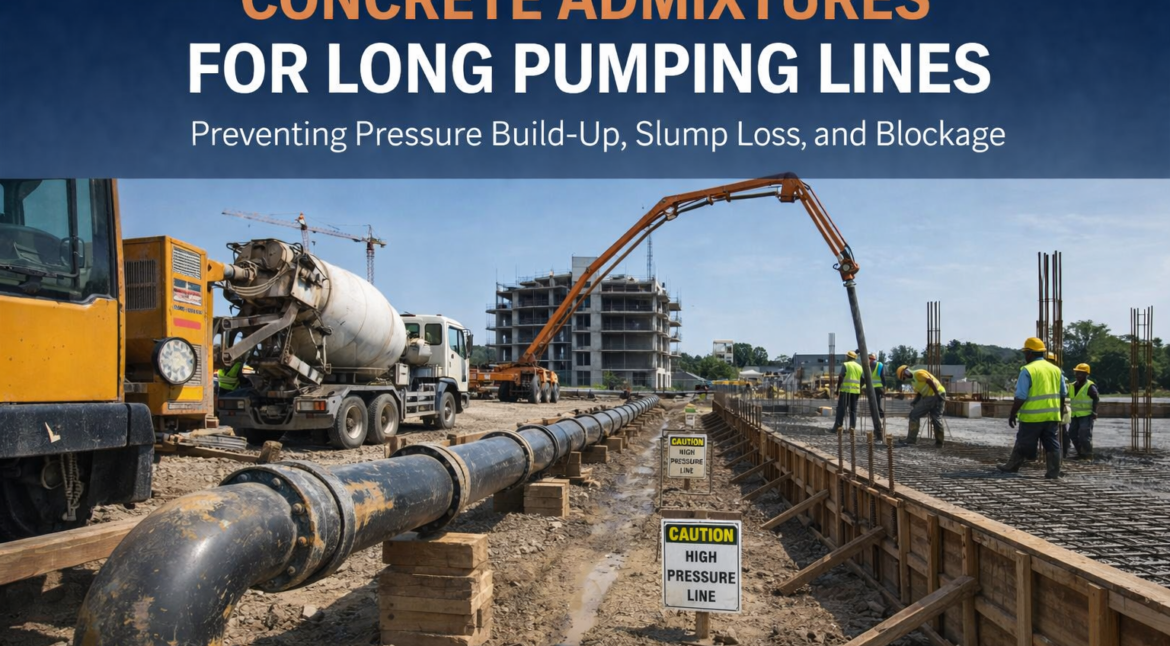
Concrete Admixtures for Long Pumping Lines: Preventing Pressure Build-Up, Slump Loss, and Blockage
Concrete pumping is now standard practice on large residential, commercial, and infrastructure projects. But as pumping distances increase, concrete behavior becomes more difficult to control. Long pumping lines create higher friction, longer travel time, and greater pressure demand inside the pipeline. If the mix is not designed correctly, this often leads to slump loss, pipe blockage, segregation, or inconsistent discharge at the end point.
This is where concrete admixtures become essential. In pumped concrete, admixtures are not just used to improve workability on paper. They directly affect flow behavior, pressure stability, pumpability, and placement quality on site.
For contractors, batching plants, and pumping teams, selecting the right admixture combination can make the difference between a smooth pour and a blocked line that stops the entire operation.
Common Question Asked:
Q.1 Can concrete admixtures improve pumpability in long pumping lines?
Yes, the right concrete admixtures can improve flow retention, reduce friction inside the line, control slump loss, and lower the risk of pressure build-up and blockage during pumping.
Why Long Pumping Lines Create Problems
Concrete that performs well at the batching plant may behave very differently after traveling through a long pump line. As the pumping distance increases, the mix is exposed to continuous pressure, shear stress, and time delay.
Common problems include:
- rapid slump loss before discharge
- high pumping pressure
- segregation in poorly balanced mixes
- pipe choking at bends or reducers
- inconsistent flow at the outlet
These issues are not caused by pumping equipment alone. In many cases, the root cause is mix design and inadequate use of admixtures.
Why Pumpability Depends on the Concrete Mix
Pumpable concrete needs more than just “high slump.” A mix can look workable at discharge and still fail inside the pipeline if cohesion, lubrication, and retention are poor.
For long pumping lines, the concrete must:
- remain workable for the full pumping duration
- Resist segregation under pressure
- Maintain a stable mortar layer along the pipe wall
- pass bends and vertical sections without choking
This is why modern pumped concrete relies heavily on superplasticizer systems and supporting admixtures to maintain performance over time and distance.
Role of Superplasticizer in Long Pumping Lines
Superplasticizers are one of the most important admixtures in pumped concrete because they improve flowability without increasing water content. That matters because adding water may temporarily improve slump, but it also increases segregation risk and reduces final strength.
In long-line pumping, superplasticizers help by:
- reducing internal friction in the mix
- improving flow through congested pipelines
- maintaining better workability at a lower water-cement ratio
- supporting smoother discharge at the placement point
For example, products like Plastcone AP430 can help improve flow characteristics where better dispersion of cement particles is needed. In high-performance pumped mixes, solutions such as Plastcone HS200 and Plastcone HS200 N are relevant where strong workability and consistency are required over longer pumping cycles.
On demanding pours, superplasticizer options such as Procrete HHP, Procrete MP20, and Procrete PCMU can support mix stability and placement performance without relying on excess water addition.
In mixes requiring improved particle packing and pumpability support, materials like Redwop Pozo and Redbrawn 800 may also contribute to better overall rheology depending on the design approach.
Slump Loss and Why It Happens During Pumping
Slump loss is one of the biggest problems in long pumping lines. A mix that leaves the plant with acceptable workability may stiffen significantly before reaching the discharge point.
This usually happens due to:
- long transport or pumping time
- rapid water demand from cementitious materials
- inadequate admixture retention
- hot weather conditions
- Poor control of aggregate moisture
Once the slump begins to drop, the pumping pressure rises. As pressure rises, blockage risk increases.
This is why water reducing admixtures are often used alongside superplasticizers to improve workability without making the mix too wet or unstable.
For instance, products such as Plastcone AP211 and Procrete LP20 can help improve water efficiency and maintain workable concrete under controlled mix conditions. In site and ready-mix applications where stable performance is important, Procrete NPL S15, Procrete S15, and Redbrawn 400 can be used to support more balanced concrete behavior during pumping.
Pressure Build-Up Inside the Line
Pressure build-up usually starts when the concrete loses its ability to move smoothly through the pipeline. This may happen because the mortar fraction is insufficient, the mix becomes too sticky, or coarse particles begin to resist movement at bends and transitions.
Common triggers include:
- low paste volume
- harsh aggregate grading
- inadequate slump retention
- excessive fines or poor cohesion balance
- line layout with too many bends or vertical sections
Admixtures help reduce this risk by improving dispersion, maintaining flow, and stabilizing the mix over time. But they must be chosen based on pump length, temperature, mix design, and placing sequence.
How Air Entrained Admixture Can Support Flow Stability
In some concrete systems, a controlled amount of microscopic air can help improve cohesiveness and reduce harshness in the mix. This does not mean air entrainment is the primary solution for long pumping lines, but in selected designs it can support workability and reduce internal friction.
An air entrained admixture such as Plastcone Airent may be considered where improved consistency and easier movement are needed, provided the air content is compatible with strength and durability requirements.
This should always be used carefully, since excess entrained air can affect strength if not properly controlled.
Are Concrete Accelerators Useful in Long Pumping Lines?
A concrete accelerator is usually not the first solution for long pumping lines. In fact, acceleration can sometimes work against pumpability by shortening the workable period of the mix.
That said, products like Redoshine or Redwop CA 94 may have a role in very specific site conditions where early set or fast strength development is needed after placement. But they should be selected carefully, because for long-distance pumping, slump retention is generally more important than acceleration.
So in this type of application, accelerators are usually a supporting consideration, not a core strategy.
Role of Integral Waterproofing Compound in Pumped Concrete
An integral waterproofing compound is not primarily selected to solve pumping problems, but it may still be part of the concrete design when durability and water resistance are required in the final structure.
For example, in raft slabs, basements, retaining walls, or water-resisting elements placed through pumps, products like Plastcone AP90 Powder and Plastcone AW + may be incorporated to improve resistance to water penetration.
In those cases, the mix designer must ensure that pumpability and waterproofing performance are balanced together.
Practical Site Measures to Prevent Blockage
Admixtures are critical, but they work best when supported by correct site practice.
Important precautions include:
Proper Priming of the Pump Line
Before pumping begins, the line should be primed correctly so the concrete does not immediately lose lubrication.
Controlled Mix Consistency
Do not add random water at the site to “improve flow.” This often creates segregation and weak concrete.
Monitoring Pump Pressure
A steady rise in pressure is usually an early warning sign that the mix is losing pumpability.
Avoiding Delays During Pour
Unnecessary stoppages allow concrete to stiffen in the line, increasing blockage risk.
Matching Admixture to Weather and Distance
A mix for a short line in cool weather is not the same as a mix for a long vertical line in high ambient temperature.
Conclusion
Long pumping lines place real demands on concrete. Pressure build-up, slump loss, and line blockage are usually signs that the mix is not properly designed for pumping distance and site conditions. This is why concrete admixtures play such an important role in modern pumping operations.
With the right combination of superplasticizer, water reducing admixtures, and selected supporting systems, contractors can improve pumpability, maintain workability for longer durations, and reduce the risk of costly interruptions during placement.
When admixture selection is aligned with line length, weather, and concrete performance requirements, pumping becomes more stable, efficient, and reliable. For more information, Contact Us.
FAQs
-
1. Why does concrete lose slump in long pumping lines?
Concrete loses slump due to time delay, pressure, temperature, and inadequate slump-retaining admixture performance.
-
2. Which concrete admixtures are most useful for long pumping lines?
Superplasticizers and water reducing admixtures are usually the most important because they improve flowability and reduce pressure-related pumping issues.
-
3. Can extra water solve blockage in pump lines?
No. Adding extra water may temporarily increase slump, but it can increase segregation and reduce concrete strength.
-
4. Are concrete accelerators good for pumped concrete?
Only in limited cases. For long pumping lines, accelerators are usually less important than workability-retaining admixtures.
-
5. Can waterproofing admixtures be used in pumped concrete?
Yes. Integral waterproofing compounds can be included when the structure requires water resistance, but pumpability must still be properly controlled.