


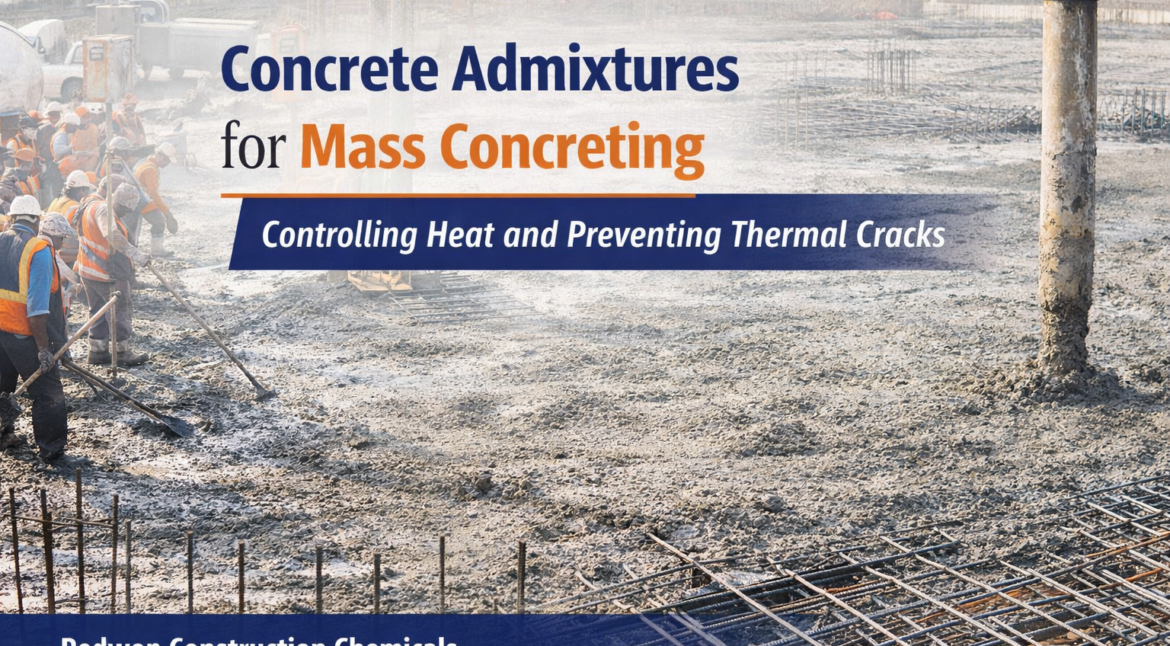
Concrete Admixtures for Mass Concreting: Controlling Heat and Preventing Thermal Cracks
Mass concreting is used in large structural elements such as foundations, dams, raft slabs, and thick retaining walls. Unlike normal concrete applications, mass concrete generates a significant amount of heat during cement hydration. If not properly controlled, this heat buildup can lead to temperature differentials within the structure, resulting in thermal cracks.
To manage these challenges, engineers rely on concrete admixtures. These admixtures play a crucial role in controlling heat generation, improving workability, and enhancing the long-term durability of concrete structures.
In modern construction, the use of admixtures is not optional for mass concreting—it is essential to ensure structural integrity and performance.
Common Question Asked:
Q.1 Can concrete admixtures prevent thermal cracking in mass concrete?
Yes, when used correctly, concrete admixtures help control heat generation, improve workability, and reduce temperature-induced stresses that lead to thermal cracking.
Why Thermal Cracking Occurs in Mass Concrete
Mass concrete structures generate heat as cement reacts with water during hydration. This heat builds up internally because thick sections prevent quick heat dissipation.
The main causes of thermal cracking include:
Heat of Hydration
Cement hydration produces heat, increasing the internal temperature of concrete.
Temperature Gradient
The core of the concrete becomes hotter than the surface, creating internal stress.
Restrained Shrinkage
As concrete cools and contracts, internal restraint leads to cracking.
Poor Mix Design
High cement content and lack of proper admixtures increase the risk of excessive heat buildup.
Without proper control measures, these factors can cause visible cracks that compromise durability.
Role of Concrete Admixtures in Mass Concreting
Concrete admixtures are used to modify the behavior of concrete and reduce the risk of thermal cracking.
Superplasticizers for Heat Control and Workability
One of the most important admixtures in mass concrete is the superplasticizer. These admixtures improve flowability without increasing water content.
By reducing the water–cement ratio, superplasticizers help lower the overall heat generated during hydration.
For example, products such as Procrete HHP and Procrete MP20 are commonly used to achieve high workability in large pours without compromising strength.
Similarly, in applications requiring controlled setting and extended workability, Procrete PCM U and Procrete R20 help maintain consistency during placement.
For mass concrete where long workability retention is critical, solutions such as Procrete R75, Procrete R75 4H, and Procrete R80 provide controlled hydration and improved flow characteristics.
Additionally, high-performance admixtures like Redbrawn 600, Redbrawn 601, and Redbrawn 800 are used in demanding structural applications where both strength and durability are critical.
Supplementary materials such as Redwop Pozo also help reduce heat generation by partially replacing cement content.
Water Reducing Admixtures for Lower Heat Generation
Another important category is water reducing admixtures. These admixtures reduce the amount of water required in the mix, which in turn lowers cement demand and heat generation.
Products like Plastcone AP211 improve concrete workability while maintaining strength. Similarly, Procrete LP20 and Procrete NPL S15 are used to enhance mix performance in large pours.
In structural applications requiring better compaction and reduced shrinkage, solutions such as Procrete S15 and Redbrawn 400 help improve overall concrete quality.
By reducing water content and optimizing cement hydration, these admixtures play a key role in controlling thermal stress.
Air Entrained Admixtures for Crack Resistance
In some cases, air entrained admixtures are used to improve durability and reduce cracking risks.
These admixtures introduce microscopic air bubbles into the concrete mix, which:
- reduce internal stress
- improve workability
- enhance resistance to temperature changes
Products like PLASTCONE AIRENT are used where improved durability and stress relief are required.
Crystalline Waterproofing Admixtures for Durability
Mass concrete structures are often exposed to water, making durability a key concern. Crystalline waterproofing admixtures help protect concrete by blocking water pathways internally.
These admixtures react with moisture to form crystals that seal pores and micro-cracks.
For example, solutions like Admix L and Admix P improve resistance to water ingress and enhance long-term durability.
Practical Measures Along with Admixtures
While admixtures play a major role, proper site practices are equally important.
Temperature Control During Placement
Concrete temperature should be controlled during mixing and placement using chilled water or ice if required.
Proper Curing
Adequate curing helps control temperature gradients and reduces shrinkage stress.
Controlled Pour Size
Large pours should be planned in stages to avoid excessive heat buildup.
Monitoring Temperature
Temperature sensors can be used to monitor internal and surface temperature differences.
Benefits of Using Concrete Admixtures in Mass Concrete
Using the right combination of admixtures provides several benefits:
- reduced heat generation
- improved workability
- minimized thermal cracking
- enhanced durability
- better long-term structural performance
These advantages make admixtures essential for large-scale concrete structures.
Conclusion
Mass concreting presents unique challenges due to heat generation and temperature differentials within the structure. Without proper control, these factors can lead to thermal cracking and long-term durability issues.
Using the right concrete admixtures, including superplasticizers, water reducers, air entraining agents, and crystalline waterproofing systems, helps manage these challenges effectively. When combined with proper construction practices, these admixtures ensure stronger, more durable, and crack-resistant concrete structures. For more information, Contact Us.
FAQs
-
1. What is mass concreting?
Mass concreting refers to large concrete pours where heat generation must be controlled to prevent cracking.
-
2. Why does thermal cracking occur in concrete?
Thermal cracking occurs due to temperature differences between the interior and surface of concrete during hydration.
-
3. How do superplasticizers help in mass concrete?
Superplasticizers improve workability and reduce water content, helping control heat generation.
-
4. Are water reducing admixtures important in mass concrete?
Yes, they reduce water and cement content, which helps lower heat of hydration.
-
5. What role do crystalline admixtures play?
They improve durability by sealing pores and preventing water ingress.