


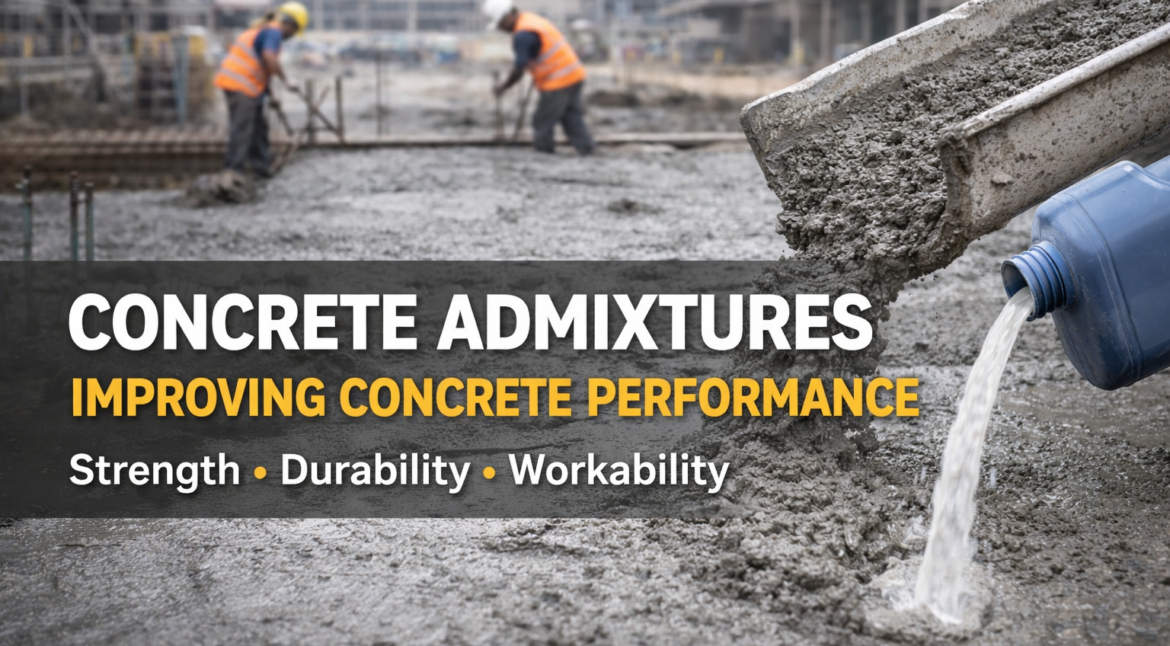
How Concrete Admixtures Improve Strength, Durability, and Workability of Concrete
Concrete is one of the most widely used construction materials in the world. From residential buildings to large infrastructure projects, concrete forms the backbone of modern construction. However, the performance of concrete depends on several factors such as mix design, environmental conditions, and curing practices.
To enhance the performance of concrete, engineers often rely on concrete admixtures. These specialized construction chemicals are added to the concrete mix to modify its properties and improve strength, durability, and workability.
Concrete admixtures help address many challenges faced on construction sites. They can reduce water demand, improve flowability, increase resistance to moisture, and protect concrete from environmental damage. Because of these advantages, admixtures have become essential components in modern concrete technology.
Common Question Asked:
Q.1 Do concrete admixtures really improve the strength and durability of concrete?
Yes, when used correctly, concrete admixtures significantly enhance concrete performance by improving workability, reducing water content, increasing strength, and protecting structures from environmental damage.
Why Concrete Performance Needs Improvement
Traditional concrete mixtures often face several practical limitations during construction. Without proper modifications, concrete can develop issues such as poor workability, low durability, or excessive cracking.
Some common challenges include:
- Difficulty placing concrete in congested reinforcement areas
- Reduced durability in harsh environmental conditions
- Water penetration through pores and micro-cracks
- Segregation or bleeding during mixing and placement
Concrete admixtures help overcome these issues by adjusting the behavior of concrete during mixing, placing, and curing.
Improving Concrete Workability with Admixtures
Workability refers to how easily concrete can be mixed, transported, placed, and finished. Concrete that is difficult to handle can lead to poor compaction and weak structural performance.
One of the most effective ways to improve workability is through water reducing admixtures.
Water Reducing Admixtures
One of the most effective ways to improve workability in concrete is by using water reducing admixtures. These admixtures allow contractors to achieve better flowability without increasing the water content of the mix. Since excess water weakens concrete strength, water reducers help maintain a lower water–cement ratio while keeping the concrete workable during placement.
For example, admixtures such as Plastcone AP211 are commonly used to enhance dispersion of cement particles, allowing the concrete to flow easily in congested reinforcement areas without compromising strength.
Similarly, products like Procrete LP20 and Procrete NPL S15 help improve workability in ready-mix and site-mixed concrete where consistent performance is required.
In situations where higher strength and durability are important, solutions such as Procrete S15 or Redbrawn 400 can be used to optimize water reduction while maintaining proper compaction and structural performance.
These water-reducing admixtures allow concrete to be placed more efficiently while ensuring the final structure achieves the desired strength and durability.
Enhancing Durability with Waterproofing Admixtures
Durability is one of the most important factors in structural concrete. Structures exposed to water, chemicals, and weather conditions require concrete that can resist long-term deterioration.
One effective way to improve durability is by using integral waterproofing compounds.
Integral Waterproofing Compounds
Another important group of concrete admixtures used to improve durability is integral waterproofing compounds. These admixtures are mixed directly into concrete to reduce permeability and block capillary pores that allow water to penetrate structural elements.
By reducing water absorption, waterproofing admixtures help protect reinforced concrete from common durability issues such as reinforcement corrosion, structural deterioration, and long-term moisture damage.
For example, powder-based solutions such as Plastcone AP90 are widely used in concrete mixes where improved resistance to water penetration is required. These admixtures react within the concrete matrix to reduce pore connectivity and enhance durability.
In applications where liquid admixtures are preferred for easier dosing and mixing, products like Plastcone AW+ can be incorporated directly into the concrete mix to provide internal waterproofing protection.
When used correctly, these waterproofing admixtures significantly improve the durability and service life of concrete structures exposed to moisture or water pressure.
Improving Concrete Resistance to Freeze-Thaw Cycles
Concrete structures exposed to cold climates face additional challenges. When water inside concrete freezes, it expands and creates internal pressure that can cause cracking.
Air Entrained Admixtures
Air entrained admixtures introduce microscopic air bubbles into the concrete mix. These tiny air pockets provide space for water to expand during freezing conditions.
As a result, concrete becomes more resistant to freeze-thaw damage.
One example is PLASTCONE AIRENT, which helps improve durability in environments exposed to moisture and temperature fluctuations.
Air entrainment also improves workability and reduces segregation during placement.
How Concrete Admixtures Increase Strength
Strength is one of the primary requirements of structural concrete. The compressive strength of concrete depends largely on the water-cement ratio.
By reducing the amount of water required for mixing, admixtures help produce stronger and denser concrete.
Key mechanisms include:
- improved cement hydration efficiency
- reduced water-cement ratio
- better compaction during placement
When these factors are optimized, the resulting concrete develops higher strength and better structural performance.
Additional Benefits of Using Concrete Admixtures
Beyond improving strength and workability, admixtures offer several additional advantages.
Improved Surface Finish
Concrete with proper admixtures tends to have smoother surfaces and fewer defects.
Reduced Cracking
Admixtures can help control shrinkage and reduce the likelihood of cracking.
Better Construction Efficiency
Improved workability allows faster placement and easier finishing.
Long-Term Structural Protection
Waterproofing and durability-enhancing admixtures protect concrete from environmental damage.
Because of these advantages, admixtures are widely used in residential, commercial, and infrastructure projects.
Choosing the Right Concrete Admixture
Selecting the right admixture depends on several project-specific factors.
These include:
- environmental exposure conditions
- concrete strength requirements
- placement conditions
- structural durability requirements
Consulting with construction chemical specialists and selecting high-quality admixtures ensures optimal concrete performance.
Conclusion
Modern construction demands concrete that is strong, durable, and easy to work with. Concrete admixtures play a crucial role in achieving these properties by modifying the behavior of concrete during mixing and curing.
Admixtures such as water reducers improve workability and strength, while integral waterproofing compounds enhance durability by reducing water penetration. Air-entrained admixtures further improve resistance to environmental stresses like freeze-thaw cycles.
When used correctly, these advanced construction chemicals significantly improve the long-term performance of concrete structures. As construction projects continue to demand higher durability and efficiency, concrete admixtures remain essential tools for engineers and builders. For more information, Contact Us.
FAQs
-
1. What are concrete admixtures used for?
Concrete admixtures are chemical additives used to improve the workability, strength, durability, and performance of concrete.
-
2. Do concrete admixtures increase concrete strength?
Yes, many admixtures reduce the water-cement ratio and improve cement hydration, which increases concrete strength.
-
3. What is the purpose of air entrained admixtures?
Air entrained admixtures create microscopic air bubbles in concrete to improve freeze-thaw resistance and workability.
-
4. How do waterproofing admixtures protect concrete?
Waterproofing admixtures reduce concrete permeability by blocking capillary pores and micro-cracks.
-
5. Are concrete admixtures necessary in modern construction?
Yes, most modern construction projects use admixtures to improve concrete performance and durability.