


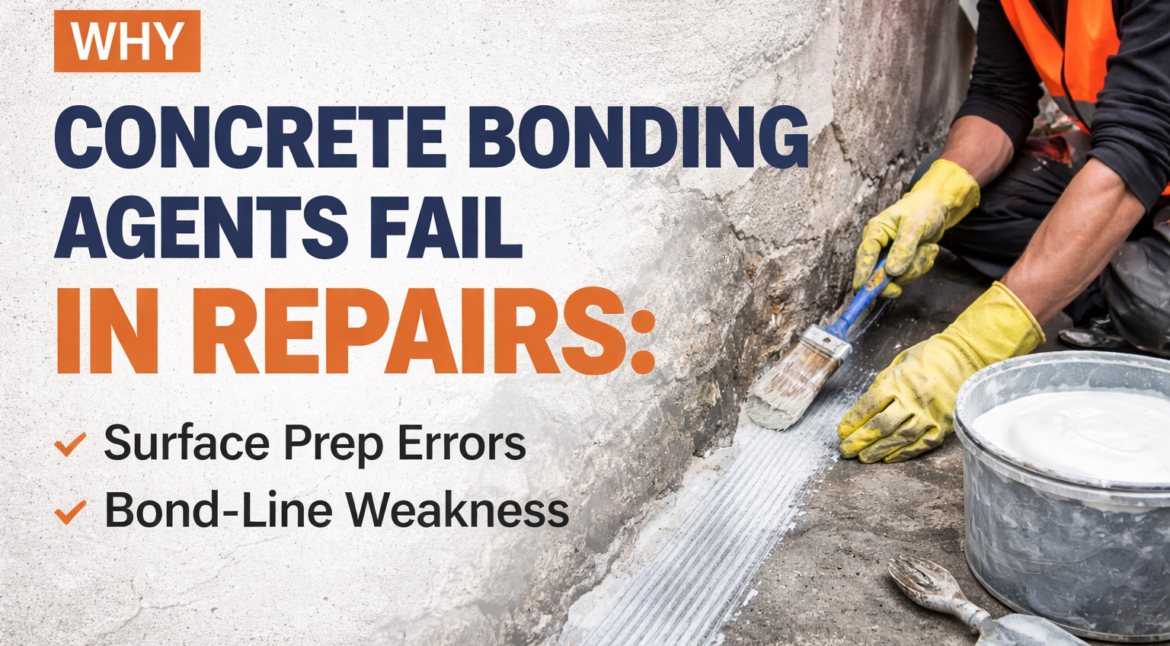
Why Concrete Bonding Agents Fail in Repairs: Surface Prep Errors and Bond-Line Weakness
Concrete repairs are expected to restore strength, durability, and service life. Yet on many sites, repair patches debond within months, plaster layers peel off, or new concrete overlays separate from old substrates.
In most of these failures, the issue is not the repair mortar itself. The weak point is usually the bond line, the thin interface where old concrete meets new material. This is exactly where concrete bonding agents are supposed to work.
But bonding agents do fail in real repairs. And when they do, the root cause is almost always poor surface preparation, incorrect system selection, or bond-line weakness caused by site shortcuts.
Understanding why concrete bonding agents fail is essential for achieving long-lasting repairs, especially in structural rehabilitation and concrete-to-concrete applications.
Common Question Asked:
Q.1 Can a concrete repair fail even after using a bonding agent?
Yes, concrete bonding agents can fail if surface preparation is poor, the wrong bonding chemistry is selected, or the bond line is weakened by moisture, dust, or incorrect application.
What Concrete Bonding Agents Are Supposed to Do
A concrete to concrete bonding agent is designed to improve adhesion between:
- Old concrete and new repair mortar
- Existing RCC surfaces and overlays
- Plaster and cementitious substrates
- Concrete joints and patch repairs
Bonding agents work by:
- Enhancing mechanical grip
- Reducing interfacial voids
- Improving tensile and shear bond strength
- Supporting durable load transfer across repair zones
Redwop offers a dedicated range of concrete bonding agent systems developed for repair mortars, plaster bonding, and old-to-new concrete integration.
Failure Cause 1: Poor Surface Preparation (The Biggest Reason)
Most bonding failures begin with the substrate, not the bonding agent.
Common Site Errors
- Bonding over dusty concrete
- Leaving laitance or weak surface layers
- Applying a bonding agent to oily or contaminated surfaces
- Skipping mechanical roughening
Concrete bonding requires a sound, open-pore surface. If the old concrete is smooth or dusty, the bonding agent forms a weak film over an unstable layer, leading to debonding.
Best Practice
- Remove loose material completely
- Roughen the substrate mechanically
- Clean with air and water jetting
- Ensure the surface is structurally sound before bonding
Even high-quality products cannot bond through dust.
Failure Cause 2: Incorrect Moisture Condition at the Bond Line
Bonding agents behave differently depending on moisture.
Too Dry Surface
- The substrate absorbs the bonding agent too quickly
- Poor film formation
- Reduced working time
Too Wet Surface
- Dilution of the bonding layer
- Slippage of repair mortar
- Weak adhesion
This is especially important when using polymer bonding agents like Redwop’s Butabond SBR, which are widely used for repair bonding and plaster integration.
A controlled SSD (saturated surface dry) condition is critical for consistent bond performance.
Failure Cause 3: Wrong Bonding Chemistry for the Repair Type
Not all bonding agents are interchangeable.
Cementitious Repairs and Plaster Bonding
For plaster bonding and cement-based repair mortars, polymer-modified systems are commonly used.
For example, Redwop’s Butabond AR is often used where repair mortars require improved adhesion and reduced shrinkage cracking.
This is particularly relevant for applications like:
- Bonding agent plaster systems
- Patch repairs on vertical surfaces
- Cement slurry bonding improvement
Epoxy Bonding Agent Requirements
For structural repairs, heavy-duty anchorage, or high-load bonding zones, an epoxy bonding agent may be required instead of polymer latex.
Epoxy systems provide:
- Higher tensile bond strength
- Chemical resistance
- Strong adhesion to dense substrates
Epoxy bonding agents are also used in specialized cases, such as epoxy bonding agent for wood, where timber-to-concrete interfaces require high-strength adhesion.
Using a polymer bonding agent in a zone that requires epoxy is a common specification mistake.
Failure Cause 4: Weak Bond Line Due to Improper Application Timing
Bonding agents are time-sensitive.
Common Mistake
Applying repair mortar after the bonding layer has:
- Dried completely
- Skinned over
- Collected dust
This creates a “film barrier” instead of an active bonding interface.
Best Practice
Always follow the product’s open time and apply repair mortar while the bonding layer is tacky or within the specified bonding window.
Failure Cause 5: Incompatible Repair Mortar or Overlay Thickness
Bonding is not only chemical, it is structural.
A thin overlay placed over old concrete can debond due to:
- Thermal movement
- Shrinkage stresses
- Impact loading
In such cases, the repair system must include:
- Proper bonding agent
- Correct overlay thickness
- Shrinkage-controlled repair mortar
Products like Admix Extra Bond are typically used in general repair bonding where controlled adhesion is needed across cementitious overlays.
Failure Cause 6: Old Concrete Not Sound Enough
A bonding agent cannot compensate for a weak substrate.
If old concrete is:
- Carbonated
- Cracked internally
- Delaminated
- Structurally compromised
Then the repair will fail regardless of bonding chemistry.
Bonding agents bond repairs to concrete, not to damaged layers.
Practical Guidelines for Bonding Old and New Concrete
For a durable bonding agent for old and new concrete applications:
- Remove all weak concrete
- Roughen the surface profile
- Clean the dust completely
- Pre-wet to SSD condition
- Apply the bonding agent uniformly
- Place repair mortar within the working time
- Cure properly to reduce shrinkage stress
When these steps are followed, bond-line failures reduce dramatically.
Conclusion
Concrete repairs fail most often at the bond line, not in the repair mortar itself. Concrete bonding agents are powerful tools, but they depend entirely on correct surface preparation, moisture control, chemistry selection, and application timing.
Whether the job involves plaster bonding, old-to-new concrete integration, or structural repair zones requiring an epoxy bonding agent, success comes from treating bonding as a complete system, not a single additive step.
With disciplined site practices and the right bonding agent choice, repair durability improves, debonding risk drops, and concrete rehabilitation becomes long-lasting. For more information, Contact Us.
FAQs
-
1. Why do concrete bonding agents fail in repairs?
Poor surface preparation and dust contamination are the most common reasons.
-
2. Can bonding agents work on smooth concrete surfaces?
Only if the surface is roughened properly. Smooth concrete provides poor mechanical grip.
-
3. When should an epoxy bonding agent be used?
In high-load structural bonding zones or chemical-resistant repair applications.
-
4. Can bonding agents be used for plaster applications?
Yes. Polymer bonding systems are widely used as bonding agent plaster solutions.
-
5. What is the best bonding agent for old and new concrete?
A system designed for concrete-to-concrete adhesion, applied on a properly prepared SSD surface.