


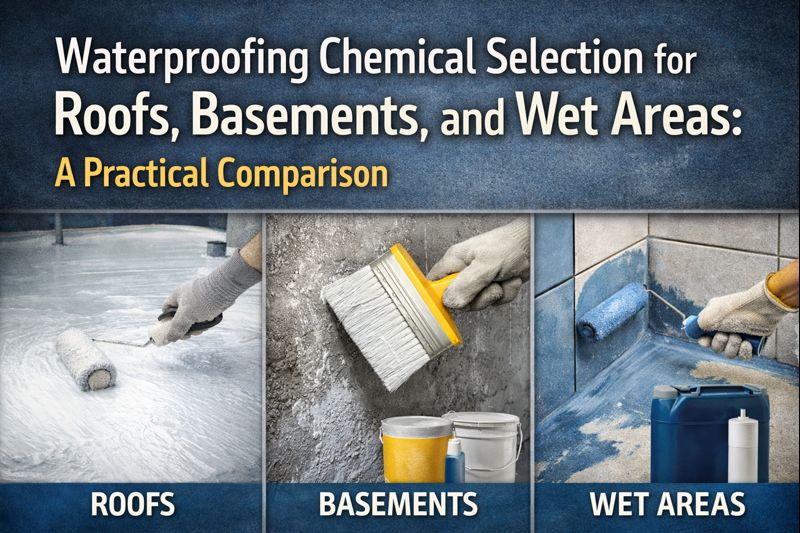
Waterproofing Chemical Selection for Roofs, Basements, and Wet Areas: A Practical Comparison
Leakage is one of the most expensive construction problems to fix after completion. Roof slabs develop damp patches, basements show seepage lines, and bathrooms or balconies start leaking into lower floors. In most failed projects, waterproofing materials were applied, yet water still finds its way through.
The reason is rarely product quality alone. In most real-world cases, failures happen because Waterproofing Chemicals are selected without matching them to the actual exposure condition, substrate type, and site practice. A chemical that performs perfectly on a terrace may fail in a basement. A coating that works on external walls may not survive permanent water pressure.
Common Question Asked:
Q.1 Can using the wrong waterproofing chemical cause leakage even if application is done correctly?
Yes, selecting an unsuitable waterproofing chemical for a specific exposure condition can lead to leakage even when application workmanship is good.
Why One Waterproofing Chemical Doesn’t Work Everywhere
Waterproofing requirements differ based on:
- Type of water exposure (rain, splash, continuous pressure)
- Substrate type (concrete, masonry, plaster)
- Crack movement and thermal expansion
- UV exposure
- Accessibility for maintenance
Because of this, liquid membrane waterproofing, cement based waterproofing, and crystalline waterproofing each serve different structural needs. Understanding these differences prevents costly trial-and-error on-site.
Roof Waterproofing: Flexibility and UV Resistance Matter Most
Exposure Condition
Roof slabs face:
- Direct sunlight
- Thermal expansion and contraction
- Standing rainwater
- Hairline crack movement
Suitable Waterproofing Chemical
For roofs, liquid membrane waterproofing systems are the most effective solution. Liquid membranes form seamless, flexible coatings that stretch with slab movement and resist UV degradation.
Redwop’s liquid membrane waterproofing systems include high-performance coatings such as Smarzkot Advanced, Smarzkot B2Flex, and Smarzkot Platinum, developed specifically for exposed terraces and podium slabs. For general roof protection and water-shedding surfaces, Smarzkot Waterguard, Superkot, and Superkot N are commonly used.
Why Cement Based Systems Fail on Roofs
Using rigid cement based waterproofing on exposed roofs often leads to:
- Micro-cracking due to slab movement
- Loss of adhesion under UV exposure
- Gradual water ingress
This is why roof waterproofing almost always performs better with liquid-applied elastomeric membranes.
Basement Waterproofing: Resistance to Water Pressure is Critical
Exposure Condition
Basements face:
- Constant soil moisture
- Hydrostatic water pressure
- Limited access for external repairs
Suitable Waterproofing Chemical
For basements, cement based waterproofing and crystalline waterproofing systems are more reliable than surface membranes alone.
Cement based waterproofing systems, such as Polycote WH, Polycote WH Crete, and Polycote WH100 are designed to form strong mineral barriers that bond with concrete and resist negative-side water pressure.
For long-term internal protection, crystalline waterproofing becomes essential. Polycote CWP crystalline waterproofing system works by forming pore-blocking crystals inside concrete, sealing micro-capillaries, and self-healing small cracks over time.
Why Liquid Membranes Alone Fail in Basements
Liquid membranes applied only on the inside face of basement walls can:
- Debond under hydrostatic pressure
- Trap moisture behind the coating
- Peel over time
This is why basements require mineral or crystalline systems that integrate with concrete rather than sitting as surface films.
Wet Areas: Adhesion and Chemical Resistance Matter Most
Exposure Condition
Bathrooms, kitchens, balconies, and utility areas face:
- Frequent water splash
- Cleaning chemicals
- Tile adhesive compatibility
- Constant dampness
Suitable Waterproofing Chemical
Wet areas perform best with cement based waterproofing, because these systems:
- Bonds strongly with concrete and plaster
- Provide rigid, tile-compatible substrates
- Resist moisture migration behind tiles
Redwop’s cement based waterproofing systems are widely used under tile beds in bathrooms and balconies to prevent seepage into lower floors.
For added internal protection in critical zones, crystalline waterproofing systems are used in backing concrete of water tanks, pools, and podium slabs to prevent long-term seepage.
Why Roof Membranes Fail Under Tiles
Using liquid membrane waterproofing below tiles without correct protection layers can lead to:
- Mechanical damage during tiling
- Poor tile adhesive bonding
- Delamination over time
This is why wet-area waterproofing requires rigid cementitious systems rather than exposed flexible membranes.
Practical Comparison: Which Waterproofing Chemical Fits Where?
Application Area | Primary Risk | Recommended System | Why It Works |
Roof & Terrace | UV + thermal movement | Liquid membrane waterproofing | Flexible, seamless, UV stable |
Basement walls & raft | Hydrostatic pressure | Cement-based waterproofing | Strong bond, negative pressure resistance |
Water tanks & pools | Continuous immersion | Crystalline waterproofing | Internal pore sealing |
Bathrooms & balconies | Tile-bed moisture | Cement-based waterproofing | Tile-compatible, rigid barrier |
Podium slabs | Combined risks | Liquid membrane + crystalline | Surface flexibility + internal protection |
Common Site Mistakes in Waterproofing Chemical Selection
- Using roof membrane products in basements
- Applying cement-based systems to moving roof slabs
- Relying only on surface coatings for water tanks
- Mixing incompatible waterproofing layers
- Ignoring the substrate moisture condition
Most waterproofing failures come from wrong system selection, not wrong product quality.
How to Select Waterproofing Chemicals Correctly
A reliable selection process includes:
- Identifying the type of water exposure
- Understanding substrate behavior
- Considering movement and UV exposure
- Evaluating long-term maintenance access
- Matching the chemical system to these conditions
When Waterproofing Chemicals are selected based on performance logic rather than habit, service life improves dramatically.
Why Integrated Waterproofing Design Matters
Modern waterproofing is not a single product application. It is a system combining:
- Correct waterproofing chemistry
- Proper surface preparation
- Controlled application thickness
- Protection layers were required
- Quality curing
This integrated approach is what separates long-lasting waterproofing from temporary fixes.
Conclusion
Waterproofing failures rarely happen because a product is weak. They happen because the wrong waterproofing chemical is used in the wrong place. Roofs need flexible liquid membranes that move with slabs. Basements require cement based or crystalline systems that resist water pressure. Wet areas perform best with rigid mineral waterproofing beneath tiles.
By understanding how liquid membrane waterproofing, cement based waterproofing, and crystalline waterproofing differ in behavior, construction teams can select Waterproofing Chemicals that match real exposure conditions. This practical selection approach prevents repeat repairs, protects structures long-term, and delivers truly watertight buildings. For more information, Contact Us.
FAQs
-
1. Can one waterproofing chemical be used for all areas of a building?
No. Different exposure conditions require different waterproofing systems.
-
2. Why do roof waterproofing coatings crack over time?
Rigid or wrong waterproofing systems cannot handle thermal slab movement.
-
3. Is crystalline waterproofing enough for water tanks?
Yes, when used in concrete mix or backing concrete, it provides long-term internal protection.
-
4. Can cement based waterproofing be used under tiles?
Yes. It provides strong bonding and moisture protection for wet areas.
-
5. What is the most common waterproofing selection mistake?
Using roof-grade membranes for basements or internal wet areas.