


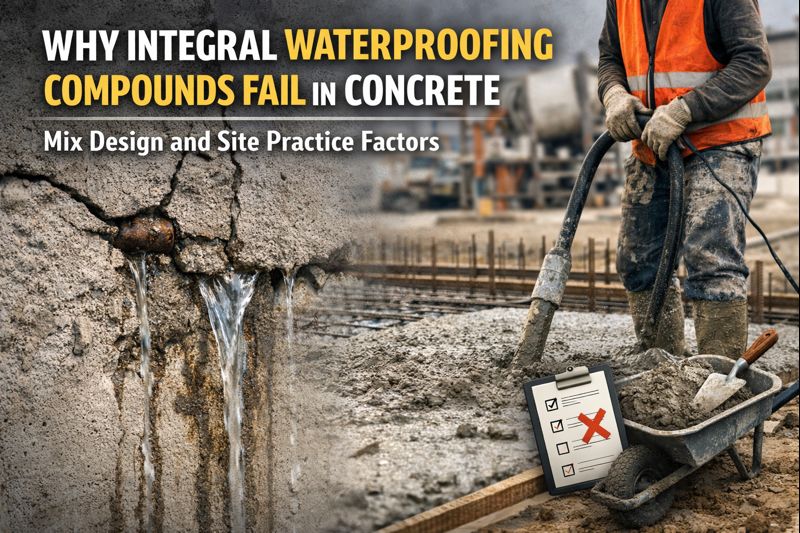
Why Integral Waterproofing Compounds Fail in Concrete: Mix Design and Site Practice Factors
Few construction problems are as expensive and frustrating as concrete leakage. Basements that seep after the first monsoon, water tanks that show damp patches, and podium slabs that start dripping, all of these often occur even when an integral waterproofing compound was added to the concrete.
On paper, integral waterproofing compounds are designed to prevent water from entering from within. In reality, failures still happen. And in most cases, the issue is not the product itself, but mix design mistakes and poor site practices.
Understanding why integral waterproofing compounds fail in concrete requires looking beyond product labels and into how concrete is actually batched, poured, compacted, and cured on site.
Common Question Asked:
Q.1 Can integral waterproofing compounds fail even when added to concrete?
Yes, incorrect mix design, wrong dosage, poor compaction, or bad curing practices can prevent integral waterproofing compounds from performing effectively.
What Integral Waterproofing Compounds Are Designed to Do
An integral waterproofing compound works by reducing capillary pores inside concrete. When dosed correctly, it:
- Lowers water absorption
- Blocks micro-capillaries
- Improves concrete density
- Reduces permeability
Redwop offers dedicated integral waterproofing compound systems formulated for both powder and liquid dosing in concrete and mortar applications. These are designed to provide internal waterproofing without relying on external membranes.
However, the compound can only perform if the concrete system around it is correctly designed and executed.
Why Integral Waterproofing Compounds Fail in Real Projects
1. Incorrect Water & Cement Ratio
The most common cause of failure is excess mixing water.
Concrete with a high water–cement ratio creates:
- Large capillary networks
- Higher porosity
- Weak internal structure
Even the best integral waterproofing compounds cannot seal oversized pore systems created by excess water.
This is where water reducing admixtures play a key supporting role. By lowering water demand while maintaining workability, water reducers help produce dense concrete that allows waterproofing compounds to work effectively.
Redwop provides dedicated water reducing admixtures developed to optimize concrete density and strength when used alongside waterproofing compounds.
2. Wrong Dosage of Integral Waterproofing Compound
Both under-dosing and over-dosing cause problems.
Under-dosing
- Insufficient pore blocking
- Uneven waterproofing effect
Over-dosing
- Alters cement hydration
- Can affect strength gain
- May cause surface dusting
Many failures occur simply because site teams guess dosage instead of following manufacturer recommendations.
Integral waterproofing compound products, available in powder and liquid forms, are designed for controlled and consistent dosing in concrete and mortar mixes, but only when measured correctly.
3. Poor Concrete Mix Design
Integral waterproofing works best in dense, well-graded concrete.
Common mix design errors include:
- Poor aggregate grading
- Low fines content
- Inadequate cement paste volume
This creates internal voids that waterproofing compounds cannot fully seal.
A proper mix design ensures the integral waterproofing compound distributes evenly and reacts effectively within the cement matrix.
4. Inadequate Compaction on Site
Even a perfect mix design fails if concrete is not compacted properly.
Poor compaction leads to:
- Honeycombing
- Entrapped air voids
- Weak zones around reinforcement
These become direct water paths that bypass the internal waterproofing system.
No integral waterproofing compound can compensate for honeycombed concrete.
5. Improper Curing Practices
Curing is essential for pore refinement and hydration completion.
When curing is:
- Too short
- Inconsistent
- Skipped in hot weather
Concrete develops micro-cracks and incomplete hydration zones. This reduces the effectiveness of integral waterproofing action.
Proper curing allows waterproofing compounds to fully integrate into the cement matrix.
The Role of Crystalline Waterproofing Admixtures
In some structures, crystalline waterproofing admixtures are used either alone or alongside integral waterproofing compounds.
A crystalline waterproofing admixture forms insoluble crystals inside capillaries when exposed to moisture, sealing micro-cracks over time.
Redwop offers dedicated crystalline waterproofing admixture systems for structures that require long-term self-sealing protection in basements, tanks, and retaining walls.
However, even crystalline systems rely on:
- Proper mix design
- Controlled water–cement ratio
- Good compaction
- Adequate curing
Without these, crystalline growth cannot fully block internal void networks.
Site Practice Factors That Commonly Cause Failure
Adding Extra Water at Site
To improve workability, site teams often add water after batching. This single act destroys the designed water–cement ratio and creates permeable concrete.
Changing Cement Brand Mid-Project
Different cement chemistries react differently with admixtures. Switching cement without rechecking compatibility often leads to inconsistent waterproofing performance.
Delayed Pouring and Re-Tempering
Concrete that starts setting and is later re-tempered with water develops micro-cracks and weak pore structures.
Skipping Vibration in Congested Reinforcement
Dense reinforcement zones require extra care in compaction. Skipping vibration leaves hidden voids.
How to Prevent Integral Waterproofing Compound Failures
A successful waterproof concrete system requires:
- Controlled water–cement ratio
- Use of water-reducing admixtures where needed
- Correct dosage of integral waterproofing compounds
- Proper aggregate grading
- Full mechanical compaction
- Consistent curing practices
When these steps are followed, internal waterproofing systems perform reliably for the life of the structure.
Practical Checklist for Site Engineers
- Verify the mix design before batching
- Measure the waterproofing compound dosage accurately
- Do not add water at the site
- Ensure continuous vibration
- Inspect for honeycombing after shutter removal
- Enforce minimum curing duration
Most waterproofing failures are preventable with disciplined site control.
Conclusion
Integral waterproofing compounds are powerful tools for protecting concrete from internal water penetration. But they are not magic additives that fix poor mix design or careless site practices.
Failures occur when excess water, poor grading, weak compaction, incorrect dosage, or inadequate curing undermine concrete quality. Supporting systems like water reducing admixtures and crystalline waterproofing admixtures further enhance waterproofing performance, but only when the concrete itself is properly designed and executed.
When mix design discipline and site practices are aligned with the waterproofing system, integral waterproofing compounds deliver dense, durable, and leak-resistant concrete structures for decades. For more information, Contact Us.
FAQs
-
1. Can integral waterproofing compounds stop leaks in honeycombed concrete?
No. Honeycombing creates direct voids that waterproofing compounds cannot seal. Proper compaction is essential.
-
2. Does adding more waterproofing compound improve performance?
No. Over-dosing can disturb cement hydration and may reduce concrete quality.
-
3. Why is curing important for integral waterproofing?
Curing allows full hydration and pore refinement, which enables waterproofing compounds to work effectively.
-
4. Can crystalline waterproofing admixture replace integral waterproofing compounds?
They serve similar goals but work differently. Both still require good mix design and site practices.
-
5. What is the biggest cause of waterproof concrete failure?
Excess water added on site is the most common reason for waterproofing failure.