


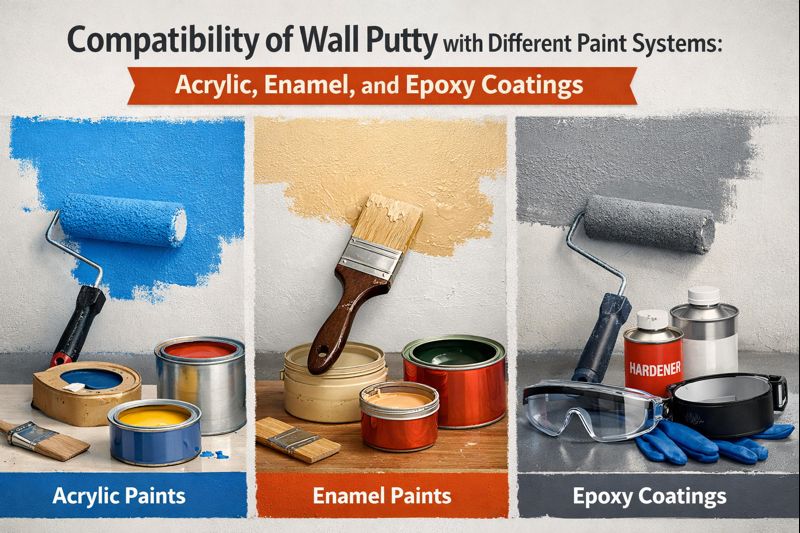
Compatibility of Wall Putty with Different Paint Systems: Acrylic, Enamel, and Epoxy Coatings
A smooth wall finish doesn’t fail on the day of painting. It fails weeks or months later when paint starts peeling, patch marks reappear, gloss turns uneven, or damp spots ghost through the surface. In many of these cases, the problem is not the paint. It’s the wall putty underneath.
On-site, painters often treat wall putty as a universal base layer. But different paint systems behave very differently on putty surfaces. Acrylic Distemper, Acrylic Emulsion Paint, enamel paint, and epoxy coatings each interact with wall putty in their own way. If compatibility is ignored, even premium paint systems fail prematurely.
Understanding how wall putty works with different paint types is essential for achieving durable, defect-free finishes.
Common Question Asked:
Q.1 Can the wrong combination of wall putty and paint cause peeling or poor finish?
Yes, incompatibility between wall putty and specific paint systems can lead to adhesion loss, patchiness, uneven sheen, or early paint failure.
Why Wall Putty Compatibility Matters
Wall putty creates the final substrate on which paint bonds. Its:
- Porosity
- Surface smoothness
- Moisture content
- Alkalinity level
- Curing condition
directly affects how paint forms a film and adheres.
A paint that works perfectly on one type of putty may fail on another if surface conditions are not matched correctly. This is why professional finishing systems treat wall putty and paint as a combined system, not separate products.
Wall Putty range is designed to provide a controlled, uniform base for modern decorative and protective paint systems.
Wall Putty and Acrylic Distemper Compatibility
How Acrylic Distemper Behaves on Putty
Acrylic Distemper is a breathable, water-based decorative coating commonly used for interior walls. It relies on controlled absorption into the substrate for proper bonding.
Compatibility Factors
- Wall putty must be fully cured
- Surface should not be overly glossy
- Moderate porosity is required for proper anchoring
Common Failure Scenario
If the wall putty is over-burnished or sealed too tightly, Acrylic Distemper cannot grip properly. This leads to:
- Powdery surface shedding
- Patchy color absorption
- Uneven matte finish
Best Practice
- Light surface sanding before painting
- Proper curing time after putty application
- Avoid sealing primers before distemper unless specified
When treated correctly, wall putty provides an excellent base for consistent Acrylic Distemper finishes.
Wall Putty and Acrylic Emulsion Paint Compatibility
Why Acrylic Emulsion Needs a Stable Putty Base
Acrylic Emulsion Paint forms a flexible film on the wall surface. It does not penetrate deeply like distemper, so surface bonding quality is critical.
Compatibility Factors
- The putty surface must be dust-free
- Moisture content should be controlled
- The primer application is recommended
Common Failure Scenario
If moisture remains trapped in the wall putty, Acrylic Emulsion Paint can develop:
- Blistering
- Loss of sheen uniformity
- Micro peeling over time
Best Practice
- Ensure complete drying of the wall putty
- Apply the recommended primer before the emulsion paint
- Avoid painting on recently applied damp putty
Correct surface preparation allows Acrylic Emulsion Paint to form a durable and washable film over wall putty.
Wall Putty and Enamel Paint Compatibility
Why Enamel Paint Needs Special Attention
Enamel paint forms a hard, glossy, low-porosity film. It highlights every minor surface defect and demands strong adhesion.
Compatibility Factors
- Wall putty must be perfectly smooth
- Surface alkalinity must be controlled
- The primer layer is essential
Common Failure Scenario
Applying enamel paint directly over unprimed putty can cause:
- Loss of gloss uniformity
- Peeling at edges
- Highlighting of sanding marks
Best Practice
- Apply a suitable primer over the wall putty
- Ensure fine sanding for an ultra-smooth finish
- Allow sufficient curing before enamel application
When prepared properly, wall putty provides the flatness and uniformity that enamel systems require for premium finishes.
Wall Putty and Epoxy Coatings Compatibility
The Special Case of Epoxy Putty Systems
Epoxy coatings are high-performance protective finishes used in hospitals, kitchens, laboratories, and industrial interiors. These systems demand extremely strong surface adhesion.
In such applications, epoxy putty or specialized wall putty formulations are used to repair and level substrates before epoxy coating.
Compatibility Factors
- Surface must be non-dusty and mechanically sound
- Putty must be compatible with low-porosity epoxy films
- Proper priming is essential
Common Failure Scenario
If standard decorative wall putty is used under epoxy coatings:
- Bond failure may occur
- Hollow-sounding patches develop
- Epoxy film may detach under impact
Best Practice
- Use epoxy-compatible putty for repair zones
- Apply epoxy primers before topcoats
- Ensure a moisture-free substrate
When wall preparation is aligned with epoxy system requirements, coatings deliver long-term hygienic and chemical-resistant surfaces.
For such high-performance environments, Epoxy coating systems are designed to work over properly prepared substrates.
Key Technical Factors Affecting Compatibility
Surface Alkalinity
Fresh putty can remain alkaline. Some paints, especially enamels, are sensitive to high alkalinity.
Moisture Content
Trapped moisture beneath paint films is one of the leading causes of blistering.
Surface Porosity
Too much absorption affects distemper; too little affects emulsion bonding.
Surface Smoothness
Gloss paints and enamels demand ultra-smooth putty finishing.
Common Site Mistakes That Cause Compatibility Issues
- Painting before the putty is fully cured
- Skipping primers for enamel or epoxy systems
- Over-polishing putty before distemper
- Applying epoxy coatings over decorative putty
- Ignoring moisture testing before painting
Most paint failures blamed on product quality actually originate from these compatibility oversights.
Practical Selection Guide
Paint System | Recommended Putty Preparation | Primer Needed | Risk if Ignored |
Acrylic Distemper | Lightly sanded, moderate porosity | Optional | Patchy finish |
Acrylic Emulsion Paint | Smooth, dry surface | Recommended | Blistering |
Enamel Paint | Ultra-smooth, primed | Mandatory | Peeling, gloss loss |
Epoxy Coatings | Epoxy-compatible substrate | Mandatory | Bond failure |
Conclusion
Wall putty is not just a filler layer. It is the foundation of every paint system. Acrylic Distemper, Acrylic Emulsion Paint, enamel paint, and epoxy coatings all demand different surface conditions to perform correctly. Ignoring compatibility leads to peeling, uneven finish, and premature repainting cycles.
When wall putty selection, surface preparation, priming, and curing are aligned with the chosen paint system, the result is a durable, defect-free finish that lasts for years. Treating wall putty and paint as a complete system is the key to professional, long-lasting wall performance. For more information, Contact Us.
FAQs
-
1. Can enamel paint be applied directly on wall putty?
No. A suitable primer is required to ensure proper adhesion and gloss uniformity.
-
2. Why does Acrylic Distemper sometimes look patchy over putty?
Because over-polished or sealed putty prevents proper absorption of the coating.
-
3. Is Acrylic Emulsion Paint safe to apply over fresh wall putty?
No. Putty must be fully cured and dry before emulsion application.
-
4. Can decorative wall putty be used under epoxy coatings?
Standard decorative putty is not ideal. Epoxy-compatible surface preparation is recommended.
-
5. What is the biggest cause of paint peeling over wall putty?
Trapped moisture and missing primer layers are the most common reasons.