


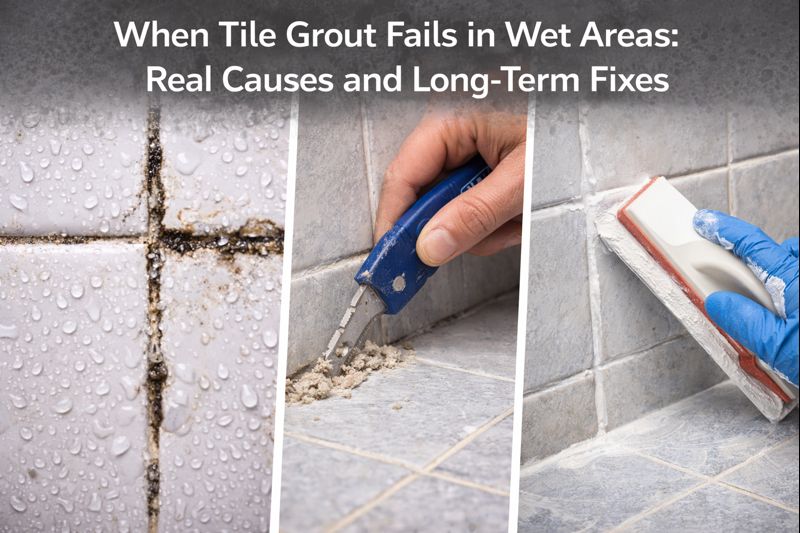
When Tile Grout Fails in Wet Areas: Real Causes and Long-Term Fixes
Bathrooms with stained joints, balconies showing cracked grout lines, and swimming pools where grout starts washing out are common real-site problems. In most of these cases, the issue is not with the tiles themselves, but with the tile grout used in moisture-exposed environments.
Wet areas place constant stress on grout joints. Water exposure, cleaning chemicals, temperature shifts, and minor structural movement gradually weaken poor-quality grout. Once grout begins to fail, water finds its way beneath tiles, leading to loose flooring, mold growth, and expensive repair work.
Understanding why tile grout fails in wet environments is the key to preventing repeat problems and choosing long-term solutions.
Common Question Asked:
Q.1 Can tile grout failures in wet areas be permanently prevented?
Yes, selecting the correct grout type and applying it properly can prevent cracking, staining, water penetration, and early grout deterioration in wet environments.
Why Wet Areas Are Tough on Tile Grout
Wet zones expose grout to:
- Constant moisture contact
- Standing water
- Cleaning detergents
- Temperature variation
- Substrate movement
If grout is not designed to resist these conditions, it slowly breaks down. Many failures blamed on workmanship are actually caused by selecting the wrong grout for the environment.
Common Tile Grout Failures in Wet Areas
Cracking in Grout Joints
Cracks appear when grout shrinks during curing or when slight movement occurs in the substrate. Traditional cement-based grout is particularly prone to this in moisture-rich spaces.
Discoloration and Staining
Porous grout absorbs soap residue, dirt, and water minerals. Over time, grout lines darken and become difficult to clean.
Powdering and Joint Erosion
In showers, balconies, and pool decks, constant water flow slowly erodes weak grout, leaving hollow or missing joints.
Mold and Fungus Growth
Moisture trapped in porous grout creates ideal conditions for microbial growth, a common issue in bathrooms and kitchens.
Tile Debonding
When water passes through failed grout, it attacks the tile adhesive below, eventually loosening tiles.
Root Causes Behind Tile Grout Failure
Wrong Grout Selection
Using standard cement tile grout in continuously wet zones is one of the most common mistakes. Cement grout is naturally porous. It works well for dry interior wall tiling but struggles in showers, balconies, and pools.
Redwop provides a dedicated cement tile grout system formulated for controlled interior environments where moisture exposure is limited.
Poor Water Resistance
Wet areas demand non-porous grout. Traditional cement grout allows water absorption, leading to long-term deterioration.
This is where epoxy tile grout becomes the reliable solution. Epoxy grout is waterproof, stain-resistant, and chemically stable, making it the best epoxy grout choice for moisture-exposed and hygiene-critical spaces.
Epoxy grout range for wet-area tiling is developed specifically for bathrooms, swimming pools, commercial kitchens, and hospital wash zones. For high-performance installations, professionals often use EPTILE GROUT epoxy tile grout, which offers strong resistance to chemicals, stains, and continuous water exposure.
Decorative spaces can also benefit from epoxy for tiles, such as glitter and sparkle grout variants, which combine design appeal with waterproof performance.
Incorrect Joint Width Grout Use
Wide joints in wet areas require high-strength polymer-modified grout. Using fine cement grout in wide joints leads to cracking and washout.
For such applications, Redwop offers a high-strength polymer sanded grout system designed for joint widths from 2–15 mm, ensuring strong, durable filling in balconies, terraces, and heavy-traffic floors.
Improper Mixing and Application
Adding excess water while mixing grout increases porosity. Inadequate compaction during application leaves voids where water collects. These voids become failure points over time.
Lack of Movement Accommodation
Wet zones experience thermal expansion and contraction. Rigid grout that lacks flexibility develops micro-cracks that expand with time.
Cement Tile Grout vs Epoxy Tile Grout in Wet Areas
|
Property |
Cement Tile Grout |
Epoxy Tile Grout |
|
Water absorption |
High |
Near zero |
|
Stain resistance |
Low |
Excellent |
|
Mold resistance |
Low |
Excellent |
|
Chemical resistance |
Low |
High |
|
Crack resistance |
Moderate |
Very high |
|
Maintenance |
High |
Low |
|
Suitability for wet areas |
Limited |
Ideal |
This is why epoxy grout has become standard in bathrooms, pools, spas, commercial kitchens, and healthcare wash areas.
Why Epoxy Tile Grout Is the Long-Term Fix
Waterproof Structure
Epoxy grout does not absorb water, preventing moisture from reaching the substrate or tile adhesive.
Chemical and Stain Resistance
Cleaning agents, soaps, and disinfectants do not damage epoxy grout joints.
Mold Prevention
Non-porous joints stop fungal growth at the root level.
High Bond Strength
Epoxy grout strongly adheres to tile edges, preventing joint breakdown.
Color Stability
No fading or yellowing even after years of use.
These properties make epoxy grout the best long-term solution for wet environments.
Where Cement Tile Grout Still Works Well
Cement grout remains suitable for:
- Dry interior wall tiling
- Decorative indoor floors
- Low-moisture residential areas
However, for continuously wet zones, epoxy or polymer-modified grout should always be used.
Selecting the Right Tile Grout for Wet Areas
- Bathrooms & Showers → Epoxy tile grout
- Swimming Pools & Spas → Epoxy tile grout
- Balconies & Terraces → Polymer sanded grout
- Kitchens & Wash Areas → Epoxy tile grout
- Dry Interior Walls → Cement tile grout
Correct selection prevents repeat failures and reduces maintenance costs.
Practical Long-Term Fixes for Existing Failed Grout
- Remove loose or deteriorated grout
- Dry the substrate completely
- Refill joints with epoxy grout
- Seal movement joints separately
- Allow proper curing before water exposure
Skipping these steps leads to repeated failure.
Conclusion
Tile grout failures in wet areas are not random. They result from selecting porous grout for moisture-exposed environments, incorrect application, or ignoring joint movement. Cement grout struggles under continuous water exposure, leading to cracking, staining, erosion, and mold growth.
Switching to epoxy or high-strength polymer grout systems provides a long-term solution. When the right tile grout is chosen and applied correctly, joints remain waterproof, hygienic, and durable for many years. For more information, Contact Us.
FAQs
-
1. Why does tile grout crack in bathrooms?
Because cement grout absorbs moisture and expands or shrinks over time, leading to cracks.
-
2. Is epoxy grout better than cement grout for wet areas?
Yes. Epoxy grout is waterproof, stain-resistant, and prevents mold growth.
-
3. Can cement grout be used in shower areas?
It is not recommended for continuously wet zones. Epoxy grout performs better long-term.
-
4. What is the best epoxy grout for tiles?
High-quality epoxy grout designed for wet and chemical-exposed areas provides the best durability.
-
5. How long does epoxy grout last in wet environments?
With correct application, epoxy grout can last for many years with minimal maintenance.